
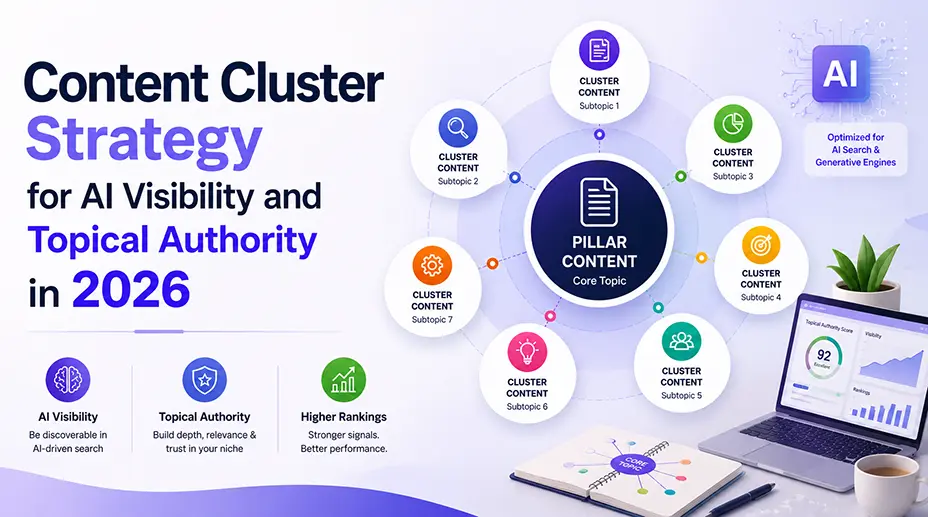
Content Cluster Strategy for AI Visibility and Topical Authority in 2026
Search used to reward individual pages. Rank the right keyword, earn the click, repeat. That model is breaking down.
AI Overviews now appear in an estimated 15 to 40 percent of searches depending on the niche. Answer engines synthesise information across multiple sources before a user ever reaches a result. Ranking a single page for a single keyword no longer guarantees visibility in environments where search results are being assembled and summarised before the user scrolls.
The competitive advantage has shifted. Businesses that own entire topic categories are surfacing in AI-generated answers more consistently than businesses chasing individual rankings. A content cluster strategy for 2026 is not a content formatting preference. It is the structural requirement for maintaining organic visibility as search continues to evolve.
Table of Contents
- Why Are Topic Clusters Becoming More Important Than Individual Keywords?
- How Do Topic Clusters Help AI Overviews and Answer Engines Understand Content?
- What Does Topical Authority Actually Look Like in 2026?
- How Should Businesses Build a Modern Pillar Page Strategy?
- How Can Businesses Measure the ROI of a Content Cluster Strategy?
- Why Topic Clusters Are Becoming the Foundation of AI Visibility
- Why Topic Clusters Are the Foundation of AI Visibility
- FAQs
Why Are Topic Clusters Becoming More Important Than Individual Keywords?
The keyword-first approach assumed that search engines matched queries to documents based on phrase repetition. That assumption no longer reflects how search works.
Modern search engines process queries through semantic understanding. They assess what a user is actually trying to accomplish, not just what words appear in the query. This means a page targeting “air conditioning repair” may rank for dozens of adjacent queries it never explicitly mentions, because the engine has assessed the page’s topical relevance, not just its keyword density.
The shift has accelerated because of query fan-out. When a user submits a prompt to an AI-powered search experience, the system does not look for a single best match. It expands the query across related subtopics, retrieves relevant passages from multiple sources, and constructs a synthesised response. A site with deep, interconnected coverage of a topic contributes more to that synthesis than a site with one strong standalone page.
Keyword Strategy vs. Topic Strategy
| Keyword Strategy | Topic Strategy |
|---|---|
| Targets individual search queries | Covers entire subject categories |
| Single page competes for one ranking | Cluster of pages compete across many queries |
| Authority is page-level | Authority is site and entity-level |
| Vulnerable to algorithm updates | Builds structural resilience over time |
| Limited AI retrieval signal | Stronger signal for AI citation and passage retrieval |
Topical authority SEO has become the mechanism through which sites demonstrate to search engines that they have no meaningful gaps in their coverage of a subject. Businesses that achieve this are harder to displace because the authority is distributed across an interconnected content ecosystem rather than concentrated in a single document. This is also why content clusters for answer engines perform differently to standalone pages. Answer engines retrieve from ecosystems, not documents.
If search engines now understand topics instead of individual keywords, topic cluster SEO requires a fundamentally different content architecture to the one most businesses are currently running.
How Do Topic Clusters Help AI Overviews and Answer Engines Understand Content?
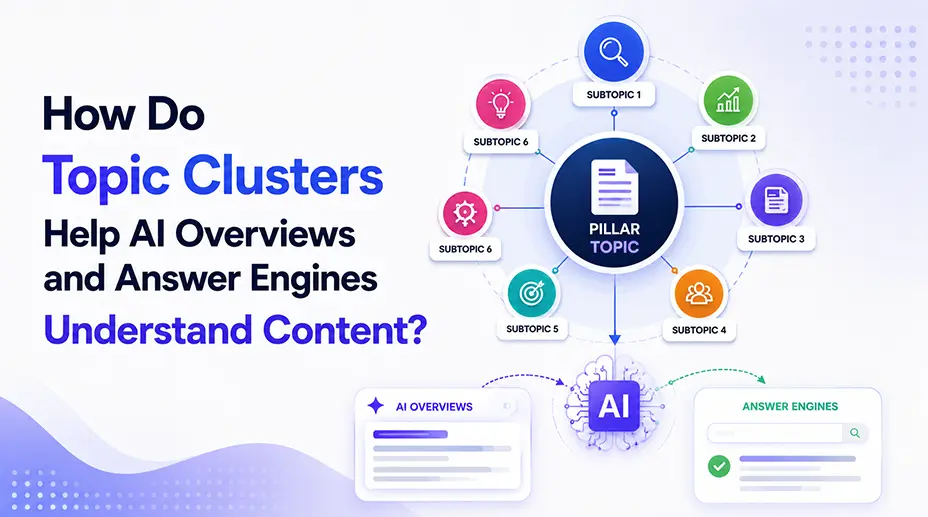
AI-powered search systems retrieve information through passage-level indexing. They do not evaluate entire pages as single units. They extract relevant sections, assess those sections for accuracy and contextual fit, and use them to construct answers across a range of related queries.
This changes what content architecture needs to accomplish. A page that is well-written but exists in isolation provides a passage retrieval signal for its own content. AI content clusters, structured as a pillar page supported by a network of related pages, create a contextual map that AI systems can interpret as authoritative coverage of a subject.
How Content Clusters Feed AI Retrieval
Pillar Page
     │
Cluster Pages
     │
Entity Network
     │
AI Retrieval
The pillar page defines the core topic at a broad level. Each cluster page resolves a specific subtopic or user intent that branches from that core. Together, the pillar page content cluster functions as a single authoritative unit in the eyes of an AI retrieval system. The internal links connecting them use contextual anchor text that reinforces the relationship between concepts. When an AI system crawls this structure, it can trace the semantic hierarchy. It can identify that this site covers the topic comprehensively, from definition to application to measurement.
Research confirms that content built with bidirectional linking, where the pillar links to cluster pages and each cluster page links back to the pillar with specific anchor text, earns AI citation at meaningfully higher rates than standalone articles. The link structure is not just a navigational aid. It is a signal to retrieval systems about the relationships between content units.
Topic clusters for AI Overviews work because they remove ambiguity. The site is not asking the algorithm to infer topical relevance. It is demonstrating it through architecture. Structure improves discoverability, but authority determines whether AI systems trust and cite the content.
What Does Topical Authority Actually Look Like in 2026?
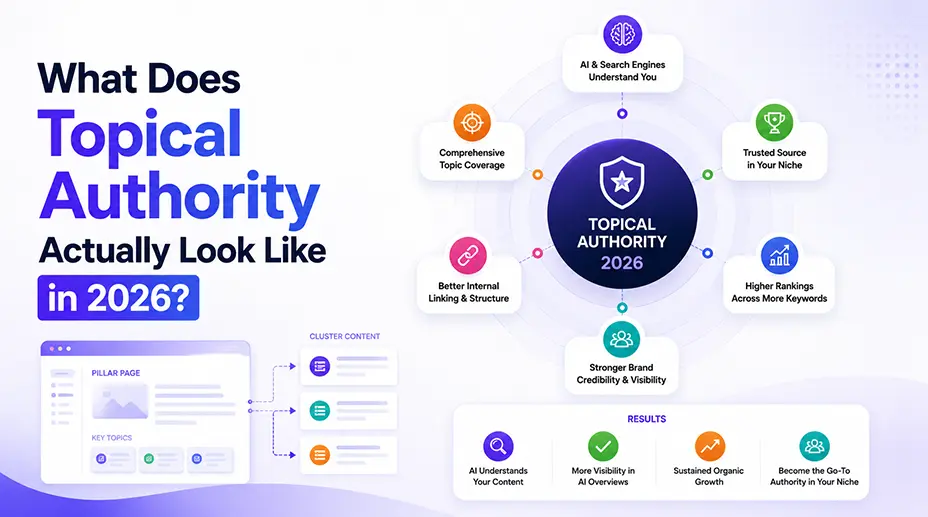
Topical authority is the degree to which a domain is recognised as a reliable, comprehensive source on a given subject. It differs from page-level authority in a fundamental way. A single page can rank well without topical authority. A site with topical authority earns visibility across an entire category of queries, including queries it has not explicitly targeted.
Ranking for a Keyword vs. Owning a Topic Category
| Ranking for a Keyword | Owning a Topic Category |
|---|---|
| Page-level win | Domain-level advantage |
| Dependent on a single document performing | Authority distributed across cluster |
| Can be displaced by a competitor’s better page | Harder to displace without matching entire ecosystem |
| Limited AI Overviews inclusion | Higher AI citation frequency |
| Grows slowly, reset by updates | Compounds with each cluster addition |
Entity associations are central to how topical authority is built in 2026. Search engines maintain knowledge graphs that connect named entities, topics, and their relationships. A site that consistently covers a subject area using accurate entity references, such as named processes, recognised frameworks, and established terminology, is mapped into those knowledge graphs. Once mapped, the site is more likely to be retrieved when those entities appear in user queries.
This is why subject matter depth matters beyond simple content volume. A content cluster built for ranking across a category, rather than a single query, requires ten thoroughly developed pages covering distinct subtopics. That builds stronger entity associations than fifty thin posts circling the same idea. The quality of the semantic signal matters more than the quantity of documents.
Authority creates visibility. Businesses still need a practical framework for building content clusters that earn and sustain that authority.
How Should Businesses Build a Modern Pillar Page Strategy?
The pillar page strategy functions as both a content planning framework and an authority architecture system. The goal is not to produce more content. It is to produce interconnected content that resolves a topic comprehensively and gives AI retrieval systems a reliable map to follow.
Cluster Planning Framework
Core Topic
     │
Subtopics
     │
Supporting Content
     │
Conversion Asset
- Step 1: Select the right pillar topic. The pillar page should target a broad, high-intent subject that your business has genuine expertise in. It should be broad enough to support multiple subtopics but specific enough to reflect a coherent area of authority. Avoid pillar topics so broad they cannot be anchored to a real business outcome.
- Step 2: Map cluster pages to user intent. Each cluster page should resolve a specific question, task, or decision point that a user encounters within the broader topic. Intent mapping should cover informational, navigational, and commercial queries. This ensures the cluster captures users at every stage of the journey, not just those ready to convert.
- Step 3: Build bidirectional internal links. Every cluster page should link to the pillar using descriptive anchor text that names the core topic. The pillar should link to each cluster page in context. This creates the semantic hierarchy that AI retrieval systems use to assess topical coverage. An internal linking content strategy that runs bidirectionally is the connective tissue of the entire cluster. Orphaned cluster pages, pages that exist without these connections, contribute little to topical authority regardless of their individual quality.
- Step 4: Align content to the user journey. The cluster should guide users from initial awareness through evaluation to a conversion point. Supporting content, such as case studies, comparison pages, or FAQs, should sit within the cluster and link back appropriately. This creates behavioural validation signals, time on site and depth of navigation, that reinforce the authority signal.
- Step 5: Establish content governance. Clusters decay when supporting pages become outdated or when new content is published without being integrated into the cluster structure. A governance process that audits internal links, refreshes dated cluster pages, and routes new content into existing clusters maintains the integrity of the semantic content strategy over time.
Building clusters is only the beginning. Measuring their impact is where many organisations struggle.
How Can Businesses Measure the ROI of a Content Cluster Strategy?
Most ROI measurement frameworks for content focus on individual page performance. Keyword rankings, organic traffic, and conversion rates per page. This approach undervalues cluster strategies because it does not capture the cumulative effect of interconnected content on domain authority, AI citation frequency, or assisted conversion paths.
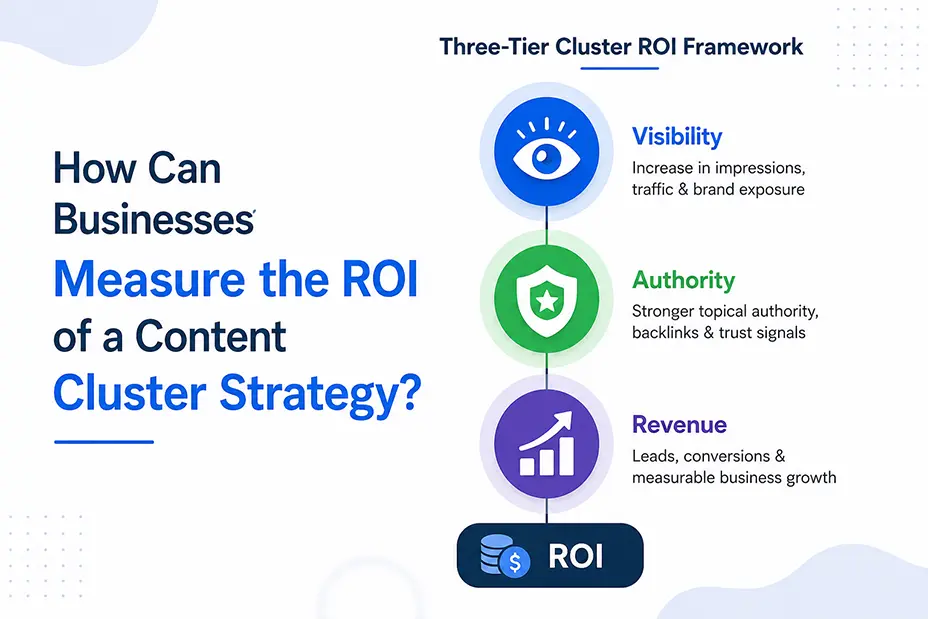
Three-Tier Cluster ROI Framework
Visibility
     │
Authority
     │
Revenue
-
Tier 1: Visibility
Visibility metrics capture the reach of the cluster across organic search and AI-generated results. Key indicators include the number of queries a cluster ranks for collectively, impressions across related long-tail terms, and frequency of inclusion in AI Overviews. A cluster that expands its ranking footprint over time, earning positions for queries it was not originally optimised for, is building topical authority correctly. -
Tier 2: Authority
Authority metrics track the qualitative strength of the cluster’s position. This includes domain-level topical relevance scores from tools such as Semrush or Ahrefs, the volume and quality of external links attracted to cluster pages, and entity recognition signals. Clusters with strong authority metrics perform more consistently across algorithm updates because their strength is structural rather than dependent on any single ranking. -
Tier 3: Revenue
Revenue attribution for cluster content should include assisted conversions, not just last-click credit. A user who reads three cluster pages before converting through a direct visit is partially attributed to the cluster even if standard analytics assign the conversion to direct traffic. Multi-touch attribution models reveal the commercial contribution of cluster content far more accurately than last-click models. Organic visibility expansion and AI citation frequency also carry revenue implications in markets where brand recognition in AI-generated answers influences downstream purchasing decisions.
As AI search evolves, the value of topic clusters will extend beyond rankings and traffic.
Why Topic Clusters Are Becoming the Foundation of AI Visibility
The relationship between content architecture and AI visibility is not speculative. It reflects how retrieval systems are designed to operate.
AI search experiences are built to identify trustworthy, contextually rich sources and synthesise information from them. A content hub strategy built specifically for AI search gives retrieval systems a clear hierarchy to follow rather than asking them to infer one from disconnected pages.
Topic clusters achieve this through three properties that isolated keyword content cannot replicate.
- Semantic hierarchy gives AI systems a clear signal about what a site covers and how deeply.
- Entity density, the presence of recognised named concepts distributed across a cluster, connects site content to the knowledge graphs that underpin AI retrieval.
- Behavioural depth, the navigation patterns generated when users move through a well-structured cluster, validates the topical authority signal with real engagement data.
Businesses that build for topic ownership rather than keyword positioning are not simply adapting to the current state of search. They are building content infrastructure that compounds over time.
A well-executed content cluster strategy in 2026 adds authority with each new cluster page that integrates correctly into the existing structure. Each AI citation earned increases brand recognition in environments where traditional click-through metrics no longer fully capture content performance.
The organisations best positioned for AI visibility in the years ahead are those that started treating content strategy as architecture, not just production, early enough to build something a competitor cannot replicate in a campaign cycle.
Why Topic Clusters Are the Foundation of AI Visibility
LLMs and generative search resolve over 60% of informational queries directly on the SERP, keyword matching is a legacy tactic. AI search engines process the structural relationship between ideas, meaning websites must pivot from isolated posts into interconnected, semantic knowledge graphs.
Let Us Build Your Content Cluster Strategy
Ready to audit your topical authority? Claim your custom semantic roadmap to eliminate content gaps, optimize internal link structures, and turn traditional blog posts into highly rentable, AI-ready knowledge graphs.
Claim Your Free Site Analysis
This is why structured topic clusters are an absolute prerequisite for AI visibility.
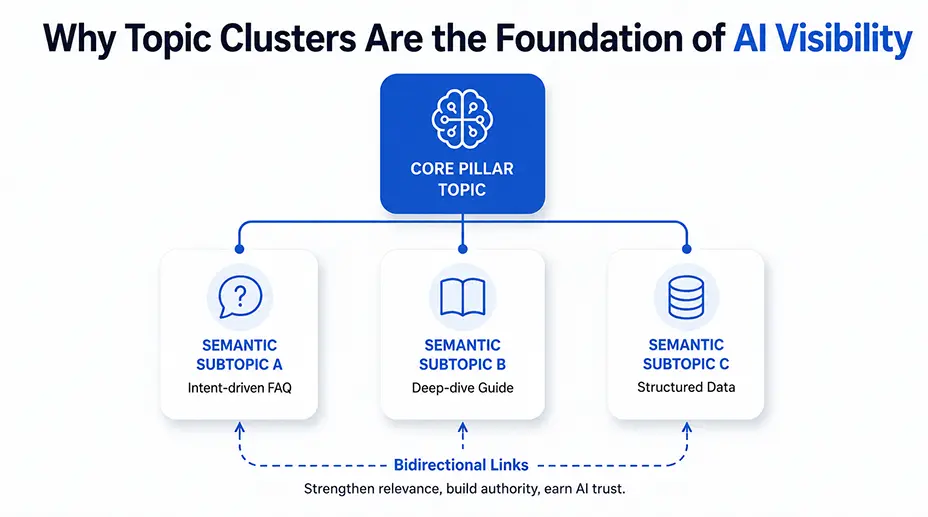
When modern engines face an intent-driven prompt, they scan the web for deeply authoritative ecosystems. By connecting a comprehensive pillar page bidirectionally to hyper-specific cluster articles, you align your content architecture with how AI synthesizes information—shifting your strategy from renting brief search traffic to earning true entity ownership.
[Core Pillar Topic]
       │
       ├──↔── [Semantic Subtopic A: Intent-driven FAQ]
       ├──↔── [Semantic Subtopic B: Deep-dive Guide]
       └──↔── [Semantic Subtopic C: Structured Data]
This structural depth feeds directly into knowledge graph expansion. Completely covering a category provides the clean data and clear context algorithms needed to cite your brand as an industry entity.
Interconnected content architectures pass algorithmic trust signals far more effectively. To secure sustainable visibility, you must own topics rather than keywords.
Businesses that own topics rather than keywords are best positioned for long-term discovery across both traditional and AI-powered search experiences.
Ready to transition your content architecture into an authoritative knowledge graph that machines trust? Let’s build an optimization roadmap that commands long-term AI visibility. Reach out to Engage Coders and We Do It today to secure your digital footprint for the future of search.
FAQs
It is a structural framework where a master pillar page links bidirectionally to a network of hyper-specific cluster pages. Instead of targeting scattered keywords, it organizes content around broad entity topics to align with semantic AI search.
AI retrieval systems use passage-level indexing to synthesize direct answers. A tightly linked pillar page content cluster acts as a unified authority map, making your data significantly easier for LLMs to extract and cite as a primary source.
A keyword strategy targets isolated pages for specific phrases, leaving you vulnerable to algorithm shifts. A topic cluster SEO strategy focuses on category ownership—distributing authority across an entire ecosystem for long-term structural resilience.
Links are the connective tissue of a content hub strategy for AI search. Bidirectional internal linking with descriptive anchor text explicitly defines a semantic hierarchy for web crawlers, preventing orphaned pages from diluting your topical authority.
A strong pillar topic targets a broad, high-intent subject that your business has genuine expertise in. It must be wide enough to branch out into multiple cluster pages, yet specific enough to drive meaningful business conversions.
When an AI engine expands a user prompt into related subtopics, it looks for deep, contextual answers. A comprehensive content cluster for ranking ensures your site satisfies all adjacent intents, capturing traffic from these automated query expansions.
Search engines map relationships between recognized terms, concepts, and brands using knowledge graphs. Using established frameworks and precise terminology across a topic cluster helps anchor your brand into these search knowledge graphs.
Quality and semantic depth matter more than quantity. A highly authoritative cluster typically features 8 to 12 distinct, thoroughly developed subtopic pages that fully resolve user intent without repeating the same core ideas.
Look beyond last-click attribution. Evaluate your return by measuring collective keyword footprint expansion, frequency of inclusion in AI Overviews, and multi-touch assisted conversions as users navigate through the ecosystem.
Ecosystems decay when data goes stale. Establish a strict governance routine to refresh statistics, optimize internal link pathways, and integrate new industry trends directly into your existing pillars to maintain topical authority.


