
Law Firm Website Structure: How to Organise Practice Area Pages for Better SEO
A potential client visiting your law firm’s website should be able to find the legal service they need without searching through unrelated information.
A clear law firm website structure helps organise practice areas, improve navigation and show search engines how your pages connect. For Melbourne law firms, this means giving important legal services a clear purpose and making related information easy to find.
As part of a wider digital marketing strategy for law firms, a well-organised website can make your services easier to discover and understand.
Table of Contents
- Does Your Website Clearly Represent Every Legal Service You Offer?
- Why Isn’t One General Services Page Enough?
- Should Every Practice Area Have Its Own Page?
- What Should a Well-Structured Legal Service Page Include?
- How Should You Organise Multiple Practice Areas on Your Website?
- Are Your Service Pages Competing for the Same Keywords?
- How Does Website Structure Support Your Law Firm’s SEO Strategy?
- Give Your Law Firm’s Website a Structure That Supports Growth
- FAQs
Does Your Website Clearly Represent Every Legal Service You Offer?
Listing your legal services is not the same as explaining them.
A law firm’s homepage might mention family law, criminal law, employment law and commercial law. However, visitors looking for help with a specific matter need more than a list of practice areas.
They need to understand:
- What types of legal matters your firm handles.
- Whether your solicitors have relevant experience.
- What support or services are available.
- What the next steps might involve.
- How to contact your practice.
Start by reviewing your existing pages. Can visitors reach each important service without searching through several unrelated sections? Does every major practice area have a clear destination?
For example, a Melbourne firm offering family law and employment law should make both services easy to locate from its main navigation.
If visitors struggle to find this information, it may be time to review your legal website structure. Your website’s organisation, navigation and content should work together to help visitors understand what your practice offers.
Why Isn’t One General Services Page Enough?
A general services page introduces your firm’s practice areas and helps visitors understand what your firm offers.
However, it may not provide enough space to explain every service in detail.
Consider a Melbourne law firm offering family law, criminal defence, employment law and commercial law. A single page may struggle to address the different needs of someone researching parenting arrangements and someone seeking help with an employment dispute.
A general services page should therefore:
- Introduce the firm’s main practice areas.
- Briefly explain each area of legal work.
- Link to relevant dedicated service pages.
Separate law firm service pages allow you to provide more focused information, such as:
- Specific services: The legal matters your firm handles.
- Relevant experience: The solicitors responsible for each practice area.
- Available support: How your firm can assist potential clients.
- Common questions: Answers to questions related to each service.
- Next steps: Clear ways to contact your practice.
This makes it easier for visitors to find relevant information without navigating through unrelated content.
For a broader understanding, read our article on the role of digital marketing for lawyers.
Should Every Practice Area Have Its Own Page?
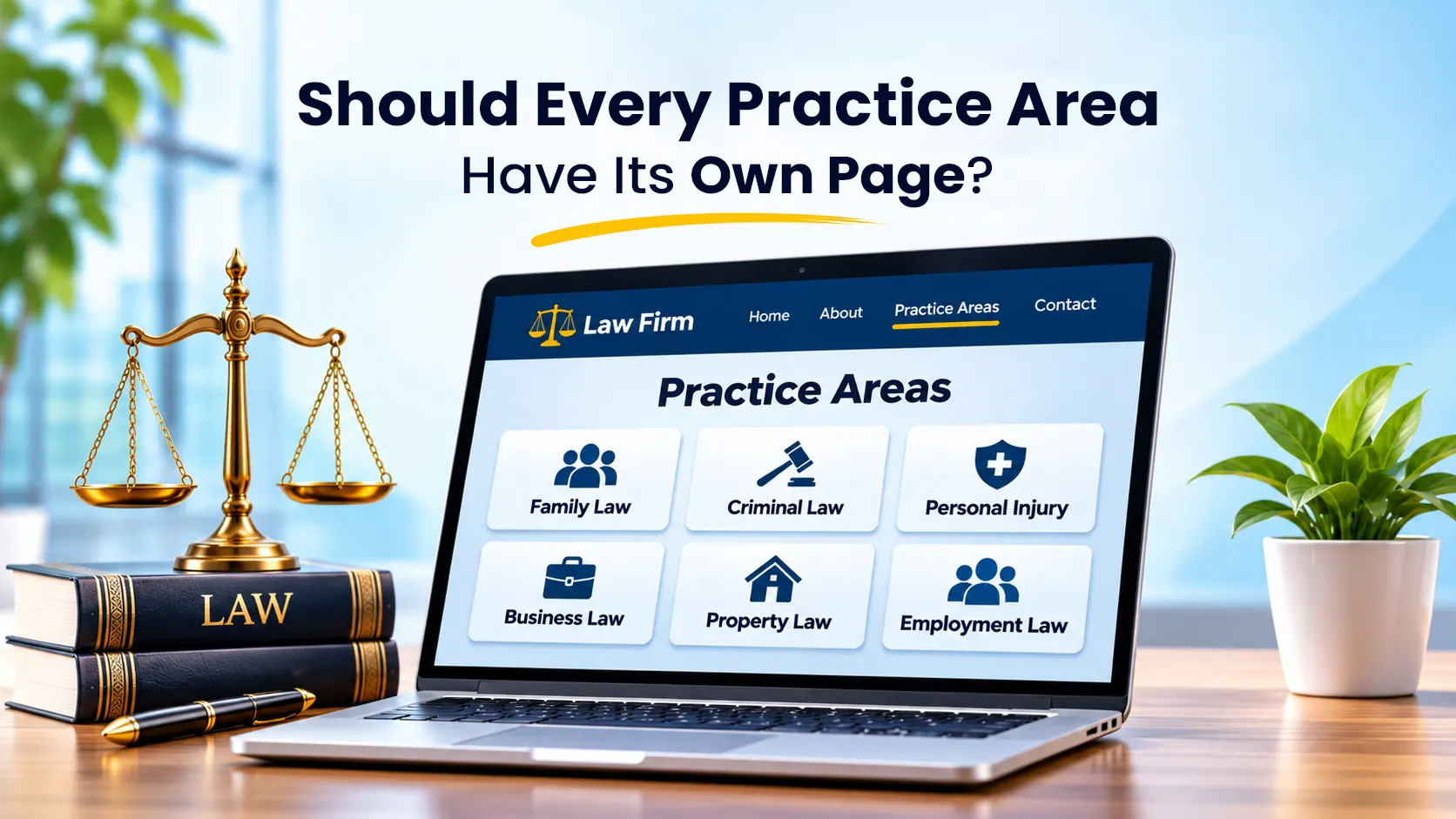
Not every individual legal service needs a separate page. The decision should depend on what your firm actually offers, whether the service addresses a distinct client need and whether there is enough useful information to justify a dedicated page.
Your law firm practice area pages should represent genuine areas of legal work rather than minor variations of the same service.
A dedicated page makes sense when:
- Your firm actively provides that legal service.
- The service addresses a distinct client need.
- You can provide sufficiently detailed and relevant information.
- The page serves a different search intent from your other pages.
For example, a family law practice might organise its website like this:
| Main practice area | Supporting service pages |
|---|---|
| Family law | Divorce, parenting arrangements, property settlements |
| Criminal law | Traffic offences, assault charges, bail applications |
| Employment law | Workplace disputes, unfair dismissal, employment contracts |
This structure gives each major practice area a clear place while allowing visitors to explore more specific services when needed.
Practice-area pages versus location pages
Melbourne firms should also distinguish between practice-area pages and location-specific pages.
A practice-area page explains the legal services your firm provides. A location page, where genuinely useful, explains how your firm serves clients in a particular area.
For example, a firm serving clients across Melbourne may need one comprehensive family law page rather than separate versions for Richmond, South Yarra, Carlton and Fitzroy.
Additional location pages should only be considered when the firm has a genuine service connection to those areas and can provide useful, distinct information.
Publishing nearly identical pages for every suburb simply to target location variations can create repetitive content and make the website harder to manage.
Before adding new pages, review your existing website using our five-step website audit checklist to identify what already exists and where genuine content gaps remain.
What Should a Well-Structured Legal Service Page Include?
Once you have identified which services need dedicated pages, each page should provide enough relevant information to help visitors understand the support your firm offers.
An SEO-friendly legal service page should explain the service clearly, address relevant client questions, demonstrate the firm’s experience and make contacting the practice straightforward.
Consider these six elements:
-
A clear, service-specific heading
Use a heading that immediately communicates the legal service covered. Visitors should not have to guess what the page is about.
-
A useful service explanation
Explain the types of matters your firm handles and the support it provides. Avoid generic descriptions that could appear on any law firm’s website.
-
Relevant information for potential clients
Address common questions and concerns related to the service. Explain processes and possible next steps carefully, without making promises about legal outcomes.
-
Relevant solicitor or practice information
Where appropriate, introduce the solicitors responsible for the practice area. Include accurate professional information and relevant experience.
-
Clear contact options
Make it easy for visitors to take the next step. Provide appropriate contact details and a clear call to action.
-
Links to related information
Connect the service page with relevant supporting pages, solicitor profiles and useful resources. These links help visitors explore related information without returning to the homepage.
Effective legal service page optimisation means making each page informative, relevant and easy to use. Each page should focus on its own service, answer the questions associated with that service and provide a useful experience.
For more ideas on structuring content for online readers, see our guide to content chunking and user experience.
You should also consider how individual service pages guide visitors towards an action. Our article on optimising landing pages for conversions and user experience explores this relationship in more detail.
How Should You Organise Multiple Practice Areas on Your Website?
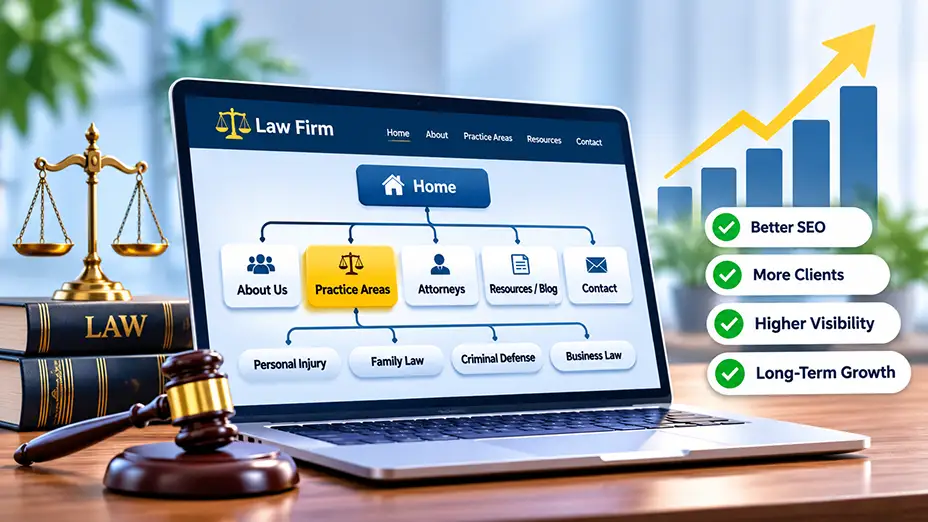
Once your firm has identified its main services and decided which ones need dedicated pages, the next step is to organise them into a logical hierarchy.
A website page hierarchy shows how pages relate to one another. Parent pages introduce broader topics, while supporting pages provide more specific information.
For example, a Melbourne law firm’s website could follow this structure:
Homepage
│
├── Our Services
│   ├── Family Law
│   │   ├── Divorce
│   │   ├── Parenting Arrangements
│   │   └── Property Settlements
│   │
│   ├── Criminal Law
│   │   ├── Traffic Offences
│   │   └── Criminal Defence
│   │
│   └── Employment Law
│       ├── Unfair Dismissal
│       └── Workplace Disputes
│
├── Our Team
│   └── Solicitor Profiles
│
├── Resources
│   ├── Legal Guides
│   └── Frequently Asked Questions
│
├── About the Firm
│
└── Contact
In this example, the Our Services page introduces the firm’s main practice areas. The Family Law page acts as a parent page for more specific services, such as divorce and parenting arrangements.
This makes the relationship between pages clearer for visitors and provides a more organised way to present the firm’s legal services.
Three elements are particularly important.
1. Create a logical page hierarchy
Group related services under their main practice areas. This prevents your website from becoming a collection of disconnected pages.
A well-planned sitemap can help you visualise the pages on your website and understand how they fit together. Explore our guide to sitemap examples and best practices to understand how to plan and review your website’s structure.
2. Keep navigation straightforward
Good website navigation for law firms should make important sections easy to locate.
Avoid overcrowding menus with every individual service. Use relevant dropdowns or dedicated service sections where they improve navigation.
Your main navigation should help visitors answer three questions:
- Where can I find the service I need?
- Where can I learn more about the firm and its solicitors?
- How can I contact the practice?
For Melbourne firms serving clients across several suburbs, avoid adding every suburb to the main navigation. Keep the primary menu focused on the firm’s services and important information. Any genuinely useful location pages can be organised separately.
Good web content should also be easy to scan. WorkSafe Victoria’s guidance on writing web content explains the importance of clear language, headings and breaking information into manageable sections.
3. Connect related pages through internal links
Internal linking for law firm websites helps visitors move between related services, solicitor profiles and supporting resources.
A family law page could link to relevant pages covering divorce, parenting arrangements and property settlements. Similarly, supporting articles can direct readers to the relevant service page when they need more information.
These connections help visitors explore your website and provide search engines with additional context about the relationships between your pages.
You can also explore our guide to building an SEO strategy around topic clusters for a wider look at organising related website content.
For a broader view of how your firm’s legal services can be planned around search demand, read our guide to understanding the search demand lifecycle.
Are Your Service Pages Competing for the Same Keywords?
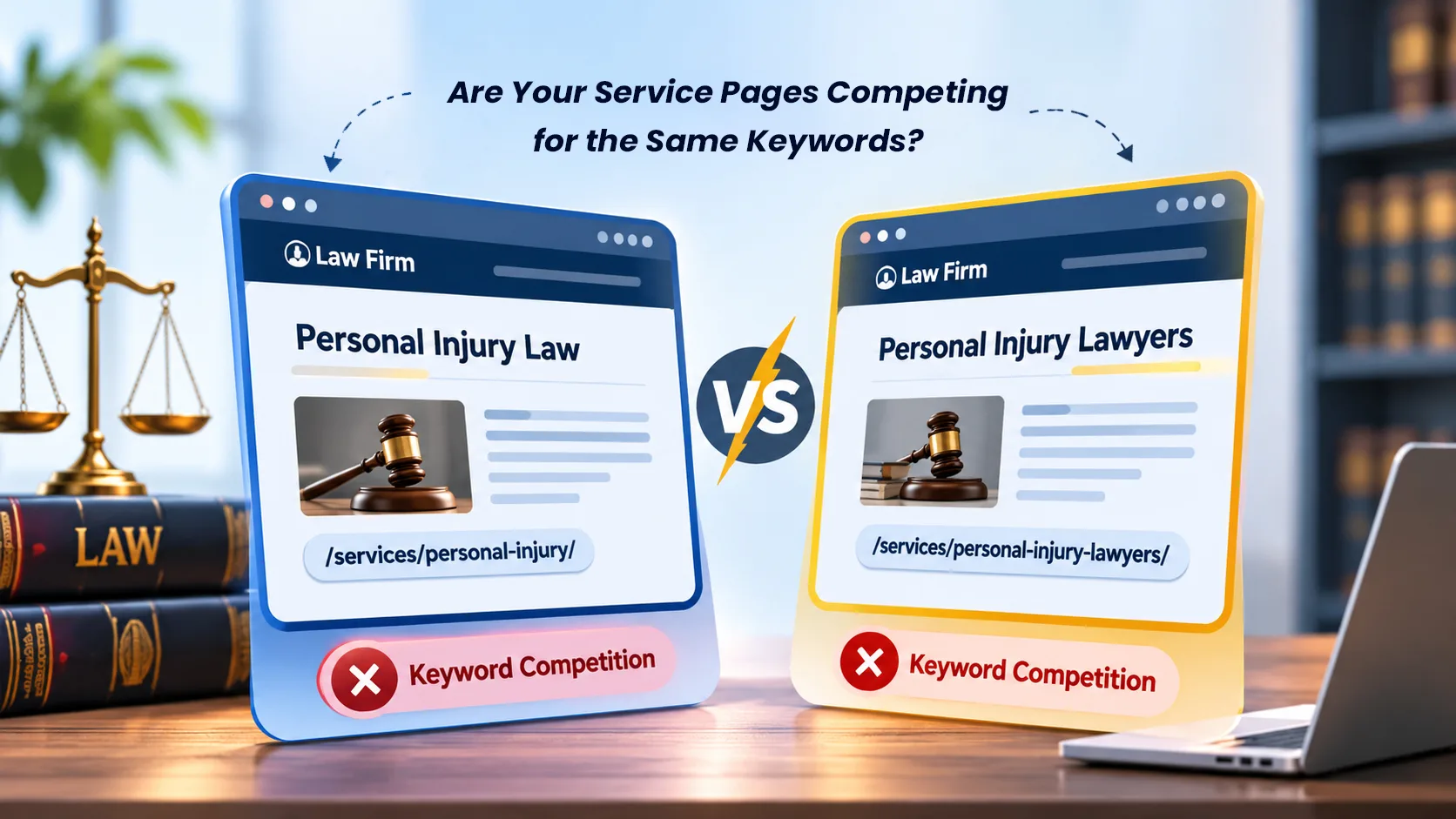
Creating separate practice-area pages is useful only when those pages have clearly differentiated purposes.
Without a proper content plan, law firms can unintentionally create pages that target similar keywords and answer almost identical questions. This can contribute to keyword cannibalisation on law firm websites.
For example, imagine a Melbourne firm has two pages:
- Family Lawyers in Melbourne
- Melbourne Family Law Services
If both pages explain the same services, target similar searches and offer nearly identical information, their purpose may be unclear.
The same issue can occur when a firm creates separate pages for several Melbourne suburbs but changes only the location name while leaving the rest of the content almost identical.
Before creating another page, review what already exists:
- Does each page address a distinct legal service or client need?
- Are the main topics and headings sufficiently different?
- Does each page offer information that is not already covered elsewhere?
- Are internal links directing visitors to the most relevant page?
- Could overlapping content be combined into one more useful resource?
You can use Google Search Console to review which queries bring visitors to individual pages. If multiple pages appear for the same searches, investigate whether their content and search intent genuinely overlap. Multiple pages appearing for a query do not automatically mean there is a problem.
Our guide to avoiding keyword cannibalisation explains how overlapping pages can be identified and addressed.
Also consider whether technical duplication is contributing to the problem. Our article on canonical tags and duplicate content URLs provides further guidance.
How can law firms prevent their practice area pages from competing with each other in search results?
Give each page a distinct purpose and target a clearly defined service or search intent. Avoid repeating the same information across multiple URLs.
Review performance data, improve overlapping content, consolidate pages where appropriate and use internal links to direct visitors towards the most relevant page.
The solution is not always to delete a page. Depending on the situation, you may need to improve its focus, consolidate overlapping content or clarify the internal linking structure.
How Does Website Structure Support Your Law Firm’s SEO Strategy?
A well-organised website gives each important service a clearer role. It helps visitors discover relevant information and gives search engines a better way to discover and understand the relationships between your pages.
For a law firm, this means:
- Better service discoverability: Visitors can reach relevant legal services through clear navigation and internal links.
- More focused content: Each page can address a specific service or client need.
- Clearer page relationships: Related practice areas, solicitor profiles and resources can connect naturally.
- Fewer unnecessary pages: Reviewing existing content helps prevent repetitive pages and overlapping search intent.
However, website structure alone does not guarantee higher rankings. Page quality, relevance, technical performance and competition also influence organic search visibility.
Before making major changes, consider conducting a complete SEO audit to identify structural issues, content gaps and technical problems. After making improvements, ongoing SEO maintenance can help you monitor the website and identify issues as your services and content evolve.
Is Your Law Firm Website Structured to Generate More Enquiries?
A confusing website structure can make it harder for potential clients to find your legal services and understand how your firm can help.
At Engage Coders, we help businesses improve website organisation, search visibility and digital performance through strategic SEO and website design.
Want to know where your website is losing opportunities?
Explore our digital marketing services in Melbourne and speak with our team about improving your website’s structure and creating a clearer path for potential clients.
Request A Free Quote Now
Give Your Law Firm’s Website a Structure That Supports Growth
Your website should do more than list your legal services. It should help potential clients understand what your firm offers, find relevant information and take the next step.
A clear hierarchy, focused practice-area pages and meaningful internal links can make your website easier to navigate while giving each important service a defined place.
For Melbourne law firms, getting this structure right also means creating location-specific content only where it provides genuine value. If you are also reviewing your firm’s local search presence, our article on law firm SEO in Melbourne explores the local visibility side of the wider strategy.
Is your law firm website organised to attract and convert potential clients?
Engage Coders helps Melbourne businesses improve website structure, search visibility and digital performance through strategic SEO and website design.
Let’s identify what’s holding your website back.Explore our Melbourne digital marketing services to discuss your website’s opportunities and the improvements that could support your practice’s growth.
FAQs
A useful law firm website structure organises services into clear practice-area categories, with dedicated pages for important legal services where appropriate. It should also include straightforward navigation, relevant solicitor profiles, supporting resources and clear contact information.
Yes, when each practice area represents a distinct service that deserves its own detailed information. Dedicated pages help explain specific legal services and address different visitor needs. However, unnecessary pages with repetitive content should be avoided.
There is no fixed number. The right number depends on the firm’s actual services, areas of specialisation and the information potential clients need. Each page should have a clear purpose and provide meaningful value.
Law firms should group related services under clear categories, use descriptive menu labels and make important pages easy to reach. Avoid overcrowded menus and confusing page relationships.
Yes. Poor navigation, disconnected pages, unclear page hierarchy and overlapping content can make it harder for visitors and search engines to understand a website. Improving these areas can support better discoverability and usability, although it does not guarantee higher rankings.


