
Agentic Advertising Framework: Why Google’s AI Future Has Less to Do With Campaigns Than Most Marketers Think
Google introduces a major change to advertising, the industry tends to focus on the visible layer first saying that it will outperform existing campaign types.
Now people ask how the new feature works, where it appears, and whether it’ll stay true to the claim by the Internet giant.
That pattern has repeated itself with AI Mode, Conversational Discovery ads, Highlighted Answers, Business Agent for Leads, and the growing collection of AI-powered shopping experiences Google has begun rolling out.
The discussion is understandable.
These are the products advertisers can see.
The harder question sits underneath them.
Table of Contents
- What Happens When Google Does the Shopping for Your Customers?
- The Shift Nobody Is Really Talking About
- Why Infrastructure Is Becoming the New Competitive Advantage
- The Agentic Advertising Readiness Framework
- Phase 1: Data Pipeline Sanitisation
- Phase 2: Building a Business Machines Can Understand
- Phase 3: Why Context Is Becoming More Valuable Than Content
- Phase 4: Learning Before the Market Settles
- The Bigger Question Behind Google’s AI Push
- FAQs
What Happens When Google Does the Shopping for Your Customers?

This question matters because every one of Google’s newest advertising experiences depends on the same thing. Before the system can recommend a business, answer a question, or guide a purchase, it has to understand what it is looking at.
For many organisations, that is where the real challenge begins.
The conversation around AI often assumes the technology will compensate for weaknesses that already exist inside a business. In practice, the opposite tends to happen. AI has a habit of exposing those weaknesses. Customer data that seemed good enough suddenly produces poor match rates. Product information maintained across multiple systems starts conflicting with itself. Website content that works perfectly for human visitors provides very little structure for machines trying to interpret it.
None of those problems are new.
They simply become harder to ignore when automation begins relying on them.
The Shift Nobody Is Really Talking About
Most commentary around Google’s AI announcements has focused on advertising formats.
That makes sense on the surface. AI Mode changes how users interact with Search. Conversational Discovery ads are designed to appear during exploratory moments. Highlighted Answers place brands directly inside AI-generated responses. Business Agent for Leads introduces conversational interactions that can happen before a user ever reaches a landing page.
Each feature solves a different problem, but only when viewed together, they reveal something larger that Google is gradually reducing the distance between a user’s question and an answer.
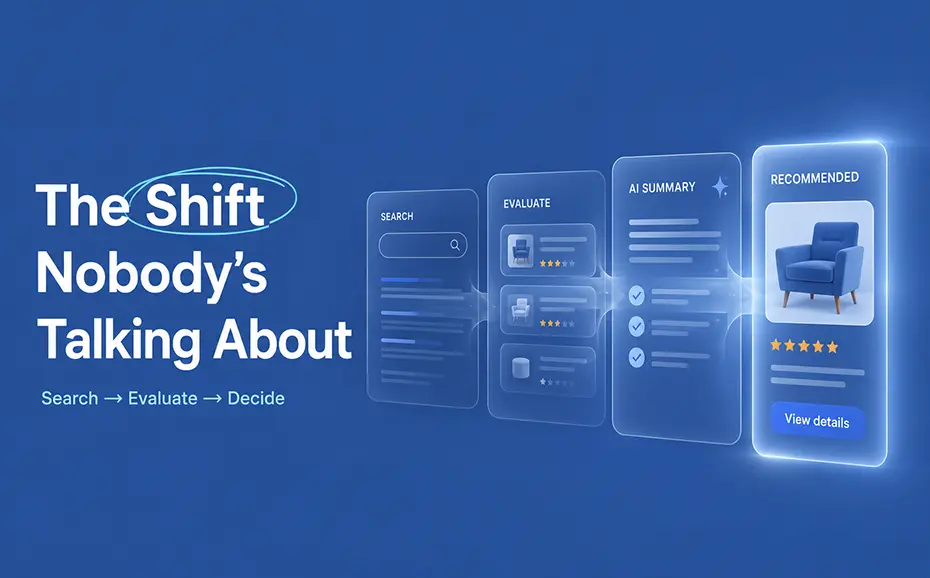
Historically, advertisers competed for clicks. A user searched, reviewed options, visited websites, and eventually made a decision. Google’s role was primarily to organise information and connect people to it.
The newer model is different.
Google is becoming more active in the evaluation process itself. Increasingly summarising directly on the platform, compressing information, comparing options, highlighting recommendations, and helping users navigate decisions that previously required multiple visits across multiple websites.
Its evolution benefits advertisers with one open question.
Some businesses may gain visibility they never would have achieved through traditional search results. Others may discover that visibility and website traffic no longer move together in the same way they once did.
Publishers are already asking versions of that question.
Advertisers will likely ask it next.
Why Infrastructure Is Becoming the New Competitive Advantage
Years, campaign management was where performance gains were made.
Better account structures mattered. Better bidding strategies mattered. Better audience segmentation mattered. Skilled practitioners could consistently outperform competitors through execution alone.
That does not disappear overnight.
What changes is the relative importance of those activities.
As more optimization responsibilities move into Google’s systems, the quality of the underlying information starts carrying more weight. Two businesses may use the same automation tools, the same bidding models, and even similar campaign structures. Yet one consistently generates stronger outcomes.
The difference often comes down to what Google’s systems are learning from.
A business with clean customer records, structured product information, and reliable feedback loops gives the platform a clearer picture of reality. A business with fragmented systems creates uncertainty.
Machines are not particularly good at dealing with uncertainty especially when information is inconsistent, systems have to infer.
Systems often infer, mistakes become more likely turns the AI readiness becoming an operational issue rather than a campaign issue.
The Agentic Advertising Readiness Framework
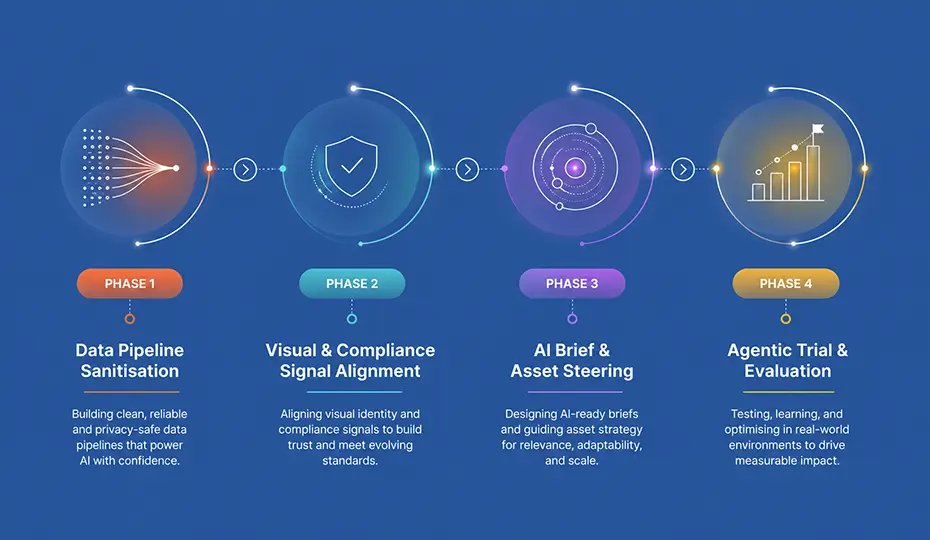
The framework itself is straightforward.
If Google’s systems are becoming more involved in discovery, evaluation, and optimization, businesses need to improve the quality of the information available to those systems.
That work generally falls into four areas.
| Phase | Focus |
|---|---|
| Phase 1 | Data Pipeline Sanitisation |
| Phase 2 | Visual & Compliance Signal Alignment |
| Phase 3 | AI Brief & Asset Steering |
| Phase 4 | Agentic Trial & Evaluation |
The phases are connected because each one addresses a different way Google learns about a business.
Phase 1: Data Pipeline Sanitisation
The first place most organisations encounter friction is customer data.
On paper, many businesses appear to have plenty of it. CRM platforms contain thousands of records. Marketing automation systems track user activity. Sales teams maintain detailed histories of customer interactions.
The problem is that volume and quality are not the same thing.
As a firm having a large database while struggling to provide useful insight. Duplicate records, outdated contact information, conflicting lifecycle stages, and inconsistent formatting all reduce clarity. Those issues might remain hidden during manual operations, but they become far more visible when systems such as Customer Match rely on them.
One of the more revealing moments occurs during audience synchronisation projects. Teams often discover that information collected over years was never designed to operate as a real-time decision signal. Different departments define customer value differently. Lead quality varies. Historical data includes records nobody fully trusts.
The technology generally works as expected.
The information feeding it often requires more attention than anticipated.
That is why organisations investing in automated CRM syncing, first-party data strategies, and value-based audience segmentation frequently outperform businesses that focus exclusively on campaign settings.
The objective is not simply collecting customer data.
The objective is creating customer truth.
Phase 2: Building a Business Machines Can Understand
Customer data explains who matters.
The next challenge is helping Google’s systems understand what matters.
This is where structured information becomes increasingly important.
AI-powered Shopping ads, native checkout experiences, Direct Offers, and broader commerce initiatives all depend on accurate product data. Pricing, inventory, specifications, promotions, and availability need to be interpreted quickly and consistently.
Historically, businesses built websites for people.
Increasingly, they are building them for people and machines simultaneously.
That distinction sounds technical, but it has practical consequences. Information that is difficult for systems to interpret becomes harder to surface, compare, and recommend. Information that is clearly structured becomes easier to incorporate into emerging AI experiences.
There is a compliance dimension to this as well.
Consent Mode V2 is often discussed as a regulatory requirement, but it also affects signal quality. Missing consent information can reduce visibility into user behaviour and limit the effectiveness of audience-based optimisation.
The issue is not merely compliance.
It is comprehension.
The less information available, the harder it becomes for systems to understand what is happening.
Phase 3: Why Context Is Becoming More Valuable Than Content
Many discussions about AI focus on content creation.
That focus is understandable because generated content is visible.
Context is less visible, but often more important.
Consider Business Agents for Leads. The technology can answer questions and assist prospective customers, but only if it understands the business well enough to respond accurately. The same principle applies to AI-generated recommendations, shopping experiences, and conversational interactions.
Without context, AI can produce responses.
With context, it can produce useful responses.
That distinction is becoming increasingly important as organisations experiment with AI Briefs and similar governance frameworks. The purpose is not simply controlling messaging. It is helping systems understand products, services, positioning, terminology, and priorities.
Businesses that provide clearer context reduce the likelihood of confusion.
Businesses that provide little context leave more room for interpretation.
Interpretation is not always your friend.
Phase 4: Learning Before the Market Settles
The final phase is less about implementation and more about adaptation.
No organisation has a complete playbook for AI-native search because the environment is still evolving. User behaviour is changing. Discovery patterns are changing. Expectations around search and shopping are changing.
That uncertainty creates risk.
It also creates opportunity.
Historically, the businesses that adapted most successfully to major platform shifts were not necessarily the ones with the largest budgets. They were often the organisations willing to learn while the rules were still being written.
The same principle applies here.
Testing AI Mode opportunities, monitoring conversational discovery behaviour, and understanding how users interact with emerging formats can provide valuable insight long before industry benchmarks become available.
Waiting for certainty is tempting.
By the time certainty arrives, much of the advantage has already been claimed.
The Bigger Question Behind Google’s AI Push

It is easy to look at AI Mode, Conversational Discovery ads, Highlighted Answers, Business Agent for Leads, and AI-powered Shopping ads as a collection of new products.
That view is not wrong.
It is simply incomplete.
Taken together, these initiatives point toward a future where Google’s systems play a larger role in understanding businesses and helping users make decisions. That future places greater value on information quality, business context, and operational clarity than many organisations are accustomed to.
The businesses most likely to benefit will not necessarily be those that adopt every new feature first.
Need Content That Performs Beyond Rankings?
We create SEO-focused, AI-ready content that helps businesses build authority, improve visibility, and stay competitive as search evolves.
Let’s Talk Content
The businesses most likely to benefit will not necessarily be those that adopt every new feature first. They will be the businesses that partner with technical teams like Engage Coders to make it easiest for Google’s systems to understand who they are, what they offer, and why they matter.
That may not be as exciting as a new ad format. It is probably more important.
FAQs
Google AI Mode relies on clear context, not just keywords. Use structured headings, concise answers, accurate product information, and schema markup so Google’s systems can interpret your content with confidence.
Business Agent for Leads is a conversational lead generation experience that allows potential customers to ask questions directly within Google surfaces before visiting a website. It uses business information and context to guide users toward conversion actions.
Improve data quality by syncing CRM records regularly and supplying multiple identifiers such as email, phone number, name, and location data. Better customer signals help Google’s systems match users more accurately.
Conversational Discovery ads are designed for exploratory searches where users are researching solutions rather than looking for a specific brand. Success depends on strong first-party data, clear product information, and relevant campaign assets.
Consent Mode V2 affects the amount of behavioural data available for measurement and optimisation. Missing consent signals can reduce audience visibility and weaken the quality of data feeding automated bidding systems.
Traditional Search Ads direct users to websites through sponsored listings, while Highlighted Answers place advertiser information directly within AI-generated responses. The latter depends more heavily on Google’s understanding of business context.
An AI Brief should define brand positioning, product terminology, messaging priorities, audience intent, and compliance requirements. The goal is to give Google’s systems enough context to make better automated decisions.
AI-generated experiences can answer questions and qualify users before they visit a website. This may reduce overall traffic while maintaining or improving conversion quality among the visitors who do click through.
Product pages should include accurate schema for pricing, availability, product descriptions, reviews, and inventory status. Structured data helps Google’s systems understand and surface products within AI-powered shopping experiences.
Not necessarily. However, many emerging AI-powered ad experiences build upon automation and machine-learning infrastructure already used within campaign types such as Performance Max and AI Max.


