
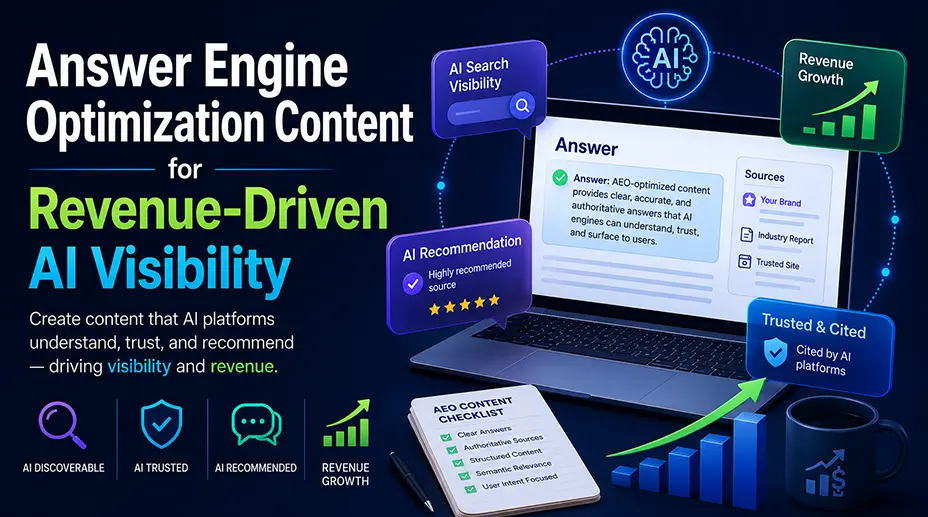
Answer Engine Optimization Content for Revenue-Driven AI Visibility
There is a major shift that is changing the vision of businesses about online visibility. The pattern of search has evolved to include AI search. Your target consumer is now discovering things directly through tools like ChatGPT, Gemini, Perplexity, and Google AI Overviews. Traditional high search rankings still matter, but if your brand is not getting cited as trusted inside AI answers, you lose a massive chunk of the market. As a result, answer engine optimization content is becoming an important part of modern digital marketing strategies.
Building a brand is not enough!
You also need to rethink factors like authority, securing trusted influencer reviews, and getting mentioned across the web so AI systems can crawl and recommend you during the purchasing decision. To drive broader business outcomes like lead generation and revenue, you still need traditional visibility through rankings. However, the value of visibility itself is changing.
Table of Contents
- Why Is AI Visibility Becoming More Valuable Than Traditional Search Rankings?
- Why Is Topical Authority More Important Than Individual Rankings?
- What Types of Content Are Most Frequently Cited by ChatGPT, Gemini or Google AI Overview, and Perplexity?
- How Can Businesses Write Content for AI Overviews Without Sacrificing Human Engagement?
- How Does Answer Engine Optimization Content Turn AI Visibility Into Revenue?
- How Can Businesses Measure the ROI of AI Visibility?
- How to Get Cited by ChatGPT and AI Search Engines
- Why Content Marketing Services Matter in an AI-First World
- The Future of Answer Engine Optimization Content Is Revenue, Not Rankings
- FAQs
Why Is AI Visibility Becoming More Valuable Than Traditional Search Rankings?
For years, top SEO rankings drove clicks, traffic, and leads, yet still being important, rankings are no longer the “only” measure of discoverability. Businesses need content for AI overviews because these platforms are capable of delivering direct, summarized answers instead of just a list of links.
Clicks to Answers Behaviour
This shift has triggered a rise in zero-click behavior, moving discoverability from click-driven to answer-driven. Users often get the information they need without ever visiting a website. In this new landscape, being cited as a trusted source within an AI response is just as valuable as ranking at the top of traditional search results.
AEO Content Writing Is The New Strategy
AI-generated answers heavily influence early-stage research and purchasing decisions. To maintain visibility, modern digital marketing requires Answer Engine Optimization (AEO). Businesses must create clear, structured, and authoritative content designed specifically for AI systems to understand, trust, and reference.
“Success is no longer measured solely by where your website ranks, but by whether your brand is trusted enough to become part of the answer.”
AEO content writing , how to get cited by ChatGPT , AI chatbot content strategy , content for AI overviews , write for AI search engines
Why Is Topical Authority More Important Than Individual Rankings?
From the beginning if a brand is doing its digital marketing. They measure success through a narrow lens: pick a keyword, optimize a page, and chase a single top ranking.
Although traditional search engines used to heavily prioritize these isolated page-level factors. However, the rise of answer engine optimization content has shifted how visibility is won. AI evaluates expertise differently, forcing brands to stop chasing single keywords and start owning entire topics.
AI Evaluation Shift of Keywords vs. Ecosystems
Traditional search engines look at keywords on a page; AI engines look at the entire content ecosystem. AI models rely on knowledge graphs and entity recognition—systems that map out real-world concepts, brands, and the relationships between them. Instead of just evaluating a single article in a vacuum, AI search tools look for topical depth. They scan your entire site to see if you have comprehensively mapped out a subject matter.
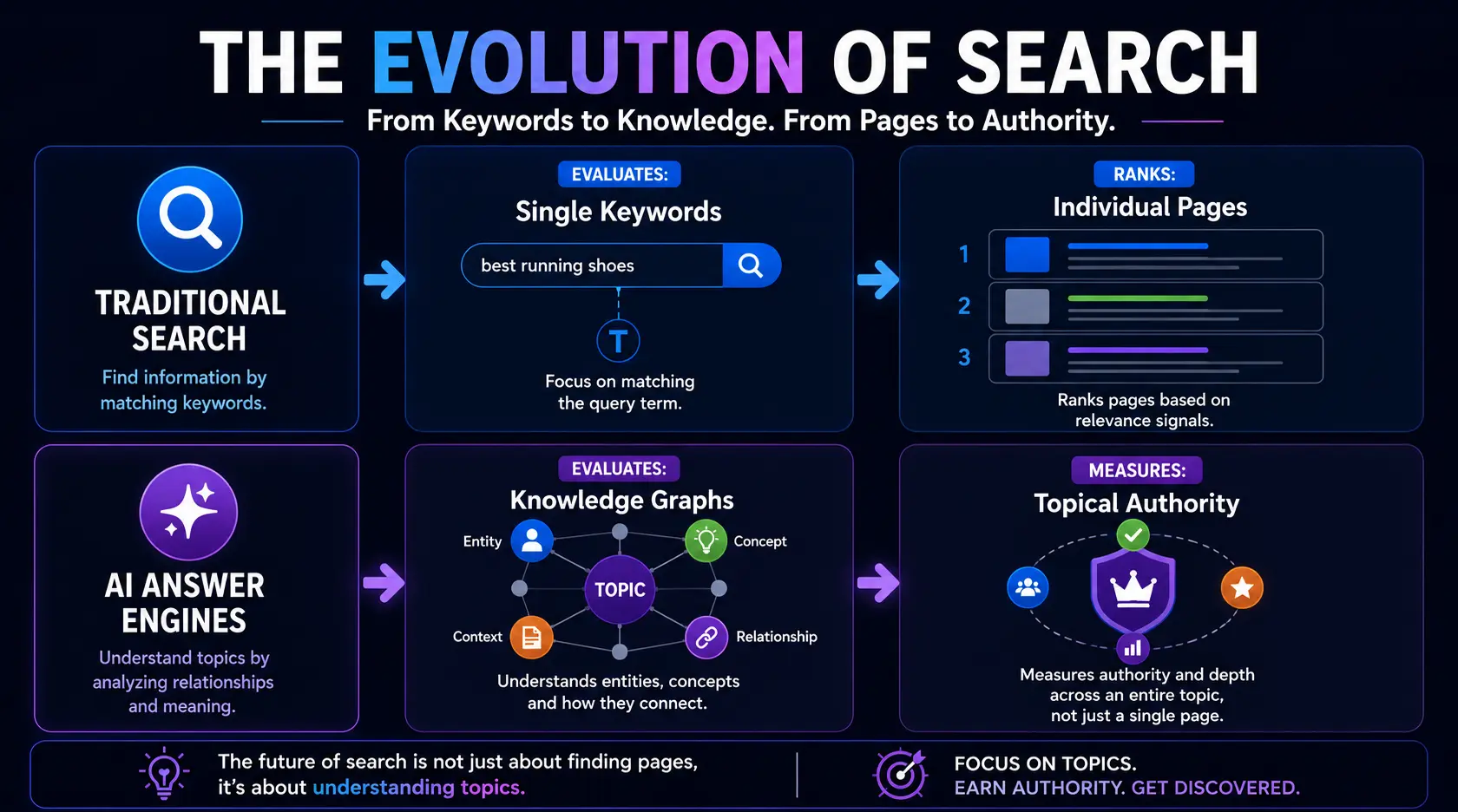
If your site only features one isolated post about a high-volume phrase, an AI engine will likely ignore it in favor of a brand that has built an interconnected web of deeper informational resources.
The Difference: Winning a Keyword vs. Owning a Category
The gap between old-school SEO and modern AEO content writing comes down to scale and sustainability:
- Ranking for one keyword: This creates a fragile, temporary spike in traffic. If an algorithm update or a competitor shifts, that single point of visibility vanishes. It ignores how conversational search actually functions.
- Owning an entire topic category: This establishes deep subject matter expertise. When you own a category, your brand sends consistent brand authority signals across the web. You become the definitive source that the AI’s internal database relies on to synthesize an answer.
When you establish topical authority, you stop fighting for a single blue link. Instead, you become the trusted entity that AI systems confidently present to users during complex, multi-turn research queries.
Building authority across a category is only the first step. The next challenge is understanding which types of content AI systems actually cite.
The Tactical Problem-Solver
Ready to Get Cited by ChatGPT, Gemini, and Perplexity?
Free Consultation
What Types of Content Are Most Frequently Cited by ChatGPT, Gemini or Google AI Overview, and Perplexity?
Getting visible in AI search isn’t about being lucky, it’s about how clearly you organize your data. AI engines use retrieval-augmented generation (RAG) to scan the web and pull sources that minimize their own processing friction. If your site features easy-to-extract data, you position yourself to win the citation. To build a successful answer engine optimization content strategy, you must understand the specific content types that naturally attract AI links.
The Content Formats That Win AI Citations
AI engines value information density and structure. The formats that get cited most frequently share a common trait: they provide definitive value that an LLM cannot manufacture on its own.
| No. | Content Type | Why AI Systems Prefer It | How to Apply It | Example |
|---|---|---|---|---|
| 1 | Original Research and Proprietary Data | AI systems favour unique information that is not available on hundreds of other websites. Original statistics, surveys, and benchmark data provide fresh insights they can reference. | Publish industry reports, customer surveys, benchmark studies, and performance data with clear numbers and findings. | “Our study of 500 B2B websites found that structured content increased AI citations by 38%.” |
| 2 | Industry Studies and Trend Reports | AI platforms often cite sources that explain market shifts, emerging trends, and industry changes with supporting evidence. | Create reports based on customer behaviour, market developments, and industry observations. | A report analysing how AI search is changing B2B buying behaviour. |
| 3 | Comparison Content and Frameworks | Users frequently ask AI tools to compare products, services, and strategies. Structured comparisons are easier for AI systems to understand and summarise. | Create comparison tables, decision-making guides, and frameworks as part of your AI chatbot content strategy. | A comparison table showing Traditional SEO vs AEO vs GEO. |
| 4 | Detailed Guides with First-Party Experience | AI systems increasingly look for content backed by real experience rather than recycled information. | Share lessons learned, implementation processes, client experiences, and practical advice through AEO content writing. | A guide showing how a company improved AI visibility through content restructuring. |
| 5 | Expert Commentary and Insights | AI systems trust content that demonstrates recognised expertise and professional knowledge. | Include expert opinions, author credentials, industry experience, and unique perspectives. | A digital marketing strategist sharing insights from enterprise AI search campaigns. |
| 6 | Structured Educational Content | Well-organised content makes it easier for AI systems to extract, understand, and summarise information. | Use FAQs, definitions, step-by-step instructions, and clear headings when creating content for AI Overviews. | A section explaining how AI search differs from traditional search. |
| 7 | Case Studies and Real Results | Real-world outcomes provide stronger trust signals than theory alone. | Document business challenges, solutions, implementation steps, and measurable results. | A case study showing how AI visibility contributed to increased lead generation and revenue growth. |
What Makes Content Citation-Worthy?
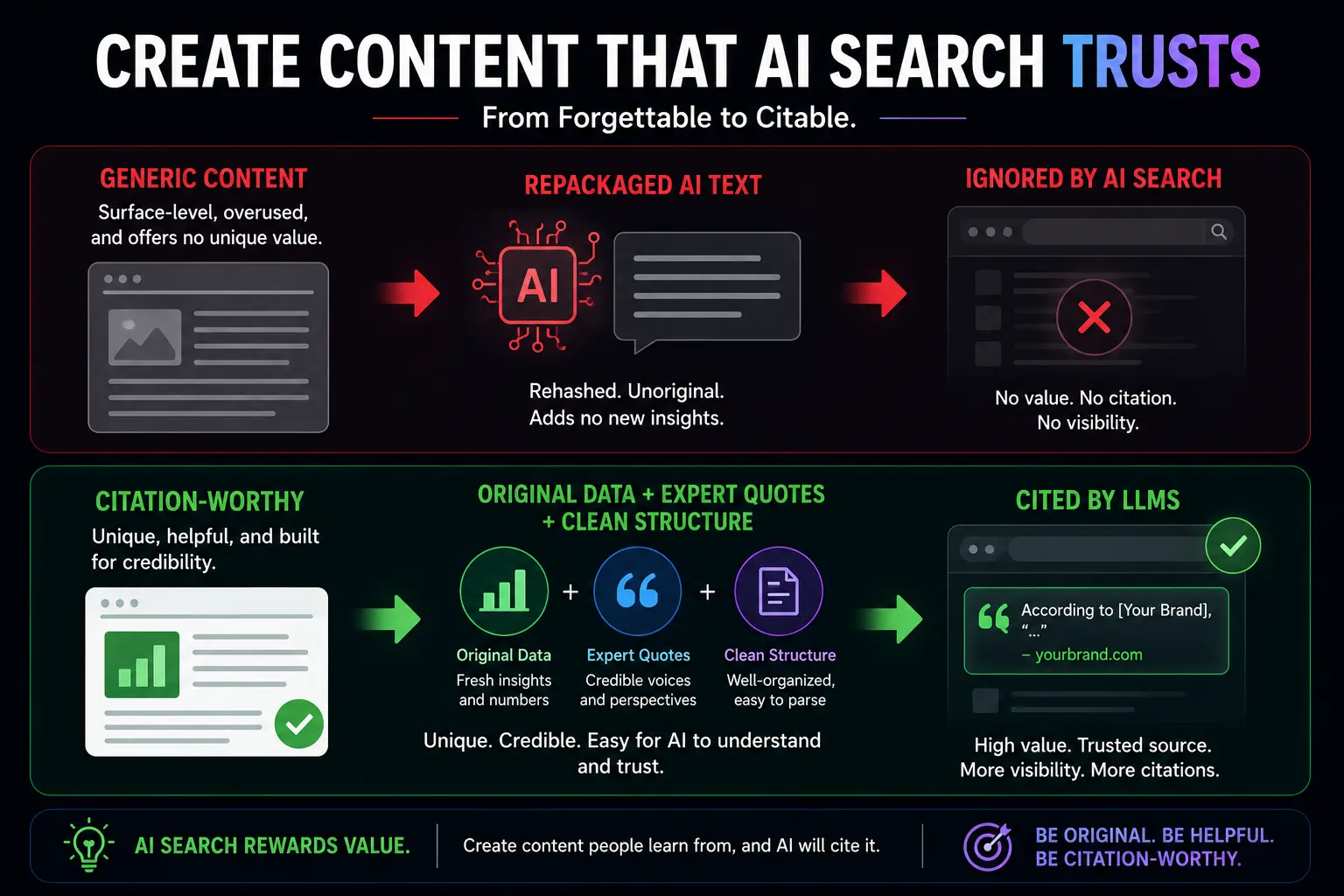
To understand how to get cited by ChatGPT, Perplexity, and Gemini, you have to look at what makes text retrievable. AI platforms favor data that is structured for machine consumption. This means using strict heading hierarchies (H2, H3), bulleted lists, and schema markup that clear up ambiguity. Furthermore, AI engines favor definitive language (e.g., “is defined as”) over hedged, vague commentary.
Why Generic AI Content Fails to Earn Citations
Many brands attempt to game AI search by using generative AI to produce bulk articles. This approach rarely works. Generic AI-generated content simply repeats the foundational training data the models already possess. Because it lacks original data, fresh insights, or unique first-hand experience, it offers nothing new for a live web crawler to retrieve. AI engines prioritize independent validation and unique information; they have no reason to cite a website that is merely echoing back their own words.
Getting cited is valuable, but citation alone does not generate revenue. The quality of content still determines how buyers engage with your brand.
How Can Businesses Write Content for AI Overviews Without Sacrificing Human Engagement?
The biggest mistake brands make when they begin to write for AI search engines is creating a dry, technical data dump. They strip out personality and narrative flow just to satisfy algorithms.
Modern digital marketing requires a dual-audience approach of structuring the content that must be enough for an AI model to extract, yet engaging enough for a human to read once they click through.
Balancing Structure and Readability
Optimizing content for AI overviews does not mean choosing between machines and humans. The secret lies in modular formatting.
AI search engines rely on sequential processing to analyze pages. They favor dense, straightforward answers they can easily summarize into overview blocks. Humans scan pages looking for quick value. You can satisfy both by using a simple layout pattern: lead with a direct, plain-language answer block, then immediately follow it with contextual depth, examples, and experience-driven insights.
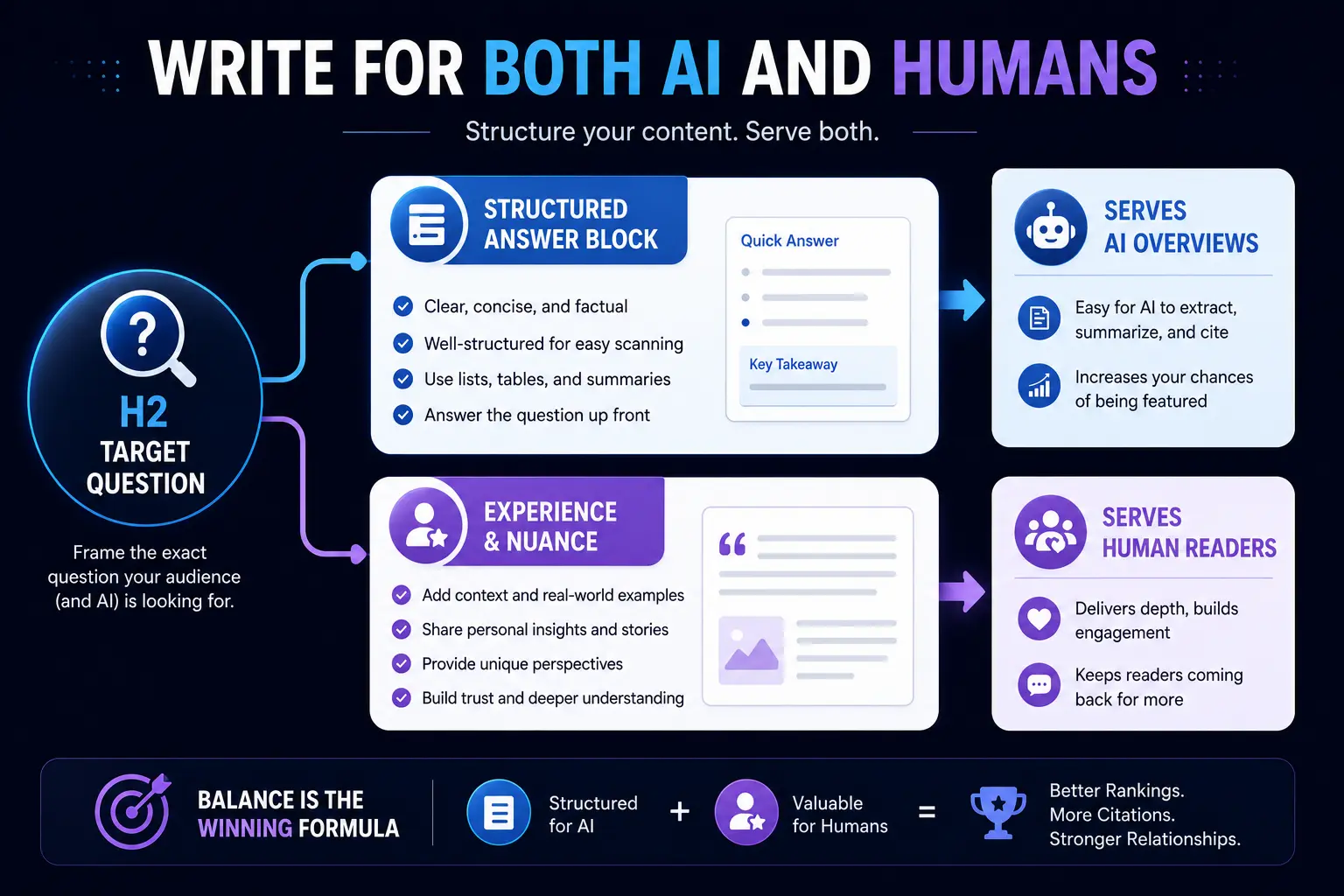
By keeping your technical formatting under the hood using clean heading hierarchies and robust semantic schema markup you provide the exact structural signals AI engines need without cluttering the visual experience for your users.
Why Human Trust Still Matters After AI Discovery
While AEO content writing helps you win the initial citation, the AI model is only acting as the introduction. An AI engine can surface your brand as a top recommendation, but it cannot finalize a business transaction.
Once a buyer clicks your link, they enter your ecosystem. If your landing page reads like generic, dry text, that hard-won human trust instantly evaporates. AI visibility gets you onto the shortlist, but human connection closes the deal.
Creating content that earns trust is important, but businesses ultimately need to connect visibility to commercial outcomes.
How Does Answer Engine Optimization Content Turn AI Visibility Into Revenue?
Most marketing teams treat AI visibility as a vanity metric, celebrating a mention inside ChatGPT or a Google AI Overview without understanding its bottom-line impact. True commercial success requires moving past basic impressions and aligning your AI chatbot content strategy directly with pipeline growth and revenue generation.
The Conversion Premium: Raw Visibility vs. Commercial Impact
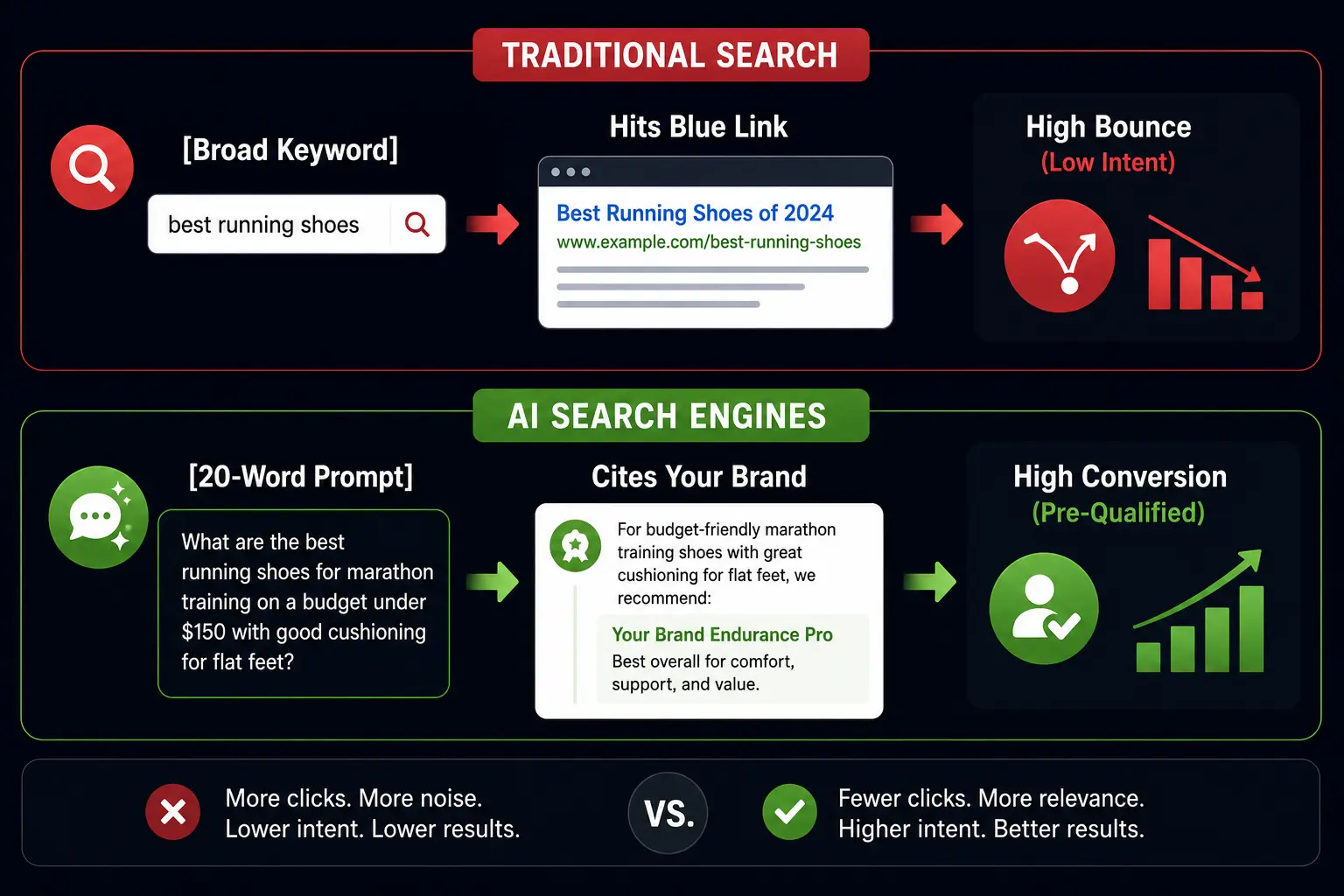
Traditional SEO is often a game of high volume and low conversion. Users type broad keywords into a search bar, click multiple links, and manually filter out noise. Because the intent is diluted, traffic frequently bounces.
High-quality answer engine optimization content operates on an entirely different economic model. When a buyer uses an AI assistant, they don’t just type keywords—they provide deep, multi-variable context (e.g., “Find a scalable CRM for a 20-person remote healthcare startup that integrates with Slack under $300 a month”).
When an AI engine processes this prompt and recommends your brand, it has already pre-qualified the lead against their exact technical and financial constraints. As a result, traffic arriving via AI citations converts into actual pipeline at significantly higher rates than traditional search traffic.
Driving Full-Funnel Outcomes Across Industry Verticals
AEO content accelerates the entire buyer journey by serving decision-stage content precisely when intent is highest:
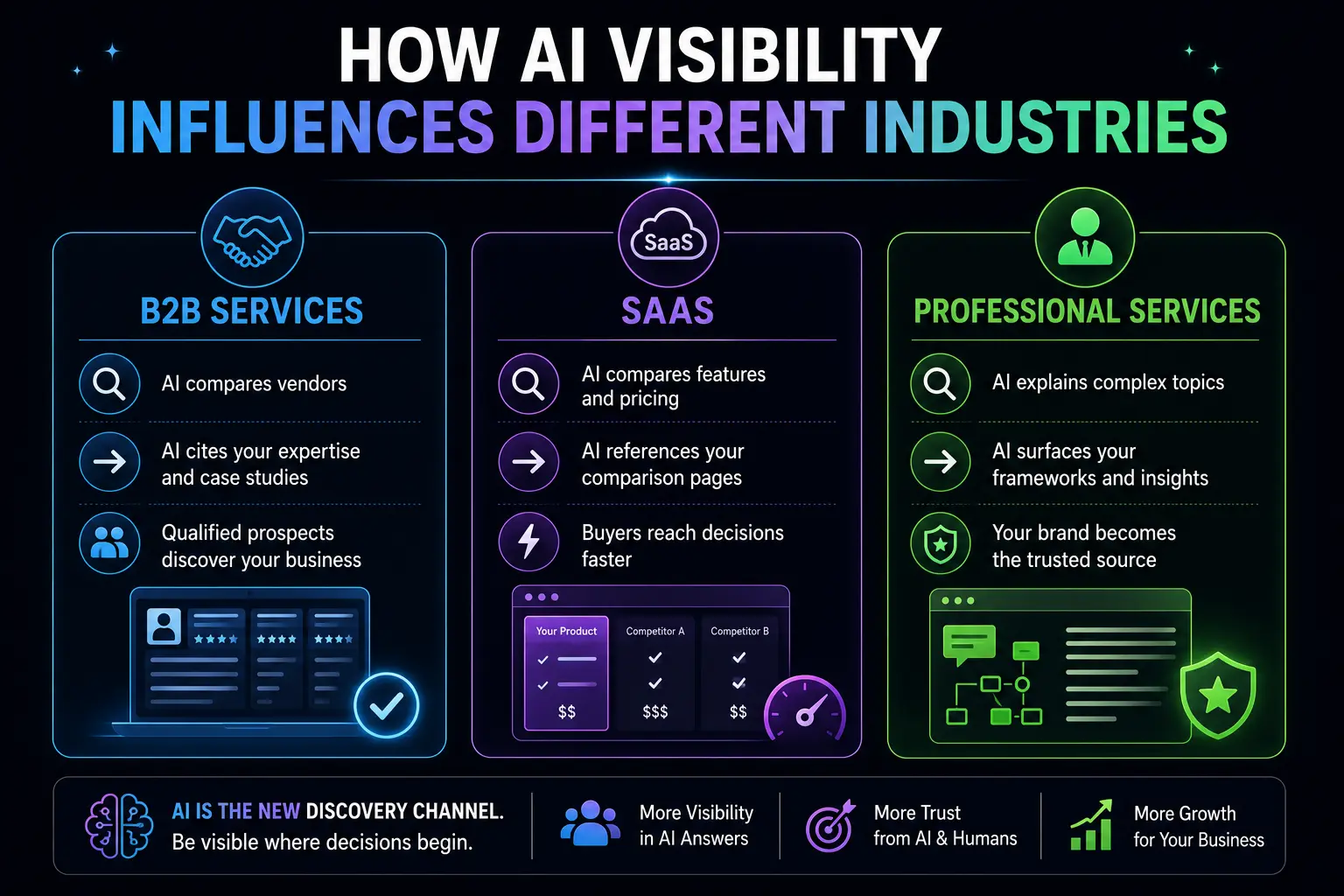
Ultimately, optimizing for answer engines changes the role of visibility. By providing clear, verifiable data that AI systems can confidently recommend, you transform passive digital mentions into a powerful driver of pipeline growth and predictable revenue.
If AI visibility can influence revenue, businesses need a reliable way to measure its impact.
How Can Businesses Measure the ROI of AI Visibility?
Most marketing teams struggle with AI search because they rely on old SEO metrics like keyword rankings and page clicks. Because AI answers user questions directly on the results page, traditional tracking models break. To understand the true business impact of your answer engine optimization content, you must implement a measurement framework tailored to conversational discovery.
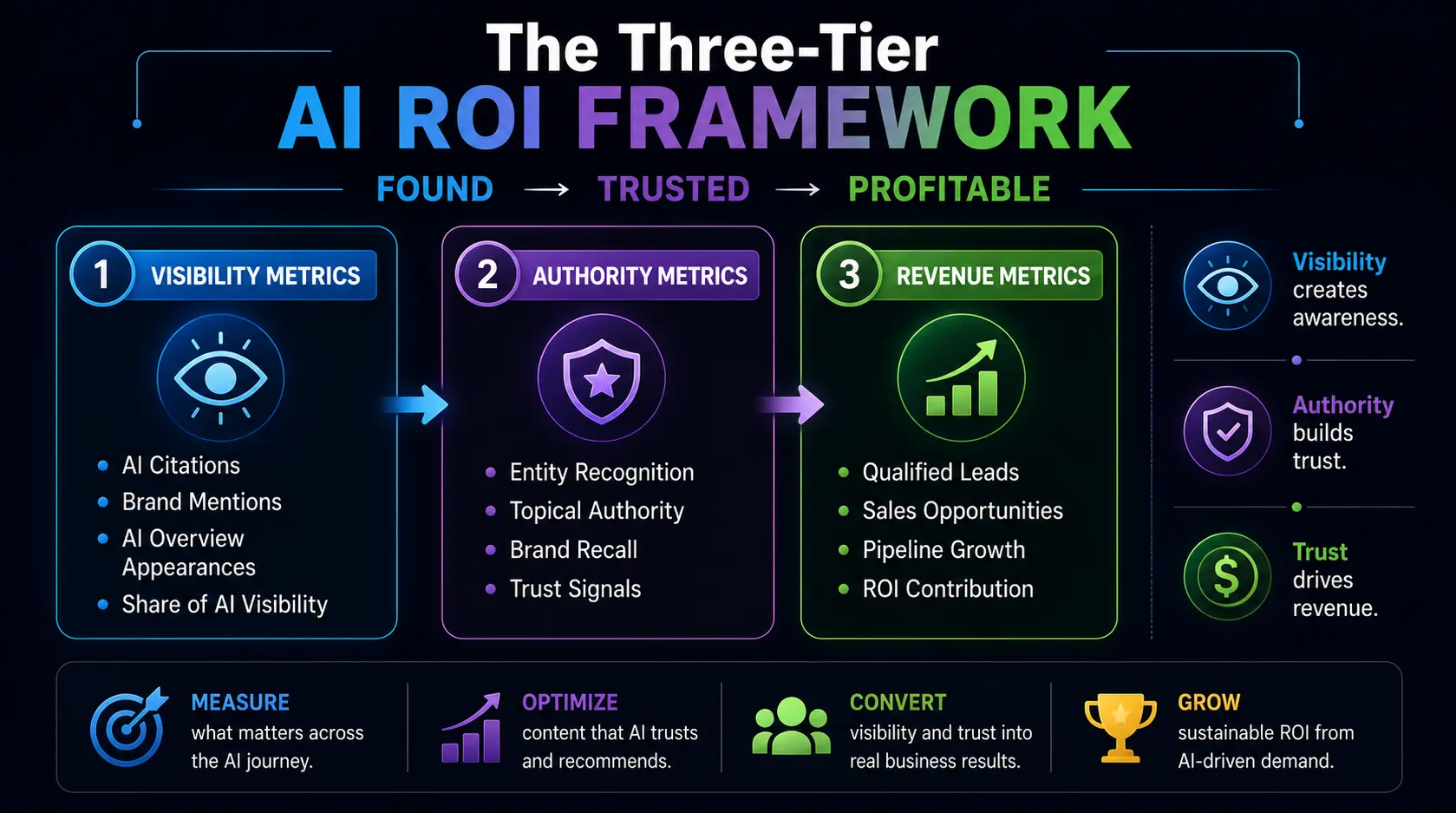
AI visibility goes beyond citations. You need to measure three things: how often you are found, how much you are trusted, and how effectively that visibility turns into leads, opportunities, and revenue.
1. Visibility Metrics (Top of Funnel)
This tier measures your raw presence within AI platforms. While you cannot track individual keyword positions, you can monitor your AI Share of Voice (SoV).
- Citations and Mentions: Track how frequently your brand name and URLs appear in responses across ChatGPT, Perplexity, and Google AI Overviews.
- Inclusion Rates: Monitor the percentage of industry-specific prompts where your brand is included in the synthesized summary.
2. Authority Metrics (Middle of Funnel)
This tier evaluates how effectively AI models recognize your brand as a market leader.
- Entity Growth: Track how often AI engines link your brand to your core industry concepts in their internal knowledge graphs.
- Topical Coverage: Measure your site’s comprehensive depth across target subjects using content audit tools to ensure no informational gaps exist.
3. Revenue Metrics (Bottom of Funnel)
This is where visibility connects directly to commercial value.
- AI Referral Traffic: Monitor direct click-throughs from citation links using UTM parameters specifically configured for AI engines.
- Assisted Conversions: Use multi-touch attribution models to identify leads who discovered your brand via an AI response before converting on your site.
- Pipeline and Closed Revenue: Track the total value of sales opportunities and closed deals influenced by high-quality AI referral traffic. Because these prospects are pre-qualified by the AI, they typically exhibit higher engagement quality and faster sales cycles.
By aligning your measurement strategy across these three tiers, you move past vanity metrics and gain a clear, accurate view of how your AI footprint drives predictable revenue growth.
Measurement is important, but sustainable AI visibility requires a deliberate content strategy.
How to Get Cited by ChatGPT and AI Search Engines
To write for AI search engines and learn how to get cited by ChatGPT, you must publish original insights, first-party data, and real expert commentary.
Avoid thin text, keyword stuffing, and generic AI copies. Instead, move your information through a clean, machine-readable pathway:
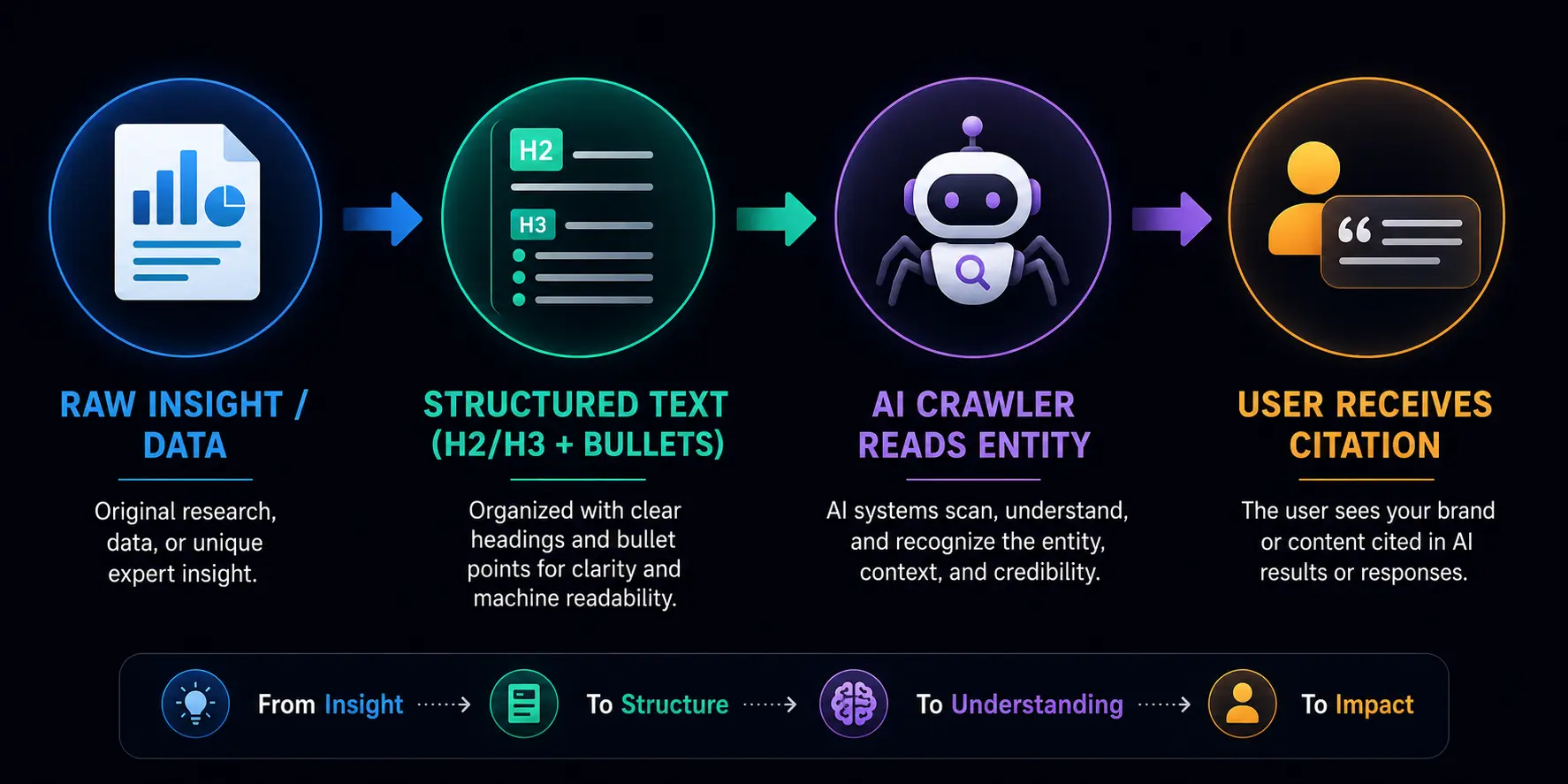
Organizing your data through this clear progression ensures your brand gets picked up and credited in summarized search answers.
Why Content Marketing Services Matter in an AI-First World
Standard keyword plans are no longer enough to stay competitive. Winning in this space requires a long-term strategy centered on topic ownership, deep research, and editorial consistency.
This is where specialized content marketing services become essential. Adapting to an AI chatbot content strategy means creating highly authoritative data structures that algorithms can easily process, verify, and trust. Because every industry has different nuances, the optimization pathway must be completely customized for each brand.
Having experience as a digital firm here at Engage Coders we often handle this level of customization. Rather than pushing rigid, standard packages, the right partner builds a tailored answer engine optimization content engine built specifically for your business framework. This ensures your content drives actual commercial revenue while keeping your brand at the center of AI-generated answers.
The Future of Answer Engine Optimization Content Is Revenue, Not Rankings
Stop chasing keyword rankings. Because AI engines answer user questions directly on the results page, traditional tracking is dead.
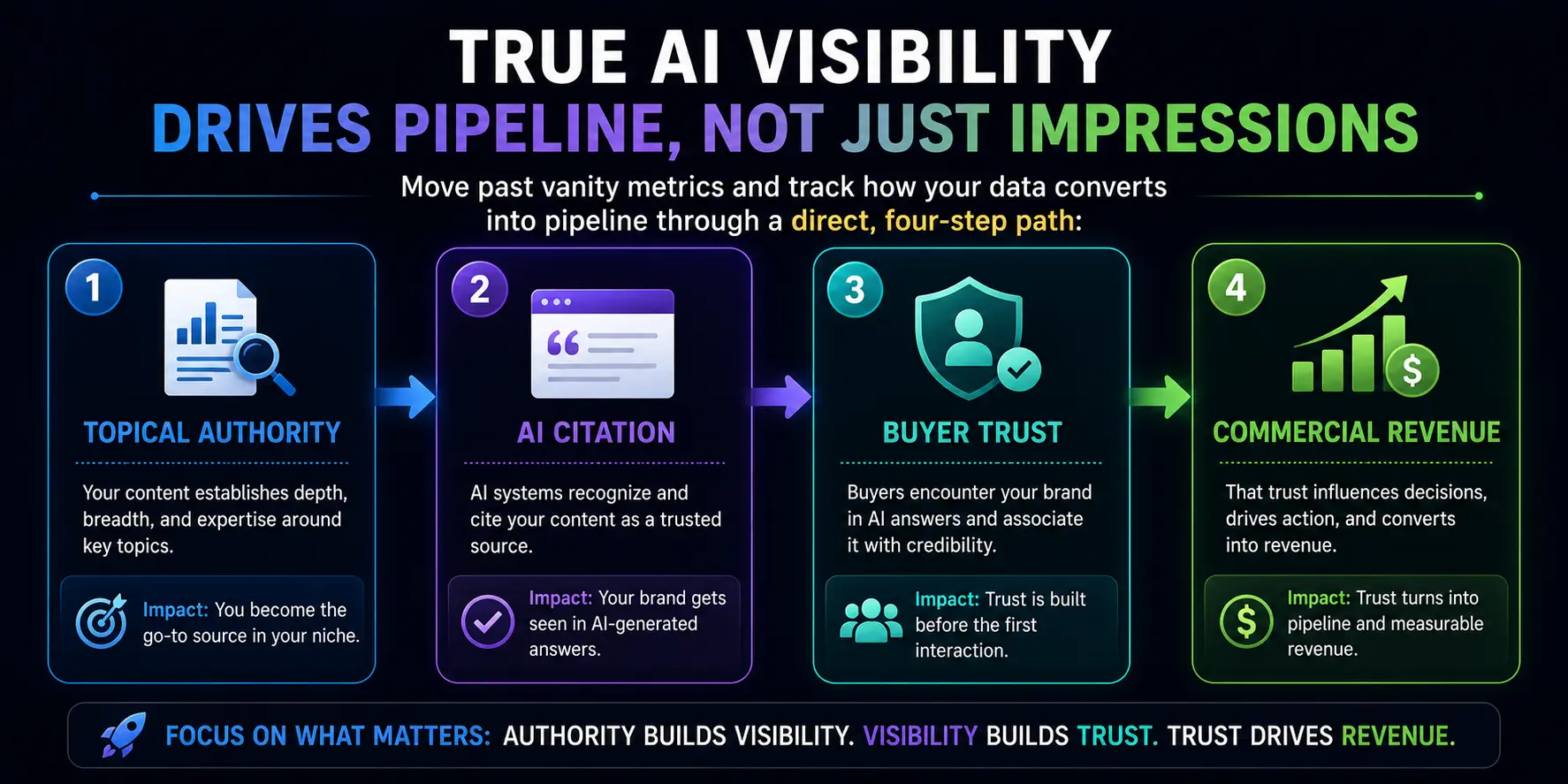
The brands winning this shift aren’t publishing bulk text; they are publishing original, trusted insights that AI models confidently recommend. Because every niche requires a different setup, generic playbooks fail.
Tailoring this process requires expert execution. While generic playbooks fail, agency specialists like Engage Coders focus on building these custom, revenue-first answer engine optimization content strategies ensuring your brand wins the recommendation when a buyer is ready to spend.
FAQs
Traditional SEO targets individual page rankings to earn link clicks from human searchers. In contrast, answer engine optimization content formats data specifically for AI models to easily crawl, extract, and cite inside conversational summaries.
Use a modular layout: place a direct, full-sentence answer block immediately under your H2 or H3 heading before diving into nuance. AI engines favor this dense structure because it minimizes computational processing friction during data retrieval.
LLMs already possess foundational training data; they have no reason to index pages that merely echo their own training parameters. To succeed, an AI chatbot content strategy must prioritize original research, unique studies, and primary data.
Schema markup acts as a labeled filing cabinet for web crawlers, defining clear entity relationships. Implementing specific JSON-LD structures like FAQPage and Product allows AI tools to easily parse and verify your data points.
Chasing single keywords creates fragile, temporary traffic spikes that fail in conversational search environments. Our engineers at Engage Coders build comprehensive topic ecosystems that establish undeniable subject authority within AI knowledge graphs.
AI platforms prioritize high-density, structured formats that machines cannot fake. This includes proprietary industry benchmarks, real-world case studies, data-heavy comparison matrices, and detailed technical integration guides.
Yes, by using clean formatting hierarchies and structured bullet lists that satisfy machine crawlers under the hood. This modular approach delivers the quick data extraction AI models require while maintaining a narrative flow that human visitors trust.
Traditional search results require users to manually filter open links, leading to lower conversion rates. When an AI tool cites your answer engine optimization content, it has already pre-qualified your brand against the user’s specific constraints.
Many conversational search bots do not execute client-side JavaScript, meaning dynamic sites can appear completely blank to them. SSR ensures your content is fully rendered into clean HTML on the first request for seamless machine indexing.
Rigid, standard marketing packages fail because every B2B niche requires a different operational setup. At Engage Coders, we map customized data layers directly to your CRM, ensuring your digital visibility directly accelerates sales pipeline velocity.


