
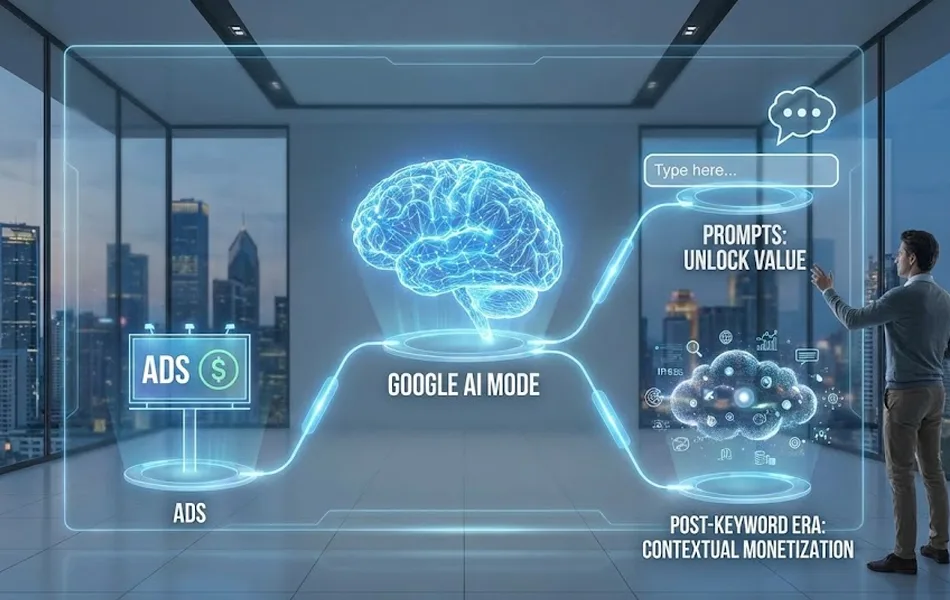
Google AI Mode And The Future Of Search Monetization: Ads, Prompts, And The Post-Keyword Era
Google AI Mode, officially rolled out in May 2025 and now accessible to all U.S. users without a waitlist, marks a major evolution in the way we use search.
Built on Gemini 2.5, this advanced interface goes beyond traditional AI Overviews by introducing a conversational assistant that stays with you throughout your search journey, merging AI-generated insights with standard search results. For marketers, this opens new possibilities in Google AI search ads, where campaigns must adapt to a more interactive search environment.
Users can easily switch between familiar search listings and AI-powered summaries, ask follow-up questions, and engage in deeper, more exploratory conversations, all within one streamlined experience.
Unlike previous tools like AI Overviews or the Search Generative Experience (SGE), which offered one-off AI answers to search queries, AI Mode encourages an ongoing dialogue, much like ChatGPT, where users interact with search in a more fluid, conversational way. This changes how advertisers approach AI search queries, requiring strategies that account for longer, natural-language prompts rather than simple keywords.
This shift redefines how people search, away from short, keyword-based inputs and toward more natural, human-like prompts that reflect real thinking and speech.
AI Mode enables richer interactions and supports longer, more complex queries, inviting users to engage with information in deeper, more meaningful ways. As user behavior evolves, advertisers must also rethink how they connect with audiences through relevant messaging and offers.
It’s reminiscent of the shift brought on by Enhanced Campaigns, when advertisers had to quickly adjust to the rapid rise of mobile usage.
We’re at a similar crossroads now, one where both Google and advertisers must evolve together to keep pace. That means re-evaluating everything from targeting strategies and attribution models to monetization tactics and ad formats.
In this post, I’ll explore what AI Mode means for the future of search, how it disrupts traditional digital advertising approaches, and why it’s critical for marketers to adapt quickly or risk falling behind.
Table of Contents
Strategic Drivers: Innovation or Defense?
Is Google launching AI Mode to seize a new opportunity—or is it reacting to competitive pressure from OpenAI and others? The reality is likely a combination of both.
Google’s technical foundation is strong.
Its subsidiary, DeepMind, was instrumental in developing the transformer architecture that powers models like GPT. And the Gemini model family has evolved rapidly in a short span.
At Google Marketing Live 2025, Sundar Pichai announced that Gemini had become the top-performing model—an assertion backed by rankings on the LM Arena leaderboard.
Yet, Google is known for moving deliberately. As a dominant player under constant regulatory watch, it can’t afford risky missteps.
The innovation behind AI Mode is genuine—but so is the strategic intent to secure Google’s leadership by integrating AI deeply into its core offerings before others gain ground.
Personally, I believe Google’s technology ranks among the best globally. But given its scale, legacy, and heightened scrutiny, it must tread more carefully than newer challengers.
That doesn’t mean it’s falling behind—it just means it’s playing a different game.
Prompt Complexity and Memory: A New Targeting Challenge
The way users seek information is shifting—from clicking through links on a search results page to holding ongoing conversations with an AI assistant.
This move from a traditional search engine to a true answer engine adds a new level of complexity for advertisers. In AI Mode, prompts aren’t just typed queries—they’re interactive conversations enriched by memory and personal context.
Consider a user engaged in a multi-turn dialogue:
- I’m running my first marathon in LA and need good shoes. What do you recommend? By the way, I have plantar fasciitis. I’m not trying to break records.
- I just need something that won’t wreck my knees.
- I’m not a fan of bland colors. What brands have something more vibrant in their current line-up?
Here, the assistant interprets the user’s intent, health needs, preferences, and emotional tone, then responds accordingly. It might recommend supportive shoes, orthotic inserts, consider local weather and terrain, or suggest vibrant color options.
Now contrast that with a typical one-word search: “running shoes.”
Simple on the surface—except in the near future, the assistant might remember that yesterday I discussed shoe sizing with a sales clerk via my bee.computer wearable, or that I used my Ray-Ban Meta glasses to snap images of shoe colors I liked.
While this exact scenario isn’t fully live yet, it’s closer than most people think—I’ve already started using early versions of this tech. It’s only a matter of time before these multimodal inputs and conversational memory come together seamlessly.
Soon, AI assistants will pick up where users left off, using a blend of past interactions, visuals, and voice prompts to deliver highly tailored responses.
And this poses a real challenge: traditional keyword targeting can’t keep up.
Each query becomes a unique moment shaped by memory, not just the words on the screen.
For advertisers, the critical insight isn’t just what the user typed—it’s what the assistant remembers and understands.
This presents a huge opportunity, but also significant targeting complexity. Google Ads was designed around keywords, not prompts. And that gap is growing.
From Keywords to Prompts: Why the Old Model No Longer Fits
The foundation of Google Ads has always been simple: match ads to search queries through keywords.
Advertisers bid on terms like “best laptops” or “budget flights,” and Google shows relevant ads based on that input.
But with AI Mode, this system is under strain. Search has become more conversational, context-aware, and personal.
Today’s queries aren’t just words—they’re full sentences, natural language, and layered context that’s often hard to distill into simple keywords.
To bridge the gap, Google has introduced a clever workaround: synthetic keywords.
These are machine-generated interpretations that try to map complex prompts back into the old keyword-based ad framework.
Partner with our Digital Marketing Agency
Ask Engage Coders to create a comprehensive and inclusive digital marketing plan that takes your business to new heights.
Contact Us
It works for now—but it’s not built for the long haul.
As prompts become more detailed, and memory plays a bigger role in shaping each interaction, the keyword—once the backbone of digital advertising—is starting to show its limitations.
At Engage Coders, we specialize in helping businesses navigate the changing landscape of AI-enabled search and advertising. Whether you’re exploring how to adapt your PPC campaigns to AI-generated prompts, integrating conversational AI into your user experience, or building custom AI solutions that respond to dynamic user behavior, our team is equipped to guide you through the transition. Contact us today!
FAQs
AI search shifts queries from keywords to full prompts, making user intent more context-driven. Marketers will need new methods to track behavior for the search ads future.
Landing pages remain important, but AI-generated responses may change how users engage. Optimizing content for post keyword SEO can help maintain visibility.
Brands should focus on prompt optimization and structured content that aligns with AI understanding to appear in conversational search results.
First-party data becomes critical for personalization, allowing advertisers to deliver tailored messages even as traditional keyword signals become less dominant.
Yes, AI assistants can guide decisions through recommendations based on previous queries and preferences, making subtle influence possible even without direct ad placement.
Attribution will need to account for multi-turn prompts and AI interactions rather than simple click-based tracking, changing how ROI is measured in the search ads future.
Competition may increase as more brands optimize for AI visibility, requiring smarter prompt optimization strategies to stand out.
Businesses should shift to content strategies that prioritize intent, context, and AI-friendly structures, embracing post keyword SEO approaches.
Over-personalization can lead to privacy concerns and limit reach. Brands must balance tailored responses with broad visibility to maintain effectiveness.
Google AI Mode shifts search intent from keywords to context, understanding what users mean rather than just what they type.


