
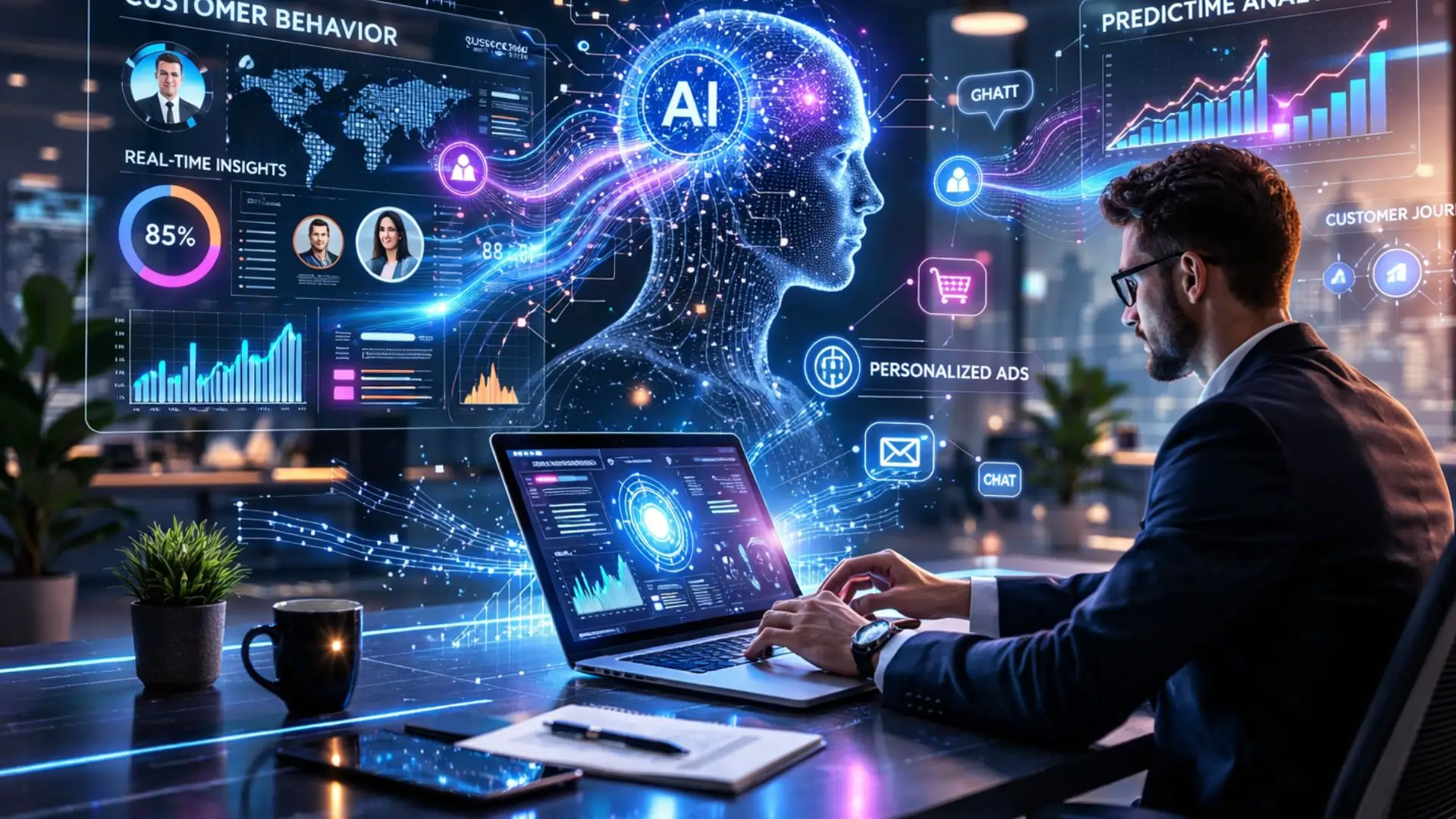
How AI Predicts Customer Intent in 2026?
Have you ever landed on a website and thought, “How did they know I needed this?”
You did not fill out a form. You barely searched. Yet the right product, the right message, and even the right offer appeared at the perfect moment.
It feels like mind-reading.
In 2026, it’s something more powerful, AI-driven predictive intelligence.
Artificial Intelligence is no longer just tracking clicks. It’s analyzing behavior patterns, predicting intent, understanding emotion, and shaping digital journeys in real time. And businesses that use it strategically are outperforming those that don’t.
Let’s break down how AI predicts custom.
Table of Contents
- AI Is Studying Behavior Patterns, Not Spying
- Predictive Analytics: Anticipating Customer Intent
- Hyper-Personalization Is Now Expected
- AI Chatbots: From Scripted Bots to Intelligent Assistants
- Emotional Intelligence in Digital Interaction
- Ethical AI: The Balance Between Intelligence and Privacy
- What This Means for Businesses in 2026
- The Winning Formula: Human Strategy + AI Intelligence
- So, Is AI Really Reading Minds?
- FAQ
AI Is Studying Behavior Patterns, Not Spying
There is a big misconception that AI watches individuals. In reality, AI studies aggregated behavior patterns across thousands or millions of users.
Modern machine learning systems analyze signals such as:
- Page visits and repeat visits
- Time spent on key sections
- Scroll depth and engagement points
- Cart additions and removals
- Search queries and refinements
- Device type and time of access
Individually, these signals mean little. Together, they reveal intent.
AI models continuously learn from this data. The more interactions they process, the more accurate their predictions become. It is not guesswork; it is statistical probability powered by pattern recognition.
Predictive Analytics: Anticipating Customer Intent
In 2026, marketing has shifted from reactive to predictive.
Instead of responding after a customer makes a decision, AI identifies decision signals in advance.
For example:
- Multiple visits to pricing pages indicate purchase consideration.
- Repeated feature comparisons suggest the evaluation stage.
- High engagement but no checkout signals hesitation.
AI systems then trigger actions such as:
- Personalized offers or discounts
- Retargeting ads with tailored messaging
- Automated follow-up emails
- Dynamic content adjustments
According to industry research, a significant majority of marketers now rely on AI to improve personalization strategies, proving predictive behavior modeling is no longer experimental. It’s operational.
The result?
Businesses reduce friction before it becomes abandonment.
Hyper-Personalization Is Now Expected
Generic marketing is fading fast. In 2026, customers expect brands to understand them and deliver relevant experiences instantly. AI makes that possible by analyzing behavior and adapting content in real time.
According to recent 2026 data, 88% of marketers say AI helps personalize customer experience, proving that AI-driven personalization is no longer optional. However, it is becoming the norm in modern marketing.
AI enables hyper-personalization by tailoring experiences such as:
- Personalized product recommendations
- Dynamic homepage banners
- Location-based offers
- Behavior-triggered popups
- Customized email sequences
AI Chatbots: From Scripted Bots to Intelligent Assistants
Chatbots have evolved dramatically.
Earlier bots followed rigid scripts. Today’s AI-powered assistants use advanced natural language processing (NLP) to understand context, tone, and intent.
Modern AI chat systems can:
- Interpret complex, multi-part questions
- Detect urgency or frustration in language
- Recommend solutions based on browsing history
- Route high-intent leads directly to sales
- Learn from past conversations
This reduces response time, increases satisfaction, and captures leads at peak interest moments
AI does not just answer questions; it accelerates decision-making.
Emotional Intelligence in Digital Interaction
One of the most advanced developments in 2026 is sentiment analysis.
AI systems now analyze emotional cues in:
- Chat interactions
- Product reviews
- On-site behavior patterns
- Abandoned sessions
For example, repeated page switching and long pauses before checkout may indicate uncertainty. Negative phrasing in chat may signal frustration.
AI responds with:
- Reassurance messaging
- Simplified guidance
- Limited-time incentives
- Escalation to human support
This combination of behavioral data and sentiment detection creates what feels like digital empathy.
And empathy drives trust.
Ethical AI: The Balance Between Intelligence and Privacy
With increased intelligence comes increased responsibility.
Consumers are more privacy-aware than ever. Responsible businesses prioritize transparency and ethical AI usage.
Best practices include:
- Clear data consent policies
- Anonymized behavioral tracking
- Secure data infrastructure
- Value-driven personalization
When customers understand how their data improves their experience, trust grows rather than declines.
Ethical AI is not just about compliance; it’s brand positioning.
What This Means for Businesses in 2026
AI-powered customer intelligence is now a strategic necessity.
Businesses leveraging predictive analytics and personalization are seeing measurable improvements in:
- Conversion rates
- Customer lifetime value
- Retention rates
- Marketing ROI
- Lead qualification accuracy
Meanwhile, companies relying on generic messaging face declining engagement and rising acquisition costs. And many of them are still struggling with the top AI challenges in marketing that prevent them from closing that gap. The competitive gap is widening, and AI is at the center of it.
The Winning Formula: Human Strategy + AI Intelligence
Despite all its capabilities, AI is not a replacement for human creativity or leadership.
AI excels at:
- Data processing
- Pattern detection
- Real-time automation
- Continuous optimization
Humans excel at:
- Storytelling
- Emotional connection
- Brand positioning
- Strategic decision-making
The brands dominating 2026 are those that combine human empathy with AI precision.
That’s where true “mind reading” begins.
So, Is AI Really Reading Minds?
Not literally.
But by analyzing behavior, predicting intent, and responding in real time, AI creates experiences that feel intuitive, almost instinctive.
The businesses thriving in 2026 are not louder. They are smarter. They remove friction before it appears. They anticipate needs before they are expressed. They respond before competitors react.
The real question is not whether AI can read your customers’ minds.
It’s whether your business is using it to understand them deeply enough.
Because in today’s digital landscape, intelligence is the new competitive advantage, and the ghost in the machine is already at work.
At Engage Coders, we help businesses build smarter digital experiences from AI-driven marketing strategies to high-converting websites. If you are ready to stop reacting and start anticipating, request a free consultation now.
Partner with our Digital Marketing Agency
Ask Engage Coders to create a comprehensive and inclusive digital marketing plan that takes your business to new heights.
Contact Us
FAQ
AI predicts customer behavior by analyzing data such as browsing history, search queries, time spent on pages, and purchase patterns. Machine learning models identify patterns and forecast future actions with high accuracy.
AI-driven personalization uses customer data and predictive analytics to deliver customized content, product recommendations, emails, and offers tailored to individual users in real time.
Yes, when implemented responsibly. Ethical AI systems use anonymized data, follow privacy regulations, and provide transparency about data usage to ensure customer trust.
AI improves conversion rates by identifying high-intent users, reducing friction in the buying journey, offering personalized incentives, and delivering relevant messaging at the right time.
Industries such as e-commerce, SaaS, fintech, healthcare, and digital marketing benefit significantly from AI personalization due to large customer data sets and online interactions.
Predictive analytics uses machine learning algorithms to analyze past customer data and forecast future actions, helping businesses anticipate needs and optimize marketing strategies.


