

How to Build a Competitive Intelligence Strategy from Scratch?
Competitive intelligence (CI) provides the insights needed to make smarter business decisions—anticipating customer needs, identifying fresh opportunities, or staying ahead of the competition.
Thrive, a marketing agency, is a great example of this.
I had a conversation with Aaron Whittaker, VP of Demand Generation and Marketing at Thrive, to learn how his team leverages CI.
Faced with a challenge—prospects opting for AI-powered marketing tools instead of traditional agencies—they turned to competitive intelligence to find a solution.
What is Competitive Intelligence?
Competitive intelligence (CI) is the process of transforming raw data about your competitors into valuable, actionable insights.
It empowers your business to make informed decisions, sharpen your strategy, and maintain a competitive edge in the market.
A well-structured competitive intelligence report helps answer three essential questions:
- Where are your competitors headed?
- Why and how are they making those moves?
- How can your business respond to stay ahead?
CI Operates on Two Key Levels:
- Tactical Intelligence: Focuses on short-term actions, like optimizing product launches, marketing campaigns, and sales tactics.
- Strategic Intelligence: Informs long-term planning—giving you a broader view of the market landscape and helping you decide where to invest your resources and how to differentiate your brand.
Competitive Intelligence vs. Market Research
Both competitive intelligence (CI) and market research are essential tools for making informed business decisions, but they serve different purposes and focus on different areas.
Competitive Intelligence is all about monitoring your competitors to uncover growth opportunities and anticipate shifts in the market.
The goal?
To gain a strategic edge and stay ahead in an ever-evolving competitive landscape.
In contrast, market research centers on understanding:
- Consumer behavior.
- Market conditions.
- Demand patterns.
- Industry growth trends.
It helps you analyze the current market environment and identify unmet needs you can address.
While CI fuels long-term strategy and competitive positioning, market research supports tactical decisions in areas like product development, customer experience, and marketing campaigns.
3 Key Components of a Competitive Intelligence Framework
A solid competitive intelligence (CI) framework revolves around three core components: Data, Analysis, and Activation. Together, they help you turn raw competitor information into strategic action.
1. Data: Collect the Right Information
The first step in any CI effort is gathering targeted, relevant data.
Start by exploring secondary sources to gain a broad understanding of your competitive landscape. This includes:
- Competitor websites.
- Help centers and support portals.
- Industry news and reports.
- Review platforms and job boards.
I spoke with Stanislav Khilobochenko, VP of Customer Services at Clario, who emphasized the importance of identifying reliable CI sources early in the process.
2. Analysis: Extract Actionable Insights
Once you’ve gathered your data, the next step is to analyze it to uncover patterns, pain points, and opportunities.
The key is cross-referencing multiple sources—such as customer reviews, sales call recordings, and competitor messaging—to gain a 360° view.
For example, let’s say you run a project management platform:
- Goal: Help your sales team close more deals.
- Insight: Customer reviews point out the lack of niche integrations; sales conversations confirm that this is a deal-breaker for some prospects.
- Decision: Prioritize new integrations on the product roadmap so sellers can overcome this objection and win more deals.
Without this kind of multi-source analysis, critical insights can go unnoticed.
3. Activation: Put Intelligence into Action
The final step is activating your insights—sharing them with the right people in the right format.
Options include:
- Battle cards for sales teams.
- Competitor profiles for product teams.
- Strategic briefs for leadership.
- Regular CI meetings to keep everyone aligned.
To dig deeper into this phase, I talked to Federico Jorge, founder of Stack Against, who builds SEO-friendly comparison pages for SaaS companies using competitive intel.
In one project, Federico helped a client uncover that a minor competitor had been acquired by a major company. Overnight, this competitor became a serious market threat, and the client used those insights to quickly adjust their positioning and marketing.
Phase 1: Goal Setting and Preparation
Before gathering any data, you need to lay the foundation for your CI process by clearly defining your purpose and mapping your competitive environment.
Define Why You Need Competitive Intelligence
Without a clear objective, you risk collecting information that adds no value. Setting a specific “why” ensures your efforts are focused and effective.
Ask yourself:
- Are you trying to enter a new market?
- Do you need to strengthen your brand positioning?
- Are you refining your product or pricing?
- Do you want to uncover differentiators?
Then, identify the questions you need answered and the stakeholders who’ll act on the insights.
Example:
You’re redesigning your software pricing.
- Poor Goal: “We need to know competitor pricing.”
- Good Goal: “Create a competitive pricing strategy.”
- Questions: What do our top three competitors charge for their enterprise plans? What value do they offer at each tier?
- Stakeholders: Product and sales teams.
Map Your Competitive Landscape
Once you’ve defined your goals, identify who you’re really up against.
- Direct Competitors: Companies offering the same product or service.
- Indirect Competitors: Companies offering alternatives or substitutes.
Use simple Google searches to begin. If you own a local bakery, search terms like:
- “Best wedding cakes near me”.
- “Custom cake shops in [City]”.
- “Birthday cake delivery [City]”.
This will help you build a relevant list of businesses to monitor.
Phase 2: Collect Data Systematically in Stages
Once you have locked in your list of competitors, it’s time to collect data. Here are some of the most popular data sources you can use:
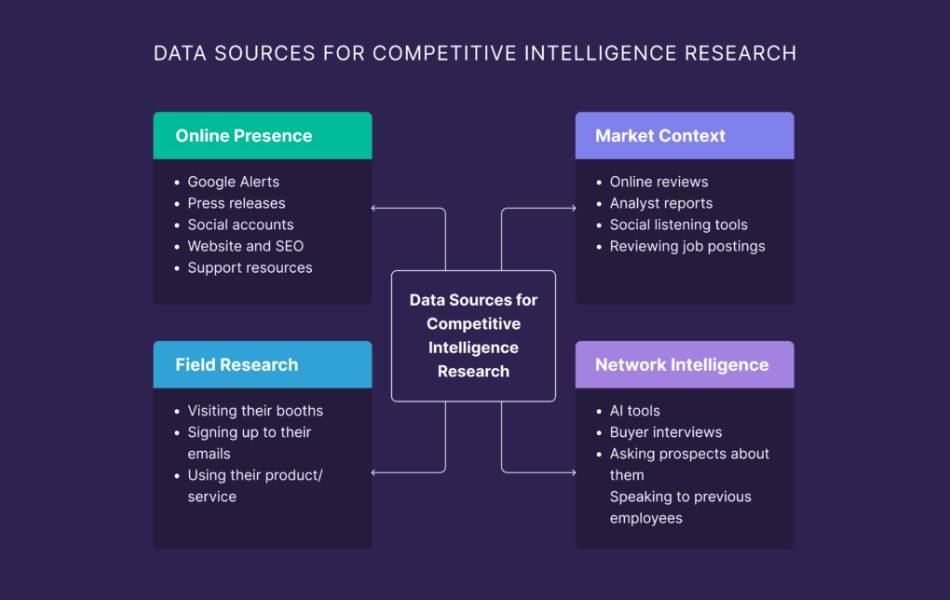
But random data won’t cut it.
I chatted with experts, and they recommend collecting data systematically in four stages.
Stage 1: Analyze Online Presence
Start with the easiest layer—your competitors’ online presence.
You can use tools to see exactly what’s working for your competitors online, from their top pages to their content strategy.
Edward White, Beehiiv’s Head of Growth, shared how he used Semrush to perform an SEO competitive analysis:
From 0 to 1 Million Clicks/Year: How Beehiiv Did It—and How You Can Too
In just 24 months, Beehiiv’s website skyrocketed from nearly zero to over 1 million clicks per year.
Curious how to run a similar analysis for your own business?
Here’s how to get started using Semrush’s Domain Overview tool.
Step 1: Choose a Competitor
Pick a key competitor in your space. For this example, we’ll use Fernish, a furniture rental company.
Step 2: Head to Domain Overview in Semrush
Type Fernish’s domain into the Domain Overview tool.
What you’ll immediately see:
- Authority Score: 31.
- Backlinks: Nearly 12,000.
- Traffic Trends: Organic and paid traffic over the past two years.
- Top Countries: Most traffic comes from the U.S., followed by Indonesia and Canada.
Already, that’s a treasure trove of insights. But to outsmart competitors, you need to dig deeper, beyond just surface-level metrics.
We’ll uncover things like:
- Which keywords are driving their traffic.
- How their backlink profile is structured.
- What content performs best.
- Where you can gain an edge.
Stage 2: Understand the Market Context
To outpace your competitors, it’s crucial to know how the market perceives them. Use the following tools and sources to gather that intel:
- Social listening tools: Track brand mentions and run social media competitor analyses.
- Analyst reports: Gain perspective on how competitors are positioned within the broader industry.
- Review platforms: Discover customer pain points, satisfaction levels, and unmet needs.
- Annual reports (for public companies): Get a detailed look into operations, financial health, and strategic priorities.
Aaron Whittaker from Thrive Internet Marketing Agency shared how going beyond surface-level data can uncover game-changing insights.
“Our breakthrough came when we started mapping less obvious patterns. For example, we tracked a competitor’s job postings over six months. It revealed they were quietly building an AI team. This gave us early insight into their future direction.”
Stage 3: Conduct Field Research
External analysis only goes so far. Field research lets you step into your competitors’ shoes and uncover real user experiences.
- Sign up for free trials.
- Buy their products or services.
- Map their entire marketing and sales funnel.
Pay close attention to:
- Onboarding processes.
- Sales messaging.
- Customer support interactions.
- Overall user experience.
These hands-on insights often reveal opportunities to differentiate and improve your own offerings.
Stage 4: Gather Network Intelligence
Tap into the knowledge held by buyers, sales teams, vendors, and even former employees.
- Analyze win/loss reports and sales calls to learn who you’re losing to—and why.
- Interview customers who chose a competitor to hear their uncensored feedback.
Sam Niro, Senior Manager of Competitive Intelligence at Talkdesk, shared her go-to strategy:
“I review press release feeds, social media, and industry media outlets to stay current with industry narratives. But my ‘secret weapon’ is buyer interviews. They show the customer’s unfiltered voice. Use them to validate your differentiators, pricing, and sales process.”
Pro Tip: Always consider historical context when benchmarking.
If your competitor is five years ahead, don’t compare their current metrics to your startup phase. Instead, find data from when they were at your stage—that’s a far more accurate and actionable comparison.
Step 2: Data Analysis Techniques
Here are three powerful methods to analyze your competitive intelligence:
1. Trend Analysis
Identify patterns over time in your competitors’ behaviors, such as:
- Product launches.
- Pricing adjustments.
- Brand repositioning.
- Marketing themes.
Example:
You run a meal-delivery business. Trend analysis reveals:
- Two competitors recently introduced plant-based meal options.
- Five others launched weekend-only delivery service.
- Many are emphasizing “locally sourced” in their messaging.
Insight: There’s growing demand for plant-based meals, weekend deliveries, and local ingredients. Use this information to enhance your offerings and stay relevant.
2. Strategic Group Analysis
Rather than analyzing competitors individually, group them by shared traits such as:
- Business model.
- Target audience.
- Pricing strategy.
- Distribution channels.
Then assess:
- What drives success in each group?
- Where are they vulnerable?
- Where do you fit in?
Example:
For a brand like Starbucks, you might compare:
- Premium café chains.
- Fast-food coffee providers.
- Local artisan coffee shops.
This broader view helps you spot strategic white space—areas where you can stand out or avoid head-to-head competition.
3. Gap and Opportunity Identification
As you analyze the data, look for:
- Customer pain points competitors aren’t solving.
- Features or services that others are missing.
- Under-served audiences.
- Channels or regions your competitors aren’t targeting.
These gaps present low-competition opportunities for innovation and differentiation.
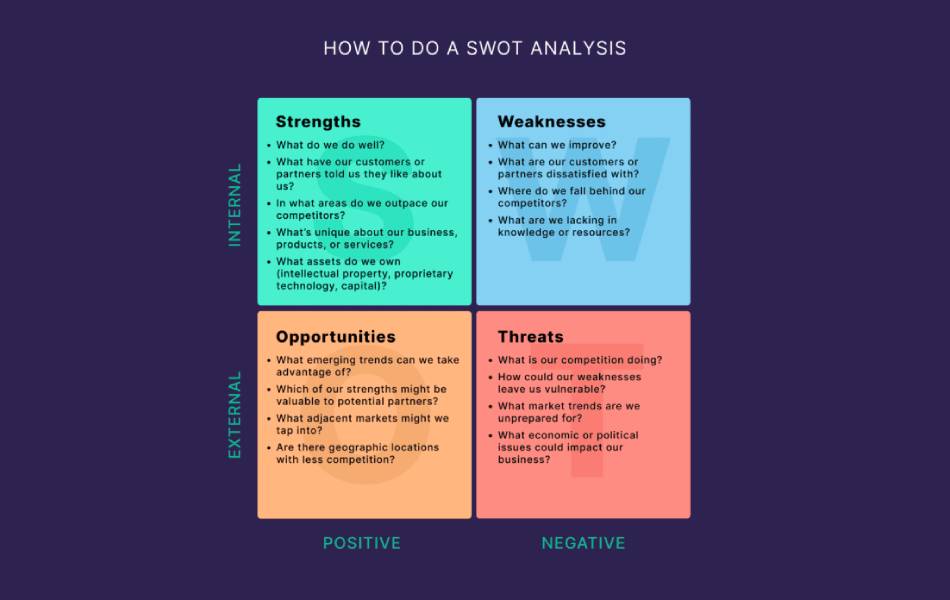
SWOT Analysis
SWOT analysis adds more depth by examining a company’s:
- Strengths: What they do well.
- Weaknesses: Where they struggle.
- Opportunities: External factors they could use to grow.
- Threats: External factors that could harm them.
Here are some questions to consider for applying this method (you can perform this on your own business/website and on your competitors):
The real value comes from connecting these analyses to action.
This phase should tell you where competitors are today and where they’re heading.
Phase 4: Activation and Implementation
In the final phase of your competitive intelligence (CI) process, it’s time to turn insights into action. This means creating practical resources for internal teams and setting a plan to keep your intelligence up to date.
Turn Insights into Actionable Deliverables
To ensure your findings drive real impact, package them into clear, accessible formats for key stakeholders. Here are some effective deliverables to consider:
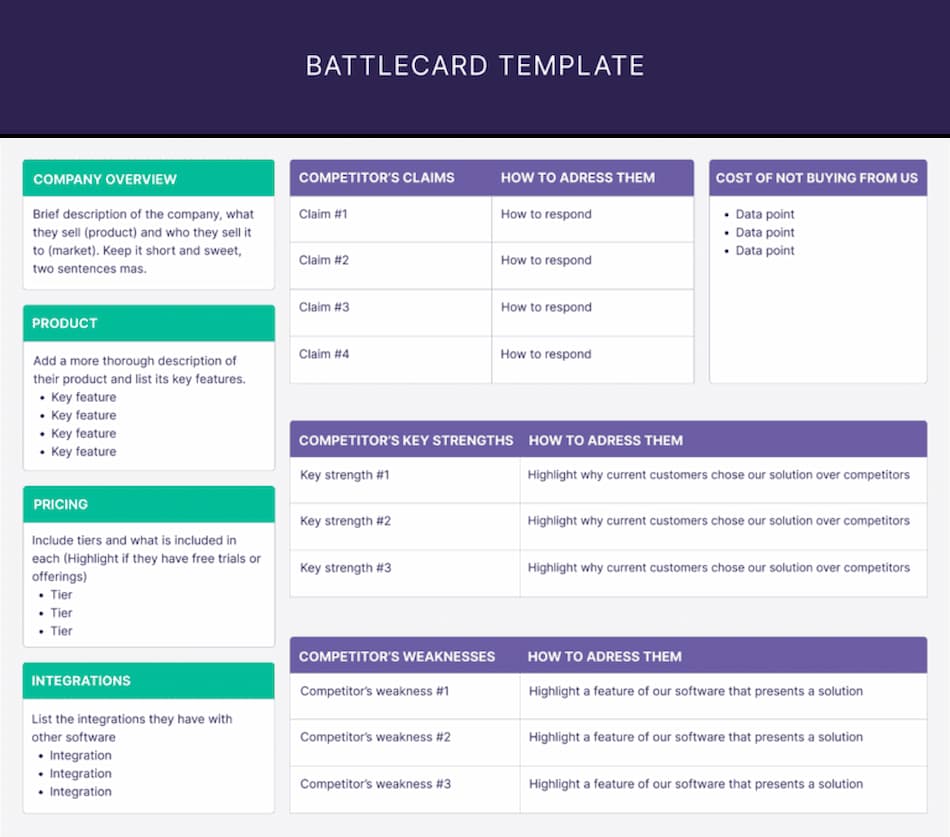
Battle Cards
Concise, visual one-pagers that highlight how your offering stands apart from each competitor.
Use these to:
- Equip your sales team with talking points to address objections.
- Highlight strengths and key differentiators.
- Provide at-a-glance comparisons with competitor products or services.
Centralized Hub
Document all of your CI findings on platforms like Notion or Confluence.
Categorize the resources by teams and make this hub searchable for easy access.
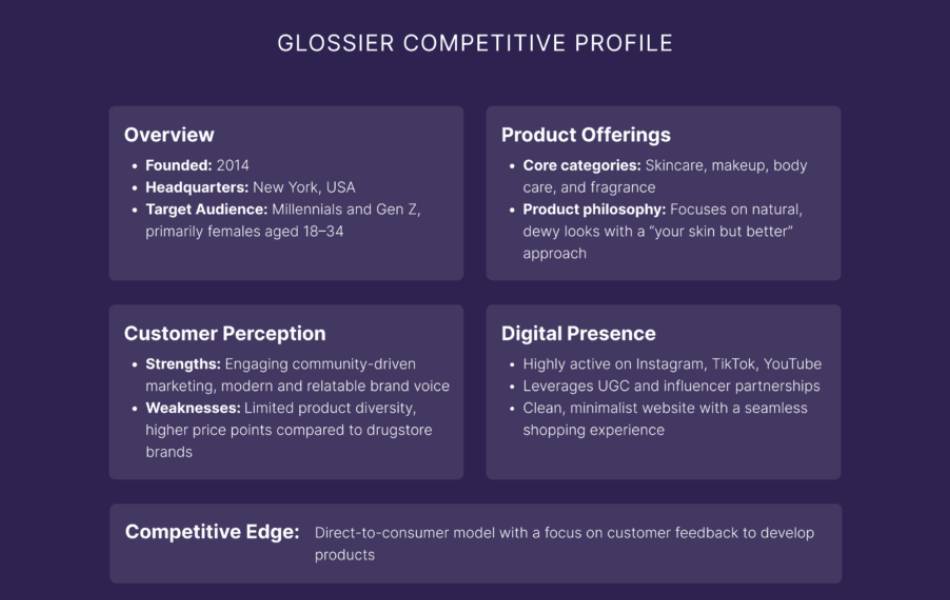
Competitor Profiles
Create in-depth profiles analyzing a competitor from all aspects.
Marketing and product teams can use them to plan their campaigns and plan the roadmap.
Here’s an example of the beauty brand Glossier’s competitive profile:
Implement a Distribution Plan
Set up a dedicated Slack channel to share real-time competitive insights, enabling your team to quickly respond to competitor moves and plan strategically.
Other effective ways to distribute your research include:
- Weekly updates featuring competitor campaigns and social media highlights.
- Monthly emails summarizing key changes in pricing, features, and market activity.
- Quarterly cross-department meetings to review critical intelligence and reassess competitor priorities.
Additionally, set up alerts for major events such as acquisitions, leadership changes, and other significant developments.
Monitor and Update Your Strategy
Markets and competitors are always evolving — competitive intelligence isn’t a one-time task.
Establish ongoing workflows to continuously monitor and refresh your insights.
Schedule regular check-ins with your sales, marketing, and customer success teams to gather timely feedback and keep your intel up to date.
Key Applications of Competitive Intelligence
- Sales Enablement: Sales teams leverage CI to analyze competitors’ sales strategies and buyer journeys. In fact, 78% of CI professionals convert these insights into battle cards. This empowers sales reps to craft compelling pitches, handle objections with confidence, and showcase relevant social proof. Plus, it clearly highlights your key differentiators against each competitor.
- Product Development: Competitive intelligence helps product teams track competitor launches and gather customer feedback to understand user expectations. These insights guide prioritization of new features that keep you ahead of the curve. It also supports roadmap planning focused on addressing unmet needs. As Aaron Whittaker from Thrive shared, “CI revealed a market gap: while competitors added complex AI features, customers wanted simple, human-readable reports. This led us to create streamlined dashboards that became a major selling point.”
- Market Positioning and Strategy: CI research uncovers how competitors position themselves, who they target, and their marketing approaches. This analysis lets you differentiate your messaging to better connect with your audience and identify underserved markets ripe for opportunity.
- Pricing and Revenue Optimization: Pricing intelligence is essential for crafting an effective pricing strategy. By gathering data on competitors’ pricing models and comparing it against perceived value and customer loyalty, you can optimize your pricing structure to boost revenue and market share.
Use Competitive Intelligence to Stay Ahead
Competitive intelligence transforms information about your rivals into strategic actions that drive business growth.
As you develop your CI research process, remember these three key principles:
- Define clear goals before gathering data.
- Prioritize actionable insights over random information.
- Share findings through relevant, easy-to-access formats.
The true power of competitive intelligence lies in focusing on the right competitors.
Before you begin your research, conduct a thorough market analysis to identify the brands that truly influence your industry.
Explore our comprehensive guide to learn how to perform effective market analysis and build a solid foundation for your competitive intelligence efforts.
Partner with our Digital Marketing Agency
Ask Engage Coders to create a comprehensive and inclusive digital marketing plan that takes your business to new heights.
If you’re looking for expert support, Engage Coders offers specialized competitive intelligence and digital marketing services across the USA to help businesses make smarter, data-driven decisions and stay ahead in their markets. Contact us today!


