
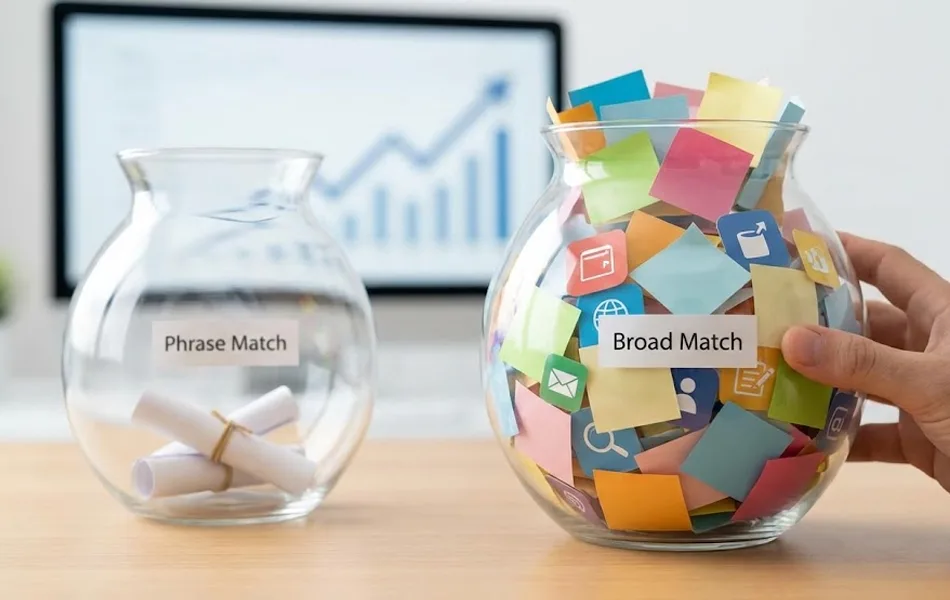
Why Phrase Match is Losing Ground to Broad Match in Google Ads
Broad match vs phrase match—once a measured debate of precision versus reach—is now increasingly tilting in favor of broad. What was once a tactical choice in a media buyer’s playbook has evolved into a bigger question about cost, automation, and the future of Google’s algorithmic ecosystem.
And while arguments around control and relevance still matter, they’re no longer the biggest consideration. The defining factor in this conversation? Cost—and how Google’s automation is driving that cost in very specific ways.
Let’s take a closer look at how Google Ads match types in 2025 are changing the dynamics of search advertising, and why many advertisers are beginning to reassess their approach.
Table of Contents
Google’s Long Game: The Broad Match Push
For the better part of a decade, Google has been quietly—but consistently—nudging advertisers toward broad match. Whether through auto-apply recommendations, machine learning updates, or subtle phrasing in their help documents, the direction has been clear.
It’s no longer just about matching keywords to queries. Google’s pitch hinges on signals—user location, past search behavior, device, time of day, landing page context, and even ad group keyword clusters. And when combined with Smart Bidding with broad match, these signals supposedly lead to better performance outcomes.
The trend is visible across industries. Broad match isn’t just an option anymore—it’s rapidly becoming the foundation of a modern Google Ads keyword strategy.
And while the technical capabilities are undeniably impressive, there’s a deeper financial shift driving this change.
The Real Issue: Phrase Match Is Getting More Expensive
Let’s get one thing out of the way: broad match vs phrase match isn’t just about query control anymore. In fact, that debate has lost ground to a far more tangible concern—cost.
Over the past couple of years, advertisers have observed an undeniable rise in phrase match CPC trends. The increase hasn’t been gentle.
While many advertisers used to stick with phrase match for its cleaner query matching and reduced noise, the cost equation is no longer in its favor. Despite a well-structured account with granular targeting, Google Ads match types in 2025 show that phrase match is often more expensive and less effective in comparison.
Google’s auction system, influenced by quality score, reserve prices, and ad rank, does not favor phrase match when compared to broad.
The CPC Gap Between Match Types
When comparing match types side by side, the difference is no longer subtle. From mid-2023 to mid-2025, broad match Google Ads performance has remained relatively stable in terms of cost—rising by about 29%. Phrase match CPCs, however, have surged by 43% during the same time frame.
This disproportionate growth has flipped conventional wisdom. Many campaigns that previously relied on phrase are now overpaying for clicks that broad match can often deliver at a lower cost.
And with Google’s de-prioritization of large keyword lists—thanks to the LSV (Low Search Volume) status—scaling phrase match with high intent terms is increasingly impractical.
Add to this the rise of close variants, which allow both exact and phrase match to act almost as loosely as broad match (but without the benefits of Smart Bidding signals), and it’s clear that phrase match is no longer what it used to be.
All signs point to broad match not only winning in cost but in consistency and adaptability as well.
Considerations for Lead Gen Advertisers
The picture isn’t entirely black and white. If you’re in ecommerce, where revenue signals are high-frequency and conversion cycles short, broad match Google Ads performance is easier to trust.
But in lead generation? Things are more complex.
Advertisers in this space are rightfully cautious. Broad match can cast too wide a net, leading to form submissions or phone calls that don’t convert into real customers. That’s where EC4L Google Ads lead generation comes into play.
Enhanced Conversions for Leads (EC4L) allows advertisers to feed real conversion data back to Google—even post-form fill. This helps the algorithm learn which clicks lead to actual customers, not just leads.
Even if you don’t meet the threshold of 30 conversions in 30 days, you can still enrich your signal quality. By integrating call tracking platforms like CallRail or adding intermediate funnel steps, you increase your data volume and improve your targeting.
In one lead gen case study, shifting from phrase to broad and layering in EC4L with Smart Bidding with broad match led to fewer but far higher quality conversions—driving real revenue, not just MQLs.
Is It Time to Pause Phrase Match?
It’s not an exaggeration to say that Google Ads match types in 2025 are evolving faster than most advertisers expected.
One broad match keyword today has the potential to replace ten carefully constructed phrase match terms. And with the algorithm only getting stronger, maintaining control via phrase match may no longer be the cost-effective option.
While some might argue that exact match is still worth holding onto, phrase match finds itself in an awkward middle ground—too loose for control, too rigid for Google’s automation, and too costly to justify.
With phrase match CPC trends climbing and close variant quality declining, it might be time to reconsider whether phrase match still earns its place in your ad strategy.
Final Thoughts
If the last few years have taught us anything, it’s that automation is not optional—it’s inevitable.
The conversation around broad match vs phrase match is no longer about personal preference or comfort with query types. It’s about understanding how Google is optimizing performance at scale and how that fits into your overall Google Ads keyword strategy.
Partner with our Digital Marketing Agency
Ask Engage Coders to create a comprehensive and inclusive digital marketing plan that takes your business to new heights.
Contact Us
Advertisers who embrace Smart Bidding with broad match, leverage signal-enriching tools like EC4L Google Ads lead generation, and adapt to changing cost dynamics will likely find themselves ahead of the curve.
Ready to Outperform Your Competitors? Let Engage Coders craft data-driven PPC campaigns that turn ad spend into real revenue.
Let’s build smarter, faster, and stronger—starting today.


![What Are Good Google Ads Benchmarks In 2025? [STUDY]](https://www.engagecoders.com/wp-content/uploads/2025/07/image1-5-450x350.png)


