
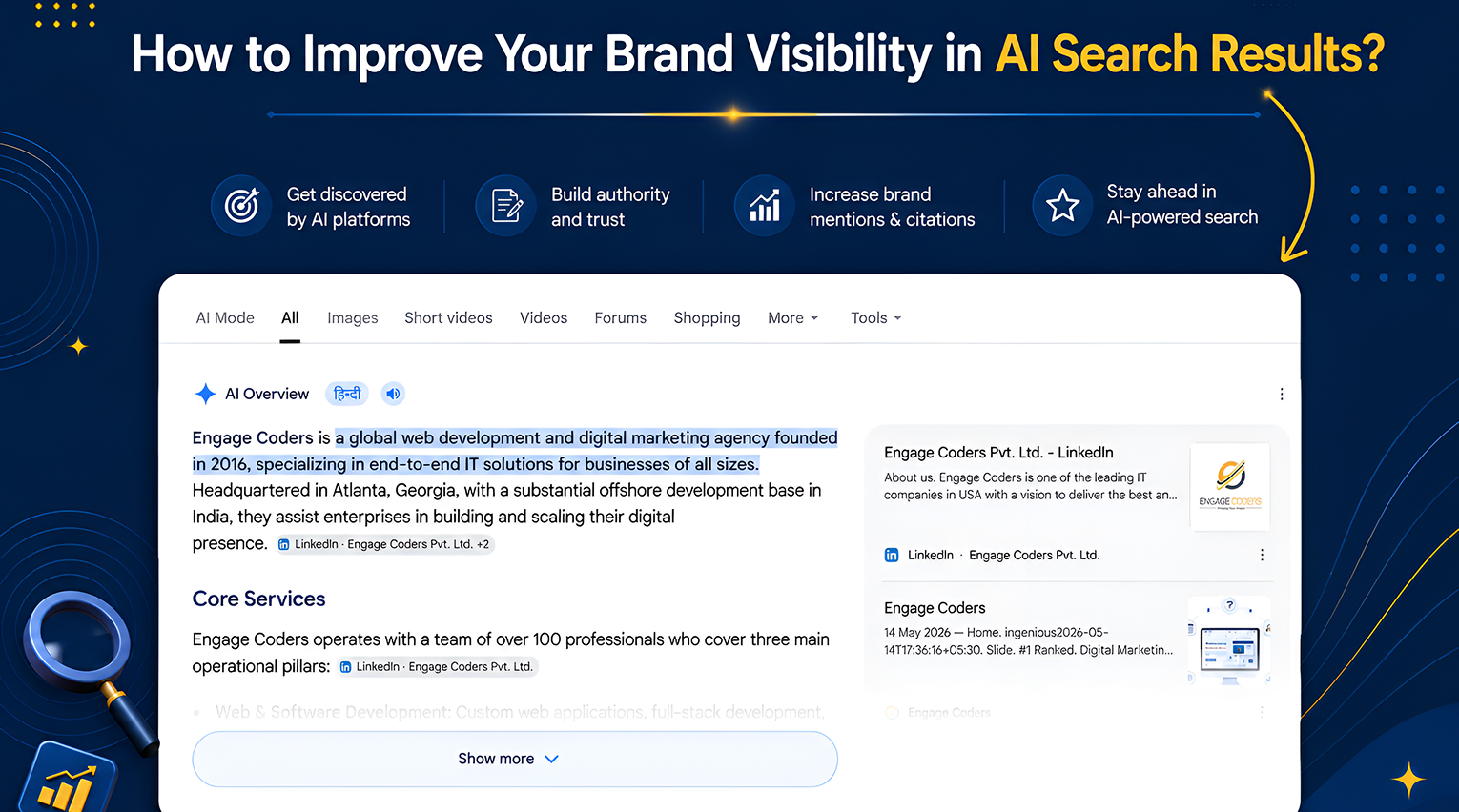
How to Improve My Brand Visibility in AI Search Results?
When someone asks ChatGPT or Perplexity to recommend a digital marketing agency, a product, or a service, they get a direct answer with specific brand names. If your brand is not in that answer, you have lost the lead before your website was ever visited. This is not a future problem. AI search tools like Google AI Overviews, ChatGPT, and Perplexity are already shaping buying decisions right now, and most businesses are not optimized for them.
This guide covers exactly what you need to do to get your brand cited, recommended, and trusted in AI search results:
Table of Contents
What is AI Search Visibility and Why Does It Matter in 2026?
Understanding the New Search Landscape: SEO, AEO, and GEO
How AI Systems Decide Which Brands to Cite
7 Strategies to Improve Your Brand Visibility in AI Search Results
1. Build a Clear Brand Entity Foundation
2. Create Answer-First Content That AI Can Extract and Cite
3. Implement Schema Markup Across Your Key Pages
4. Build Third-Party Authority Through Earned Mentions and Backlinks
5. Actively Manage Your Brand’s Reputation Across Review and Community Platforms
6. Build Topical Authority Through Consistent, Depth-First Content Publishing
7. Keep Content Current and Signal Freshness Visibly
How to Measure Your Brand’s AI Search Visibility
What Hurts Your AI Visibility (And What to Stop Doing)
How Engage Coders Helps You Get Found in AI Search
- FAQs
What is AI Search Visibility and Why Does It Matter in 2026?
AI search visibility refers to how frequently and favorably your brand appears in AI-generated answers across platforms like Google AI Overviews, ChatGPT, Perplexity, Microsoft Copilot, and Gemini. Unlike a traditional search ranking, which places your page at a numbered position in a results list, AI visibility is about whether the model cites you, mentions you, or recommends you when a user asks a question relevant to your business. That distinction matters more than it might seem.
Buyer behavior is already shifting toward these platforms at a measurable pace. According to HubSpot’s 2025 AI Trends for Marketers report, 31% of Gen Z users now start queries directly in AI tools rather than search engines. Google AI Overviews appeared in 18% of all U.S. desktop searches as of early 2025, and that figure has continued to climb. For businesses, the more important number comes from Semrush research, which found that visitors arriving through AI search convert at 4.4 times the rate of traditional organic visitors.
That conversion gap exists because of how AI recommendations work. A buyer who receives your brand name as part of an AI-generated answer has already had it validated by the model before they visit your site. They arrive with a level of trust that cold organic traffic simply does not carry. For any business serious about growth in 2026, appearing in those AI-generated answers is not a secondary SEO task. It is one of the highest-value visibility opportunities available right now.
Understanding the New Search Landscape: SEO, AEO, and GEO
These three terms are often used interchangeably, but they describe distinct disciplines that serve different purposes within your overall visibility strategy. Understanding the difference between them determines where you invest your effort and why.
-
-
Traditional SEO
-
Traditional SEO focuses on ranking your web pages in search engine results through keyword optimization, backlinks, technical site health, and content quality. It remains the foundation that every other visibility discipline is built on. Without it, neither AEO nor GEO will perform consistently.
-
-
Answer Engine Optimization (AEO)
-
Answer Engine Optimization (AEO) is the practice of structuring your content so that AI-powered answer features, specifically Google AI Overviews, Perplexity, and Bing Copilot, can extract your information and present it as a direct response to a user’s query. This typically involves writing content that answers specific questions clearly from the first sentence, supported by FAQ schema markup and a definition-first structure.
-
-
Generative Engine Optimization (GEO)
-
Generative Engine Optimization (GEO) goes beyond ranking and answer extraction to focus on earning citations from large language models directly. GEO is about building the kind of authoritative, structured, and widely referenced digital presence that AI systems draw on when generating responses from scratch. Some recent research also confirmed that content structure, information density, and citation-worthiness are stronger predictors of AI citation than keyword optimization alone.
In 2026, none of these three works in isolation. Strong SEO gets your content indexed and trusted. AEO gets it extracted into direct answers. GEO gets your brand cited and recommended. A competitive visibility strategy needs all three moving together.
How AI Systems Decide Which Brands to Cite
AI models do not rank brands the way Google ranks pages. They evaluate a broader set of signals to determine whether your brand is trustworthy, authoritative, and consistently described enough to include in a generated response. Understanding those signals is what separates a strategy that produces AI citations from one that produces nothing.
A Yext study of 6.8 million AI citations found that 86% come from sources that brands of any size can directly control, specifically first-party websites at 44% and business directory listings at 42%. That means AI visibility is not a competitive advantage reserved for enterprise brands with large budgets. Any business that builds a clear, consistent, and well-structured digital presence is competing on a level playing field for citation share.
The specific signals that drive AI citation, drawn from current GEO research and platform behavior analysis, are as follows:
- Brand entity clarity: How clearly and consistently your brand is defined across your own website, third-party directories, and the wider web. If your business name, description, services, and location data contradict each other across platforms, AI models will avoid citing you rather than risk surfacing inaccurate information.
- Cross-platform presence: A Mersel AI study found that brands present on four or more platforms are 2.8 times more likely to appear in ChatGPT recommendations than brands with a limited digital footprint.
- Content authority and information density: AI systems are trained to favor content that provides specific, verifiable, and statistically supported information. Research from Carnegie Mellon University’s GEO framework (KDD 2024) confirmed that information density, measured as named entities and statistics per paragraph, is a stronger citation signal than keyword density.
- Third-party mentions and sentiment: An Ahrefs study found that brand web mentions carry the strongest measurable correlation with AI Overview visibility at 0.664. The more credibly your brand is discussed across independent sources, the more confidently AI systems reference it.
- Structured data implementation: According to Mersel AI’s research, schema markup improves LLM discoverability by up to 67% because it gives AI systems machine-readable context about who you are, what you offer, and which market you serve, removing the ambiguity that causes brands to be omitted.
7 Strategies to Improve Your Brand Visibility in AI Search Results
1. Build a Clear Brand Entity Foundation
AI models need to be able to identify your brand as a distinct, verifiable entity before they will confidently recommend it. This starts with what GEO practitioners call entity clarity, ensuring that everything AI systems can find about your brand is consistent, accurate, and structured.
In practical terms, this means creating a dedicated brand page on your website that clearly describes what your company does, who it serves, your key differentiators, your founding date, your location, and your core service categories. Use Schema.org Organization markup to make this information machine-readable. Claim and fully optimize your Google Business Profile with accurate NAP (Name, Address, Phone) data. Ensure that the same information appears consistently across every directory where your brand is listed, including Yelp, Clutch, G2, LinkedIn, and any industry-specific platforms relevant to your niche. Inconsistent data across platforms confuses AI systems and reduces citation confidence.
2. Create Answer-First Content That AI Can Extract and Cite
The structure of your content directly determines whether AI systems can use it. Models retrieve information differently from how a human reader browses a page. They look for clear, direct answers early in the content, well-labeled sections with descriptive headings, and specific, verifiable information that can be cited with confidence.
According to research from Frase.io’s GEO guide, content that performs best for AI citation follows these structural principles:
- Place the direct answer to the main query within the first 40 to 60 words of the page or section
- Maintain a fact density of at least one statistic or verifiable data point every 150 to 200 words
- Use descriptive, question-based headings so AI systems can match your content to specific queries
- Include a FAQ section with concise, authoritative answers for the most common questions your audience asks
Different AI platforms have different content preferences. Jasper’s GEO guide notes that ChatGPT often lifts structured formats like bullet points and FAQs verbatim; Perplexity prioritizes authoritative sources and original data with citations; Google AI Overviews favor FAQ and HowTo schema alongside short definitions; and Claude responds well to longer, coherent passages with clear reasoning and supporting evidence. Writing content that covers multiple structural formats within a single piece gives you the best chance of being cited across all major platforms.
3. Implement Schema Markup Across Your Key Pages
Structured data is the bridge between your content and the AI systems that reference it. The most advanced AI search systems rely on knowledge graphs to connect entities, their properties, and their relationships. Schema markup feeds directly into these graphs and reduces the chance of AI systems misrepresenting or omitting your brand because of ambiguous information.
The schema types most relevant for AI visibility in 2026 are:
- Organization schema on your homepage and about page, including your name, logo, founding date, contact information, and social profiles
- FAQPage schema on blog posts and service pages where you answer common customer questions
- HowTo schema on instructional content and guides
- Article schema with named author markup and publication dates on all blog content
- LocalBusiness schema if your business serves a geographic market
The Schema.org documentation is the authoritative reference for implementation. Google’s Rich Results Test lets you verify that your markup is correctly implemented and readable by search systems.
4. Build Third-Party Authority Through Earned Mentions and Backlinks
AI systems do not only look at what your website says about itself. They look at what the rest of the internet says about your brand, and they weigh third-party mentions from authoritative, independent sources very heavily. This is where traditional digital PR and link-building intersect directly with AI visibility.
- The goal is to earn mentions and citations from credible sources across the web: industry publications, recognized media outlets, authoritative blogs, and community platforms that AI systems frequently reference.
- Every time an independent source references your brand in a meaningful context, it contributes to the model’s understanding that your brand is a recognized and trustworthy player in your space.
Practically, this means investing in content that earns citations naturally. Original research, industry surveys, proprietary data studies, and detailed case studies become citation magnets because other writers need something concrete to reference. A brand that publishes its own research creates a compounding citation network that benefits every piece of content on its domain over time.
5. Actively Manage Your Brand’s Reputation Across Review and Community Platforms
AI systems do not just evaluate what your website says about you. They evaluate the broader sentiment surrounding your brand, including reviews, forum discussions, and community mentions. Ansira’s research from The Channel Effect 2026 made this point clearly: every answer engine except Google prioritizes what others say about a brand over what the brand says about itself.
This means your Google Reviews, Trustpilot ratings, G2 reviews, LinkedIn presence, and contributions to platforms like Reddit and Quora all feed into how AI systems characterize and recommend your brand.
Negative sentiment on publicly crawled platforms can result in a brand being mentioned unfavorably, or omitted entirely to avoid surfacing a controversial recommendation.
- A practical approach to this includes responding promptly and professionally to all reviews, encouraging satisfied clients to leave detailed reviews on platforms AI systems crawl frequently, and participating meaningfully in industry forums and community discussions where your expertise is relevant.
- The key word is volume and recency. AI platforms weight fresh reviews more heavily than older ones, so maintaining a consistent flow of new feedback is more effective than a single burst of reviews followed by months of silence.
6. Build Topical Authority Through Consistent, Depth-First Content Publishing
AI systems favor brands that demonstrate comprehensive knowledge of a specific subject area over brands that publish broadly across many unrelated topics. This principle, called topical authority, means that a digital marketing agency consistently publishing deep, well-researched content on SEO, content strategy, and paid advertising will be cited far more reliably on those topics than a general business blog that occasionally covers marketing.
- Building topical authority in 2026 means publishing content that covers your subject area thoroughly rather than broadly.
- For each core service or topic you want to be cited for, develop a content cluster: a comprehensive pillar piece supported by more specific supporting articles that each answer a distinct question within the broader topic.
- This architecture signals to both traditional search engines and AI systems that your brand has genuine depth of knowledge in the areas that matter to your audience.
According to Enrich Labs’ GEO guide, the brands building citation authority in 2026 will be the brands AI systems default to citing in 2027 and beyond.
Citation authority compounds over time in the same way domain authority does in traditional SEO. Starting now gives you a first-mover advantage in most industries.
7. Keep Content Current and Signal Freshness Visibly
Content that has not been updated in twelve months or more is increasingly unlikely to be retrieved as a trusted source in AI-generated answers, particularly on topics that move quickly. HubSpot’s AI search visibility guide makes a specific point about this: AI systems can detect substantive content changes and weight them accordingly. Simply changing a publication date without revising actual content does not register as meaningful freshness.
- Keeping content current means revisiting your highest-traffic posts at least every six months to update statistics, replace outdated references, revise recommendations based on current conditions, and add a “What Has Changed” or “2026 Update” section where relevant.
- Display a visible “Last Updated” date near the top of each page so both readers and AI crawlers can immediately identify the content as maintained.
- Replace vague temporal claims like “recently” with specific, dated references such as “as of Q1 2026” because specificity signals currency to AI retrieval systems.
How to Measure Your Brand’s AI Search Visibility
Measuring AI visibility requires different tools and metrics than traditional SEO. Search Console does not provide dedicated reporting for AI Overviews performance, and most traditional rank trackers do not capture AI citation data. The metrics that matter for AI visibility are:
Mentions refer to how frequently your brand appears in AI-generated responses tied to your key topics. Citations refer to whether those responses link back to your owned content or simply describe you in passing. Sentiment refers to whether your brand is characterized positively, neutrally, or negatively in AI responses. Share of voice refers to how often your brand appears relative to competitors when the same queries are submitted across AI platforms.
Tools currently tracking these signals include Surfer SEO’s AI Tracker, which monitors brand visibility across AI chat platforms, and HubSpot’s AEO tool, which provides unified visibility scores across ChatGPT, Gemini, and Perplexity. Manually auditing your AI visibility by submitting consistent test prompts to ChatGPT, Perplexity, and Google AI Overviews on a monthly basis also gives you a direct view of how your brand is being characterized and whether your optimization efforts are producing results.
What Hurts Your AI Visibility (And What to Stop Doing)
Several SEO practices that were once standard now actively work against AI visibility:
- Publishing thin or repetitive content: This signals to AI systems that your site exists to fill space, not answer questions. Recycled posts and surface-level articles dilute topical authority rather than build it.
- Keyword stuffing: It no longer signals relevance. AI search reads naturally, and unnatural keyword repetition is treated as a quality problem, not an optimization signal.
- Anonymous or unattributed content: Reports suggest that this type of content is increasingly penalized in AI citation. Enrich Labs research identifies generic “content team” bylines as a GEO penalty. Every published piece needs a named, credentialed author.
- Ignoring your off-site presence: If you only optimize your website or focus only on on-page, it can leave a major gap. AI systems cross-reference your brand across independent platforms. A brand that only appears on its own site is treated as less credible than one with consistent presence elsewhere.
- Leaving negative reviews unanswered: This is a direct visibility risk for any brand. AI systems incorporate that sentiment when characterizing your brand in recommendations.
Ready to Improve Your Brand Visibility in AI Search?
Our team helps businesses build stronger AI search presence through SEO strategy, content optimization, entity foundation work, and visibility improvements designed for modern search.
Get A Free Quote Now
How Engage Coders Helps You Get Found in AI Search
Improving brand visibility in AI search requires technical work, content strategy, reputation management, and consistent monitoring, all working toward the same goal. Missing any one of them limits the results of the others.
We have spent years managing SEO and digital presence for businesses across industries. As AI search has become central to how buyers make decisions, we have built entity foundation work, structured data, AI-optimized content architecture, and reputation monitoring into every client program we run. Every strategy starts with your business specifically, not a generic template applied across accounts. Reach out to Engage Coders for an honest assessment of where your brand stands in AI search today.
FAQs
AI search visibility refers to how often your brand appears, gets cited, or gets recommended in AI-powered search tools like ChatGPT, Google AI Overviews, Perplexity, and Gemini.
Brands appear by building authority through quality content, strong SEO foundations, structured data, consistent business information, and trusted mentions across the web.
AI search tools increasingly influence buying decisions. Strong visibility helps businesses improve discoverability, build trust, and attract higher-intent customers.
Yes. Technical SEO, content optimization, schema markup, and topical authority help AI systems better understand and reference your business.
AI systems evaluate factors like content quality, credibility, authority signals, brand mentions, structured information, and consistency across digital platforms.
Thin content, outdated information, keyword stuffing, weak brand authority, inconsistent business details, and poor online reputation can reduce AI visibility.
Businesses can improve visibility by creating helpful content, strengthening SEO, building brand authority, maintaining accurate business information, and optimizing for AI search systems.


![Marketers Using AI Publish 42% More Content [+ New Research Report]](https://www.engagecoders.com/wp-content/uploads/2025/07/Marketers-450x350.png)
