

GenZ Take on Content Marketing ROI in 2026: Beyond Traffic, Leads, and Vanity Metrics
Proving content marketing ROI 2026 for enterprise brands is now a massive bottleneck because the linear attribution funnel is dead. For a decade, brands created assets, captured organic real estate, and tracked cookies down the funnel. Today, that legacy framework has completely broken down.
While global corporate publishing spend has topped $100 billion this year, fewer than 36% of marketing organizations can accurately isolate their financial return.
This tracking deficit is driven by a fundamental shift in buyer behavior. With 88% of marketers using generative AI, the web is flooded with commoditized text, driving buyers away from traditional search links and directly into LLM-driven chat interfaces.
When a decision-maker uses an AI engine to research enterprise solutions, your content may heavily shape the output, but the traditional click-through is eliminated. To successfully measure content marketing success today, executive leaders must abandon direct-click attribution and learn to quantify invisible brand influence.
Table of Contents
- Why Content Marketing ROI Became Harder to Measure in 2026?
- How AI Search Is Reshaping Content Discovery?
- Which Content Marketing KPIs Matter Most Today?
- What Does a Modern Content Attribution Model Look Like?
- How to Build an ROI Content Strategy Around Revenue Instead of Traffic?
- The Three-Tier Framework for Measuring Content Marketing ROI in 2026
- The Future of Content Marketing ROI Is Revenue Attribution
- FAQs
Why Content Marketing ROI Became Harder to Measure in 2026?

Forcing a legacy content attribution model onto modern buyer behavior is an operational dead end. Recent 2026 industry data reveals that only 12% of B2B marketers manage to exceed their content goals, largely because traditional tracking tools are fundamentally blind to how software decisions happen today.
Modern enterprise buyers spend the majority of their research journey in the “dark funnel”—private peer communities and Slack groups where tracking cookies cannot follow. This fragmentation is accelerated by AI-assisted research; decision-makers prompt engines like ChatGPT or Perplexity to synthesize vendor shortlists instead of clicking web links.
Because these touchpoints occur in closed environments, CRMs routinely misattribute multi-million dollar deals to a final “Direct” visit, completely erasing the month-long influence that built the pipeline. Proving content marketing ROI 2026 requires moving past the visible web funnel.
How AI Search Is Reshaping Content Discovery?
The mechanics of how buyers find your business have fundamentally evolved into a “zero-click” ecosystem, where content consumption happens entirely within third-party environments.
Rather than scrolling through pages of blue search engine links, enterprise decision-makers use conversational platforms like ChatGPT, Gemini, and Perplexity to conduct market research. This shift requires a new approach to how we measure content marketing success:
- The Zero-Click Reality: Over 60% of organic searches now end without a single click to an external website. Native AI Overviews answer user queries directly on the search engine results page, extracting information on-screen.
- The LLM Intermediary: Buyers get deeply synthesized vendor comparisons and technical answers directly from the AI interface. The engine references and summarizes your authoritative content without sending that traffic to your server.
- A New Discovery Channel: Your target audience is still consuming your insights, but they are doing so via an LLM. AI visibility has emerged as the definitive top-of-funnel discovery metric.
If your technical documentation, case studies, and thought leadership are not actively ingested or cited by these large language models, your business is effectively invisible to the modern buyer.
Which Content Marketing KPIs Matter Most Today?
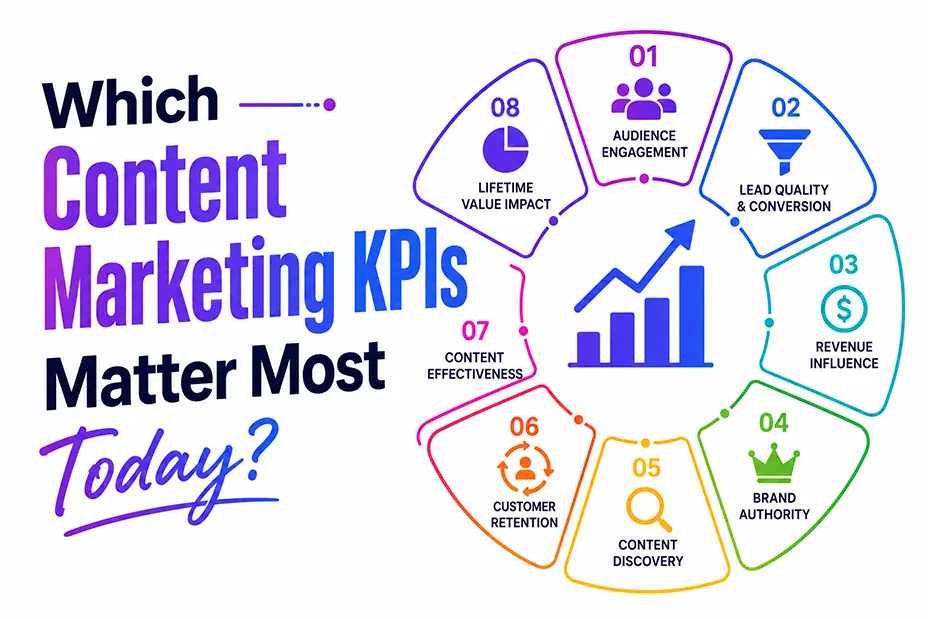
Evaluating performance based on traffic volume is an expensive executive blind spot. Because zero-click AI platforms satisfy information intent directly on the search results page, legacy metrics no longer correlate with commercial growth. Proving budget viability requires a strict transition to revenue-focused measurement.
The Metric Shift: Volume vs. Value
| Outdated Metrics (Losing Value) | Modern Content Performance Metrics 2026 (Gaining Value) |
|---|---|
|
Raw Pageviews & Sessions
Indicate broad informational intent, not active pipeline value. |
Pipeline Contribution & Revenue Influence
Tracks the total dollar value of active deals shaped by content. |
|
Organic Keyword Rankings
Diluted by AI Overviews, which push blue links completely below the fold. |
Assisted Conversions
Captures critical mid-funnel touchpoints that push deals forward. |
|
Standard Bounce Rates
Fail to measure actual asset consumption or technical readability. |
Share of Model (AI Brand Mentions)
Measures how often your brand is cited inside ChatGPT and Perplexity. |
Key Execution Focus for Content Marketing KPIs
- Track Engagement Depth: Replace superficial clicks with active scroll depth, text-highlighting, and video completion rates to measure genuine brand preference.
- Isolate High-Intent Content: Prioritize tracking assets built for evaluation and decision stages rather than bloating reports with low-intent informational traffic.
Maximize Your Content ROI
Get a Custom AI Content Strategy for Your Business — Schedule Your Session
Request a Free Report!
What Does a Modern Content Attribution Model Look Like?
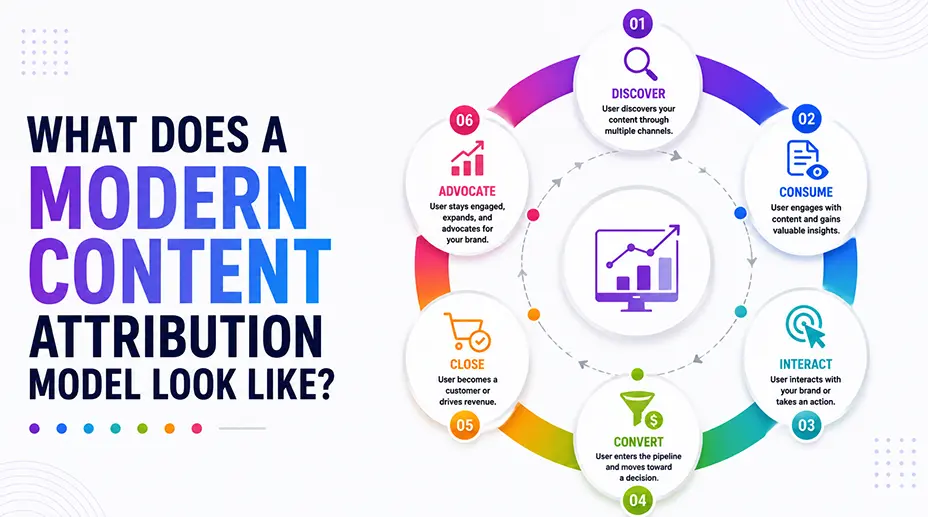
First-click attribution mistakenly awards 100% of a deal’s financial credit to the initial, often broad informational search term, ignoring the heavy lifting done by mid-funnel content assets. Conversely, last-click attribution creates an equally damaging blind spot: it assigns all economic value to the final touchpoint (like a branded “Request Demo” form). This completely erases the multi-platform discovery path that actually built the pipeline.
To defend and accurately calculate content marketing ROI 2026, revenue leaders must deploy a multi-touch, revenue-focused content attribution model. This maps content interactions directly across the entire buyer lifecycle.
The Modern Content Revenue Path
-
Awareness: Dark Funnel Discovery.
The prospect discovers an industry framework or original research insight shared in private peer communities, Slack groups, or industry networks. No cookies are tracked. -
Research & AI Discovery: Model Ingestion.
The buyer prompts an AI interface like ChatGPT, Gemini, or Perplexity to synthesize market vendors. The engine extracts data directly from your crawled thought leadership, cementing your brand on the curated shortlist without a web click. -
On-Site Intent: Website Visit.
The prospect visits the site directly or via an organic search link to evaluate technical specifications, product documentation, or native case studies. -
Pipeline Creation: Sales Conversation.
The account-based prospect requests a demo. The CRM maps the opportunity value directly to the historical, multi-touch content interaction path. -
Closed-Won Growth: Revenue Realization.
The deal closes. Revenue attribution platforms assign a balanced weight across the initial discovery assets, mid-funnel validation guides, and the final conversion point.
Executing the Multi-Touch Model
- Deploy W-Shaped Tracking: Assign a balanced percentage of pipeline value to the three critical milestones: First Touch (Discovery), Lead Creation (Engagement), and Opportunity Creation (Conversion), while distributing the remaining weight across mid-funnel nurturing assets.
- Integrate Content to CRM Logs: Connect your content management data directly to your CRM (e.g., Salesforce or HubSpot) to measure exactly when open, multi-million dollar deals interact with specific technical articles or pricing content.
How to Build an ROI Content Strategy Around Revenue Instead of Traffic?
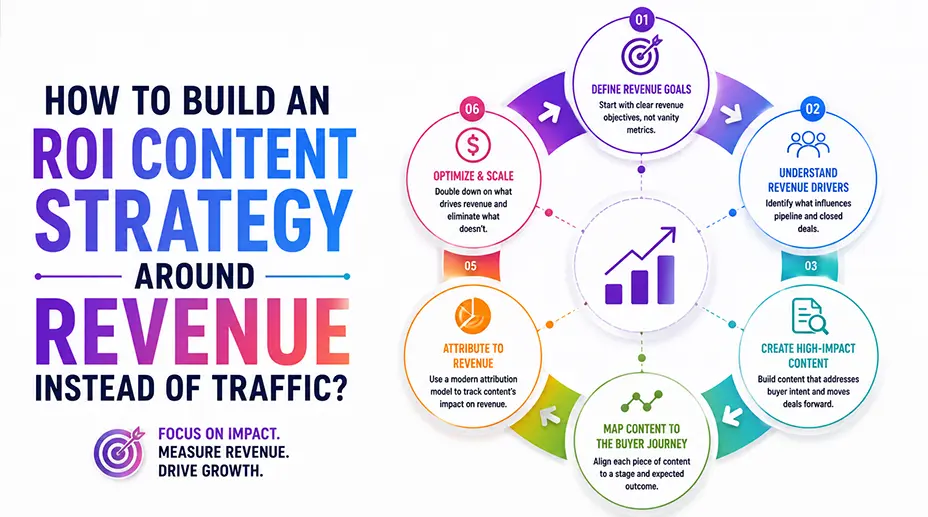
Chasing raw search volume with high-level informational content is an operational money pit. In an LLM-dominated, zero-click landscape, broad keyword rankings rarely translate into pipeline value.
To build a resilient ROI content strategy, enterprise brands must pivot from search volume to commercial intent—aligning production directly with the distinct revenue stages of the modern buyer’s cycle.
The Revenue-Aligned Content Framework
| Content Tier | Strategic Core Focus | Primary Impact Metric |
|---|---|---|
| 1. Awareness Content | Built to resolve foundational industry problems and provide original data or unique thought leadership. This content is optimized to be indexed and referenced by AI search models like ChatGPT and Perplexity. | Share of Model (AI Mentions) & Brand Search Volume |
| 2. Consideration Content | Highly technical architectural deep-dives, product integration documentation, and detailed feature breakdowns. It targets the technical buyer evaluating execution viability. | Session Engagement Depth & Resource Downloads |
| 3. Decision Content | Direct product-to-product comparison matrices, transparent pricing calculators, and security compliance documentation. It answers the final friction points before a purchasing decision. | Assisted | Conversions & Pipeline Sourcing |
| 4. Revenue Content | Granular, industry-specific case studies detailing exactly how an enterprise peer achieved measurable financial returns or infrastructure efficiency using your platform. | Closed-Won Velocity & Direct Revenue Influence |
Executing the Revenue-First Strategy
To successfully move away from superficial traffic generation, execution teams must deploy two practical adjustments:
- Invert the Editorial Funnel: Instead of dedicating 80% of your production resources to broad top-of-funnel topics, reallocate that budget to building a comprehensive library of Tier 3 and Tier 4 assets. Securing ten high-intent visits to a product comparison page or a target-account case study generates significantly more commercial value than capturing thousands of low-intent clicks on a generic educational article.
- Optimize for Content Commonality: Analyze your CRM to isolate closed-won customer accounts. Trace their specific content consumption paths back to find the exact pages they engaged with prior to conversion. Treat those high-converting assets as structural pillars for future content planning.
The Three-Tier Framework for Measuring Content Marketing ROI in 2026

To systematically measure content marketing success in a zero-click, AI-driven environment, enterprise brands must move past isolated data silos. Proving financial viability requires an integrated model that connects initial market discovery directly to commercial outcomes.
The Three-Tier Measurement Framework simplifies this complexity by categorizing your content marketing KPIs into three sequential phases of commercial impact:
      [ FOUND ]  ──> AI Citations, Search Share, Layout Visibility
           ↓
     [ TRUSTED ]  ──> Document Downloads, Scroll Depth, Return Visitors
           ↓
    [ PROFITABLE ] ──> Pipeline Sourced, Assisted Deals, Revenue Value
The Three-Tier Architecture
Tier 1: FOUND (Visibility Metrics)
Before an asset can influence a buyer, it must be discoverable across modern search ecosystems. This tier measures your baseline market presence, specifically tracking whether your data points are visible where buyers research.
Core Metrics: Share of Model (LLM citations inside ChatGPT/Perplexity), AI Overview visibility percentage, and brand-plus-keyword search volume.
Tier 2: TRUSTED (Authority Metrics)
Visibility without engagement is a vanity exercise. Once a prospect interacts with your content, you must track whether that interaction creates genuine technical authority and shapes brand preference.
Core Metrics: Technical documentation download rates, active scroll depth (minimum 60%), newsletter sign-ups, and repeat organic session frequency.
Tier 3: PROFITABLE (Revenue Metrics)
This is the ultimate standard for financial validation. This tier strips away traffic volume entirely to tie your publishing resources directly to CRM opportunity creation and financial growth.
Core Metrics: Content-impacted pipeline value, mid-funnel assisted conversions, content velocity impact, and closed-won revenue attribution.
By deploying this three-tier architecture, enterprise revenue teams can clearly isolate exactly where their content engine is succeeding and where friction exists—ensuring that every creative resource allocated directly advances a commercial objective.
The Future of Content Marketing ROI Is Revenue Attribution

The era of hiding behind raw traffic spikes and superficial link-clicks is officially over. Moving forward, verifying your content marketing ROI 2026 footprint hinges entirely on your structural capability to deploy data-driven revenue attribution. Content has evolved from a simple traffic play into a sophisticated engine of digital influence, requiring revenue leaders to measure content marketing success through a definitive, value-driven progression: traffic must evolve into AI visibility, visibility must breed brand trust, and trust must ultimately drive pipeline revenue.
Achieving this level of clarity requires a specialized approach to content data. Growth advisors like Engage Coders handle this differently for every infrastructure, embedding attribution architecture directly into the development cycle so content layers align seamlessly with data warehouses and CRMs from day one. Ultimately, authoritative content is not a cost center; it is the fundamental infrastructure that shapes how the market perceives your software. Brands that measure performance using legacy metrics will see their budgets systematically stripped. Conversely, leaders who treat content as an attributable financial asset will build an unassailable pipeline advantage that carries their brand safely through the next generation of search.
See real 2026 revenue attribution data—request your free, tailored content performance report today.
FAQs
First- and last-click models ignore the non-linear buyer journey, erasing invisible mid-funnel touchpoints like AI discovery. Modern content marketing ROI 2026 tracking requires multi-touch systems that map every interaction across the lifecycle.
When AI engines answer queries directly on the search results page, traditional web traffic drops but brand influence spikes. Revenue teams must pivot from measuring raw link clicks to tracking total pipeline value and direct model citations.
It is a multi-touch framework that awards equal financial credit to three critical deal milestones: initial discovery, lead creation, and opportunity conversion. The remaining value is distributed among mid-funnel content interactions.
By integrating content data directly with CRM logs to isolate exactly when open enterprise deals engage with specific assets. At Engage Coders, we embed this tracking architecture directly into your infrastructure from day one.
Chasing raw informational volume leads to high bounce rates and zero commercial pipeline value in an LLM-dominated search landscape. Brands must invert the funnel and focus production on high-intent decision assets.
Attribution platforms track data correlations between direct web traffic surges and non-clickable brand impressions inside conversational search tools. This provides a clear framework to measure content marketing success in dark channels.
A tiered framework systematically connects initial market visibility (Found) to technical brand trust (Trusted) and closed-won contract value (Profitable). This ensures your publishing resources advance concrete corporate growth.
Success requires shifting your editorial production from basic keyword search volume directly to commercial intent. This means aligning your content planning with technical buyer evaluation and vendor decision stages.
We build bespoke data connections that align your active content layers directly with your data warehouses and CRM systems. This helps enterprise revenue leaders accurately calculate content marketing ROI 2026 based on deal velocity.
Generative engines crawl and synthesize original data, unique industry frameworks, and authoritative insights to build their answers. If your content lacks deep technical authority, your brand will be completely omitted from AI shortlists.


