

From Zero to Growth: Exploring the Business Potential of ChatGPT Astra
Growing a business takes more than a good product or service. Companies need effective marketing, a strong online presence, efficient operations, and a clear understanding of what their customers want. Managing all these areas can be challenging, especially for small businesses and growing teams working with limited time and resources.
Artificial intelligence is creating new ways to approach these challenges. OpenAI introduced GPT-6 Astra on September 3, 2026, with capabilities designed to help complete multi-step tasks involving computer use. These capabilities could help businesses explore new ways to manage research, prepare reports, support software testing, and streamline selected digital workflows.
But how can a business turn these capabilities into meaningful growth? The answer lies in identifying the right opportunities and connecting AI with a broader business strategy.
In this guide, we explore how ChatGPT Astra could support business growth, where it may deliver practical value, what companies should consider before adopting it, and how the right digital strategy can help turn AI capabilities into business opportunities.
Table of Contents
- What is ChatGPT Astra, and Why Should Businesses Pay Attention?
- 5 Ways ChatGPT Astra Could Help Businesses Grow
- How Can Businesses Measure the Value of ChatGPT Astra?
- What Should Businesses Consider Before Adopting ChatGPT Astra?
- How to Turn AI Capabilities Into a Business Growth Strategy
- Why the Right Digital Partner Matters
- How Can ChatGPT Astra Help Your Business Grow?
- FAQs
What is ChatGPT Astra, and Why Should Businesses Pay Attention?

ChatGPT Astra, referred to in OpenAI’s announcement as GPT-6 Astra, is an AI model designed to handle complex tasks, including interactions with computer interfaces. Its capabilities extend beyond generating text to working through sequences of digital actions in supported environments.
For businesses, this opens up possibilities in areas such as research, document preparation, CRM workflows, software testing, and reporting. Rather than manually completing every step of a routine process, teams may be able to use AI to assist with parts of that work.
Consider a business preparing a marketing campaign. Its team may need to research competitors, organize audience insights, review website content, prepare campaign materials, and track performance. AI could help with selected research and administrative tasks, giving the team more time to focus on strategy and execution.
However, AI capabilities alone do not create business growth. Companies still need a clear plan, reliable information, appropriate tools, and people who can evaluate the results.
This is why businesses should approach AI as part of a wider digital strategy rather than as a standalone solution.
5 Ways ChatGPT Astra Could Help Businesses Grow
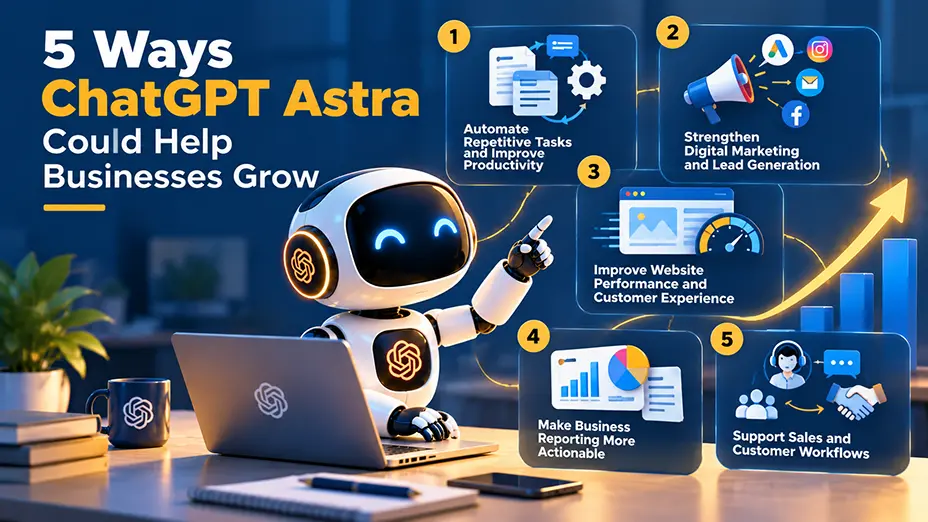
1. Automate Repetitive Tasks and Improve Productivity
Routine administrative work can take time away from activities that contribute directly to business growth. Preparing reports, organizing research, updating records, and compiling information are common examples.
Depending on the applications and permissions available, AI-assisted workflows could help businesses complete parts of these tasks more efficiently.
Potential applications include:
- Collecting and organizing information from approved sources.
- Preparing initial drafts of business documents and reports.
- Summarizing research for internal teams.
- Assisting with routine updates in supported applications.
- Organizing information for follow-up actions.
The business benefit comes from using the time saved productively. Employees can focus more on customer relationships, planning, problem-solving, and other work that requires human judgment.
For smaller companies, this can be particularly useful when teams need to manage several responsibilities without expanding their workload unnecessarily.
2. Strengthen Digital Marketing and Lead Generation
Digital marketing is one area where businesses can explore AI-assisted workflows. Marketing teams regularly research audiences, plan content, analyze competitors, monitor campaigns, and review performance.
ChatGPT Astra could support selected activities within these processes, helping teams organize information and prepare work for review.
For example, a company could use AI assistance to organize customer feedback, prepare content briefs, summarize campaign reports, or research questions that potential customers frequently ask.
However, producing more marketing content does not automatically generate more leads. Businesses need content that reaches the right audience, communicates a clear value proposition, and encourages visitors to take action.
That requires a combination of keyword research, useful content, search engine optimization, website experience, and conversion-focused planning.
Engage Coders explores these opportunities in its guide to scaling a business with AI-powered digital marketing. The important takeaway is that AI works best when it supports a marketing strategy built around measurable business objectives.
For businesses seeking growth, the goal should be to attract relevant visitors, build trust, and turn that attention into qualified enquiries.
3. Improve Website Performance and Customer Experience
Your website is often one of the first places potential customers interact with your business. If it loads slowly, communicates your services poorly, or makes contacting you difficult, visitors may leave before enquiring.
AI-assisted computer use and software-testing capabilities could help technical teams investigate certain issues, conduct checks, and organize testing findings. The specific tasks possible will depend on the environment and available permissions.
Businesses can also use AI to support research into customer questions, review website content, and identify areas that may need improvement.
Still, a website needs more than technical functionality. It should explain what the business offers, why customers should trust it, and what they should do next.
A conversion-focused website typically needs:
- Clear service pages that address customer needs.
- Straightforward navigation and mobile-friendly design.
- Relevant content that answers buyer questions.
- Visible calls to action and simple enquiry forms.
- Performance tracking to identify where visitors drop off.
Engage Coders discusses the relationship between AI and modern websites in its article on AI in website development.
For businesses investing in AI, combining technical improvements with a clear website strategy can help create a stronger customer experience.
4. Make Business Reporting More Actionable
Business owners need reliable information to understand whether their marketing and operational efforts are working. Yet data often sits across different dashboards, spreadsheets, and platforms.
AI may help teams summarize information, organize reports, and investigate patterns that deserve further attention. These capabilities could make it easier to prepare regular performance reviews and identify questions for further analysis.
For example, a marketing team might review website traffic, enquiry volume, conversion rates, and campaign spending together instead of looking at each metric in isolation.
The next step is connecting those findings to business decisions.
If website traffic increases but enquiries remain unchanged, the business may need to review its landing pages, calls to action, audience targeting, or service messaging. If a campaign generates enquiries but few qualified leads, the team may need to reassess its targeting or offer.
AI can assist with analysis, but teams must verify calculations and confirm that conclusions are supported by the underlying data.
To understand how performance measures can support better marketing decisions, explore Engage Coders’ practical guide to marketing KPI dashboards.
5. Support Sales and Customer Workflows
Sales teams often spend considerable time researching prospects, organizing customer information, preparing follow-up messages, and updating CRM records.
AI-assisted workflows could help with selected administrative activities, allowing sales professionals to devote more time to conversations and relationship building.
For example, AI could help prepare a prospect research summary or draft a follow-up email for a sales representative to review. Where supported, it may also assist with updating information in business applications.
Businesses should establish approval procedures before enabling AI to change customer records or send external communications. Customer data must also be handled according to applicable privacy and security requirements.
The aim is to support the sales process, not to remove the human judgment needed to understand customer needs and build trust.
How Can Businesses Measure the Value of ChatGPT Astra?
Before investing in an AI workflow, businesses should establish what they want it to improve. Without clear objectives, it can be difficult to distinguish genuine business value from activity that simply looks productive.
A practical starting point is to select one recurring task and compare the current process with an AI-assisted version.
| Business objective | What to measure |
|---|---|
| Reduce manual work | Time required to complete a task |
| Improve work quality | Error rates and corrections needed |
| Support lead generation | Qualified enquiries and conversion rate |
| Improve marketing efficiency | Cost per qualified lead and campaign performance |
| Strengthen website experience | Conversion rate, form completion, and user engagement |
| Control operating costs | Total workflow cost, including review and maintenance |
These measures should reflect the business’s actual goals. For example, a company focused on generating enquiries may prioritize qualified leads and conversion rates rather than content output alone.
OpenAI has published benchmark results for GPT-6 Astra, including scores on computer-use and terminal-based tasks. These results provide technical context, but they do not establish the return on investment a particular business will achieve.
The most reliable approach is to run a controlled pilot, record the results, and expand only when the workflow demonstrates value.
What Should Businesses Consider Before Adopting ChatGPT Astra?
AI adoption requires more than access to a capable model. Businesses must consider how it will interact with existing tools, information, and employees.
- Data security: Limit access to sensitive information and review data-handling requirements before introducing AI into business workflows.
- Accuracy: Verify important facts, calculations, and recommendations before using them to make decisions.
- Permissions: Restrict computer-use capabilities to appropriate tasks and require approval for sensitive or irreversible actions.
- Integration: Check whether the tools and applications your business relies on support the intended workflow.
- Total cost: Account for model usage, implementation, employee training, monitoring, and the time required for human review.
- Availability: Confirm current access, product limitations, and pricing directly through OpenAI’s official model documentation.
Businesses should also review OpenAI’s GPT-6 Astra safety overview and establish their own safeguards before using AI for sensitive work.
A careful rollout helps companies understand the benefits and limitations before making AI part of important operations.
How to Turn AI Capabilities Into a Business Growth Strategy
The real opportunity is not simply using a new AI tool. It is identifying where technology can help your business attract customers, improve efficiency, and deliver a better experience.
Here is a practical way to begin.
Step 1: Identify Your Biggest Bottleneck
Determine where your team spends unnecessary time or where potential customers are being lost. This could involve repetitive reporting, inconsistent marketing, a poorly performing website, or a slow enquiry process.
Step 2: Choose One Measurable Goal
Define the outcome you want to improve. Examples include reducing time spent preparing reports, increasing qualified enquiries, or improving the conversion rate of a service page.
Step 3: Test a Suitable AI-Assisted Workflow
Choose a manageable task, use appropriate permissions, and compare the results against your existing process. Keep human review in place while testing.
Step 4: Connect AI With Your Digital Strategy
Consider how the workflow fits into your website, content, marketing campaigns, and customer journey. AI-generated research has limited value if it is not used to improve a meaningful business activity.
Step 5: Track Results and Refine
Review the results regularly. Keep workflows that demonstrate value, improve those that need refinement, and discontinue those that introduce unnecessary costs or risks.
For businesses that need help connecting these activities, Engage Coders provides digital marketing and website development solutions designed around business needs. Explore the company’s digital marketing and growth resources to understand how AI can fit into a broader online growth strategy.
Why the Right Digital Partner Matters
AI tools can help businesses work differently, but successful implementation still requires planning, technical understanding, and a clear connection between technology and business objectives.
A business might use AI to research customer questions, for example, but it still needs an effective content strategy to attract relevant visitors. It might automate parts of its reporting, but it needs the right performance indicators to make informed decisions. It might improve website testing, but it still needs a website that communicates value and encourages enquiries.
These activities work best when they support the same growth plan.
Engage Coders helps businesses strengthen their digital presence through digital marketing and web development services. Rather than treating each activity as an isolated task, businesses can approach their website, marketing, and customer acquisition efforts as connected parts of their growth strategy.
The right starting point is to identify your business goals, understand the challenges holding you back, and determine which digital improvements are most likely to make a difference.
Ready to strengthen your digital presence and build a clearer path to growth?
Connect with Engage Coders to discuss your website and digital marketing goals and explore the right solutions for your business.
Contact US
How Can ChatGPT Astra Help Your Business Grow?
ChatGPT Astra creates new possibilities for businesses exploring AI-assisted automation, digital marketing, reporting, sales support, and website development. But technology itself is only one part of the equation.
Meaningful growth comes from applying the right capabilities to real business problems, measuring the results, and improving the customer journey. That means connecting AI with a strong website, relevant marketing, reliable data, and a clear plan for turning visitors into customers.
If your business is exploring how AI could support its next stage of growth, start by identifying the opportunities that matter most to your team and customers.
FAQs
ChatGPT Astra, referred to in OpenAI’s announcement as GPT-6 Astra, is an AI model with capabilities that include computer interaction and multi-step digital tasks in supported environments.
It could assist with selected tasks involving research, reporting, document preparation, marketing workflows, and sales administration. Its value depends on the business’s requirements, available integrations, and ability to review its work.
It may support marketing research, content planning, and analysis, but it cannot guarantee more leads. Lead generation also depends on audience targeting, service positioning, website usability, conversion paths, and campaign execution.
Its computer-use and software-testing capabilities could support selected technical checks and testing workflows. Website improvements still require appropriate development, quality assurance, and attention to customer experience.
Pricing depends on the product and usage model. Businesses using the API should check OpenAI’s official documentation for current rates and availability before estimating costs.
Not necessarily. Businesses should assess the tasks involved, data sensitivity, software compatibility, expected costs, and human oversight requirements before adopting it.
Begin with one clearly defined business problem, set a measurable goal, test a suitable workflow, and evaluate the results. Expand only when the approach delivers practical value and meets the company’s security and quality requirements.


