Fixed-Price vs. Time & Materials: Which Pricing Model is Right for Your Project?
When you engage a web development agency, the financial structure of your relationship is typically governed by one of two primary pricing models: Fixed-Price or Time & Materials (T&M). This isn’t just a contractual detail; the model you choose has a profound impact on your project’s budget, flexibility, risk management, and the overall dynamic between you and your development partner.
There is no single “best” model. The right choice depends entirely on the clarity, complexity, and stability of your project requirements. Selecting the wrong model can lead to friction, frustration, and financial surprises. This detailed guide will break down the differences, pros, and cons of each to help you make the most strategic choice.
Table of Contents
The Fixed-Price Model: Predictability and Precision
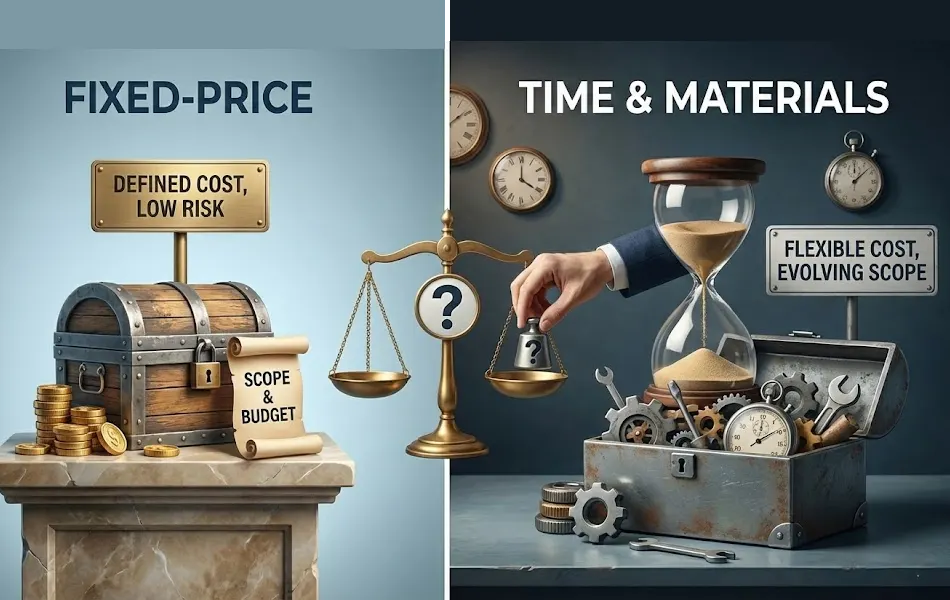
In a Fixed-Price contract, the client and agency agree on a single, total cost for a precisely defined scope of work to be completed by a specific deadline. The price is set in stone before the project begins.
- Best Suited For:
- Small to medium-sized projects.
- Projects where the requirements are crystal clear, fully documented, and highly unlikely to change.
- Examples: A Minimum Viable Product (MVP) with a tightly limited feature set, a standard brochure website, a single landing page, or minor, well-defined bug-fixing tasks.
- The Proverb: “You know exactly what you’re getting and exactly what you’ll pay for it.”
Client Advantages of a Fixed-Price Model:
- Budget Predictability: This is the primary benefit. The total cost is known upfront, eliminating the risk of unexpected expenses and dramatically simplifying financial planning and approval processes.
- Lower Management Overhead: Once the intensive and exhaustive initial planning phase is complete, this model typically requires less day-to-day management from the client.
- Risk Transference: The financial risk of the project taking longer than expected is transferred to the agency. It is their responsibility to deliver the agreed-upon scope within the agreed-upon budget.
Client Disadvantages of a Fixed-Price Model:
- Inherent Rigidity: The greatest weakness is its lack of flexibility. Any change or addition to the agreed-upon scope, no matter how minor, is challenging, requires a formal (and often lengthy) change request process, and can be costly to negotiate. This can stifle innovation and prevent the project from adapting to new insights or market feedback.
- Risk Premium: To protect themselves against unforeseen complexities and the risk they are absorbing, agencies almost always build a significant “risk premium” or buffer (often 20-30%) into the fixed price. This means you may be paying more than the project’s actual labor cost.
- Potential for Adversarial Relationship: This model can create a dynamic where the client wants the most features possible for the price, and the agency wants to do the least amount of work necessary to fulfill the contract. This can lead to corner-cutting on quality to protect profit margins.
- Lengthy Upfront Planning: A successful fixed-price project requires an exhaustive and time-consuming upfront planning and specification phase to create the detailed Statement of Work (SOW) the model depends on.
The Time & Materials (T&M) Model: Flexibility and Collaboration
Under a T&M contract, you pay the agency for the actual time spent by the project team (programmers, designers, project managers), billed at a pre-agreed hourly, daily, or weekly rate, plus the cost of any materials or third-party expenses.
- Best Suited For:
- Large, complex, and long-term projects.
- Projects where the requirements are expected to evolve, or the full scope is not known at the outset.
- Projects utilizing Agile development methodologies (like Scrum), which rely on iterative progress and continuous feedback.
- The Proverb: “You pay for exactly what you get, and you can change your mind along the way to build the best possible product.”
Client Advantages of a T&M Model:
- Maximum Flexibility: This is the key benefit. The T&M model allows the project scope to be adjusted, features to be added or modified, and the product direction to pivot in response to user feedback or changing business priorities. This agility often leads to a higher-quality, more market-aligned final product.
- Faster Start Time: Projects can begin much more quickly, as a complete, exhaustive specification is not required upfront. Development can begin in parallel with ongoing discovery and refinement.
- Transparency and Partnership: T&M fosters a more collaborative and transparent partnership. The client has full visibility into the work being done and the time being spent, operating as part of a single, unified team with the agency.
- No Risk Premium: You are paying for the actual time worked, so there is no hidden buffer built into the cost.
Client Disadvantages of a T&M Model:
- Lack of Budget Certainty: This is the primary drawback. The final cost is not known at the beginning of the project, which can create significant financial risk if the project is not managed carefully.
- Susceptible to Scope Creep: Without proper controls and prioritization, the project can continuously expand, leading to budget overruns.
- Requires High Client Involvement: This model is not a “set it and forget it” approach. It demands a high level of active involvement from the client, who must be available to provide regular feedback, make timely decisions, and prioritize tasks to keep the project on track and within a target budget range.
| Criteria | Fixed-Price Model | Time & Materials (T&M) Model |
|---|---|---|
| Budget Predictability | High. Total cost is known upfront, minimizing financial risk. | Low. Final cost is unknown and depends on actual effort. Requires careful budget management. |
| Scope Flexibility | Very Low. Changes are difficult, slow, and costly to implement. Can stifle innovation. | Very High. Allows for easy adaptation, iteration, and changes in project direction. |
| Client Involvement | High during the initial planning phase; lower during development. | Consistently high throughout the project. Requires active participation and timely feedback. |
| Speed to Start | Slow. Requires lengthy and exhaustive upfront planning and specification. | Fast. The project can begin quickly with a high-level plan, with details defined iteratively. |
| Risk Allocation | Risk of cost overruns is primarily on the agency. The risk of an inadequate final product is on the client. | Risk of cost overruns is primarily on the client. Mitigated by high control and flexibility. |
| Best For | Small, short-term projects with clearly defined, stable requirements (e.g., MVP, landing pages). | Large, complex, long-term projects with evolving requirements or undefined scope. |
The Hybrid Approach: The Best of Both Worlds
For many projects, a hybrid model can offer the perfect balance of predictability and flexibility. This strategy often involves a small, fixed-price contract for an initial “Discovery Phase.”
During this self-contained initial project, the agency works closely with you to conduct user research, define detailed requirements, create wireframes, and produce a comprehensive project plan and prioritized feature backlog. The deliverable is a crystal-clear roadmap.
Once this foundational work is complete and the scope is much clearer and de-risked for both parties, the engagement transitions to a Time & Materials model for the main development and implementation work. This approach provides an initial degree of cost control and predictability while preserving the agility and flexibility needed for the core development effort.
To learn more about how to vet an agency’s processes before committing to a contract, see our guide on the 15 Critical Questions to Ask Your Next Agency.
For a complete overview, read our Ultimate Guide to Hiring a Web Development Agency.
Unsure which pricing model best fits your project’s unique needs?
The right financial structure is key to a successful partnership. Contact Engage Coders for a free consultation. We can walk you through the pros and cons as they apply to your specific project and help you choose the model that aligns with your goals and budget.