
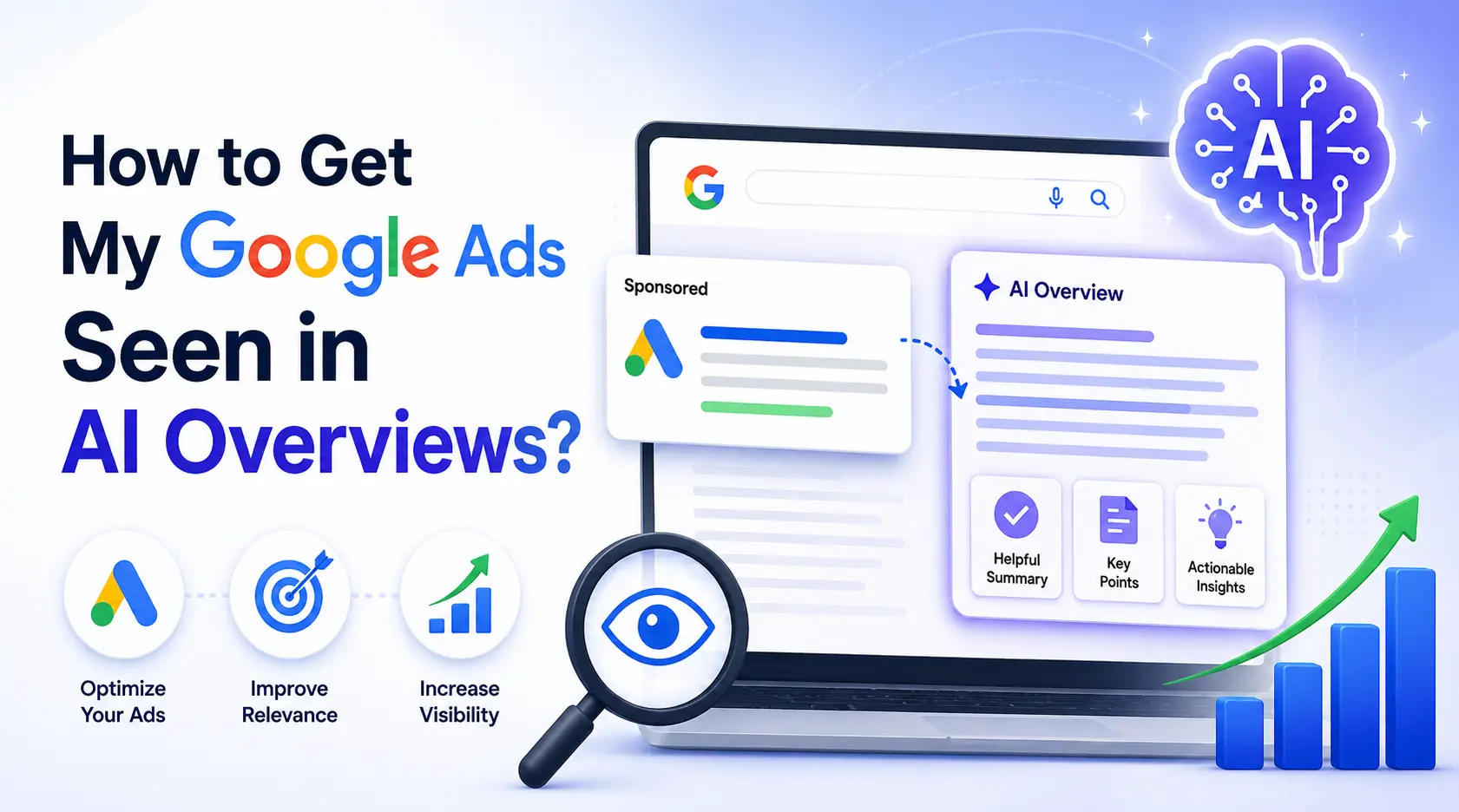
How to Get My Google Ads Seen in AI Overviews?
Yes, Google Ads can appear above, below, and within AI Overviews, but advertisers cannot directly target AI Overviews. Instead, Google determines eligibility based on factors such as campaign type, ad relevance, landing page quality, bidding strategy, and user intent. Search, Shopping, and Performance Max campaigns can all qualify for these placements when they align with both the search query and the AI-generated response.
In this guide, we’ll explain how AI Overview ads work and the specific steps U.S. businesses can take to improve their chances of appearing in these AI-powered search experiences.
Table of Contents
- What Are Google AI Overviews?
- Can Google Ads Appear in AI Overviews?
- Why AI Overview Visibility Matters for Businesses
- How Google Decides Which Ads Appear in AI Overviews
- Which Campaign Types Are Most Likely to Appear in AI Overviews?
- How to Optimize Search Campaigns for AI Overviews
- Create Landing Pages That Support AI Overview Visibility
- Why Schema Markup Matters
- Improve Your Merchant Center Feed
- Write Ads for AI-Era Search Behavior
- Strengthen Audience Signals
- Use Smart Bidding
- Monitor and Refine Performance Regularly
- Common Mistakes That Prevent AI Overview Visibility
- Need Help Maximizing Google Ads Performance?
- FAQs
What Are Google AI Overviews?
AI Overviews are AI-generated summaries that appear in Google Search for certain queries.
Google uses generative AI to analyze information from multiple sources and create a concise answer directly within search results.
These summaries typically appear for:
- Complex questions
- Multi-step problems
- Research-based searches
- Product comparison queries
- Informational searches requiring multiple sources
For example, someone might search:
- “Best way to reduce energy costs in a small business”
- “How to choose accounting software for a construction company”
- “How often should commercial HVAC systems be serviced”
Instead of showing only links, Google may generate an AI Overview that summarizes relevant information and presents recommended next steps.
According to Google, AI Overviews are available in more than 200 markets worldwide, and ads can appear above or below these AI-generated responses. Additionally, ads can appear within AI Overviews in select countries, including the United States.
Can Google Ads Appear in AI Overviews?
Yes. Google has officially confirmed that eligible ads can appear:
- Above AI Overviews
- Below AI Overviews
- Within AI Overviews
Google serves these ads using its existing advertising ecosystem rather than a separate advertising platform. Existing Search, Shopping, and Performance Max campaigns may qualify if they meet Google’s relevance and quality requirements.
This means you do not need to create a special AI Overview campaign.
Instead, you need to optimize your current campaigns to improve eligibility.
Why AI Overview Visibility Matters for Businesses
The traditional search journey is changing.
Customers increasingly receive information directly from Google’s AI-generated answers before clicking on websites.
Businesses that appear inside these experiences gain several advantages:
Earlier Customer Exposure
Your brand appears during the research phase rather than only during the purchase phase.
Higher Relevance
Google matches ads using both:
- The user’s search query
- The content generated in the AI Overview
This often creates stronger contextual relevance than traditional keyword matching alone.
New Commercial Opportunities
Many informational searches previously had little commercial value.
AI Overviews help Google identify commercial intent hidden within research-oriented searches.
As a result, businesses can reach potential customers earlier in their buying journey.
How Google Decides Which Ads Appear in AI Overviews
Google does not simply place ads into every AI Overview.
Several factors influence eligibility.
User Intent
Google evaluates whether a search contains commercial potential.
For example:
“Why is my pool green and how do I clean it?”
This query appears informational.
However, Google may recognize a commercial opportunity and display ads for pool cleaning equipment, pool vacuums, testing kits, and maintenance products.
Ad Quality
Your ad must still compete in Google’s auction system.
Factors include:
- Ad relevance
- Expected click-through rate
- Landing page experience
- Quality Score
- Bid competitiveness
AI Overview Context
Google evaluates whether your ad is relevant not only to the query but also to the content generated within the AI Overview itself.
This makes contextual alignment increasingly important.
Which Campaign Types Are Most Likely to Appear in AI Overviews?
Google specifically recommends AI-powered campaign types.
1. Search Campaigns Using Broad Match
Broad match have become increasingly important.
Google states that broad match helps advertisers reach the complex and varied searches that frequently trigger AI Overviews.
Benefits include:
- Expanded keyword coverage
- Better intent matching
- Increased eligibility for conversational searches
- Stronger AI-powered targeting
2. Performance Max Campaigns
Performance Max relies on:
- Website content
- Audience signals
- Creative assets
- Merchant Center feeds
Google’s systems use these signals to determine relevance and placement opportunities.
Businesses using Performance Max often have broader exposure opportunities within AI-powered search experiences.
3. Shopping Campaigns
For ecommerce businesses, Shopping campaigns are among the strongest candidates for AI Overview visibility.
Google specifically notes that Shopping ads can appear within AI Overviews when product relevance aligns with user intent.
4. AI Max for Search
AI Max for Search expands beyond traditional keyword targeting.
Instead of relying strictly on exact keyword matches, it uses intent-based signals and automated optimization to identify relevant searches.
How to Optimize Search Campaigns for AI Overviews
Use Broad Match Strategically
Many advertisers still rely heavily on exact match keywords.
However, AI Overviews frequently appear for long-tail and conversational searches.
Broad match allows Google to interpret user intent more effectively.
Pair broad match with:
- Smart Bidding
- Conversion tracking
- Strong negative keyword management
Focus on Search Intent
Instead of building campaigns around isolated keywords, organize campaigns around customer problems and solutions.
For example:
Rather than:
Commercial roofing company Houston
Build coverage around:
- Roof leak solutions
- Commercial roof maintenance
- Industrial roofing inspections
- Storm damage repair
This aligns better with the types of searches that trigger AI Overviews.
Improve Ad Relevance
Ads should directly address:
- Customer concerns
- Pain points
- Common questions
Google increasingly rewards relevance over keyword repetition.
Create Landing Pages That Support AI Overview Visibility
Landing page quality plays a larger role than ever.
Publish Comprehensive Content
Google’s systems need context.
Your landing pages should answer:
- What
- Why
- How
- When
- Cost
- Benefits
- Alternatives
Pages that provide complete information give Google’s AI more signals to understand your business.
Cover Related Questions
Include FAQ sections that answer common customer concerns.
Examples:
- How long does installation take?
- What does the service cost?
- What industries do you serve?
- What problems does this solve?
This creates stronger contextual relevance.
Demonstrate Expertise
Google’s AI systems prioritize trustworthy information.
Include:
- Certifications
- Industry credentials
- Customer reviews
- Case studies
- Years of experience
Why Schema Markup Matters
Schema helps Google understand your content.
Businesses should implement relevant structured data, including:
Organization Schema
Provides business information and credibility signals.
Product Schema
Essential for ecommerce businesses.
Service Schema
Helps Google understand service offerings.
FAQ Schema
Supports question-and-answer content.
Review Schema
Provides trust signals and social proof.
Industry experts increasingly recommend schema alignment to improve contextual understanding and AI-driven visibility.
Improve Your Merchant Center Feed
For ecommerce brands, feed quality can significantly influence AI Overview visibility.
Google recommends maintaining accurate product data, including:
- Product titles
- Descriptions
- Pricing
- Promotions
- Shipping information
- Return policies
- Product attributes
Google also recommends providing diverse, high-quality images and videos.
Feed Optimization Best Practices
Use descriptive product titles.
Instead of:
“Office Chair”
Use:
“Ergonomic Office Chair with Adjustable Lumbar Support”
Detailed attributes provide more opportunities for Google’s systems to understand relevance.
Write Ads for AI-Era Search Behavior
Search behavior is becoming more conversational.
People increasingly ask questions rather than entering short keywords.
Use Natural Language
Instead of:
“Best Accounting Software”
Try:
“Accounting Software Built for Growing Businesses”
Answer Questions
Create headlines that address common concerns.
Examples:
- Track Expenses in Real Time
- Simplify Payroll Management
- Manage Inventory Across Locations
Focus on Assistance
Google’s AI systems increasingly reward helpful content.
Position your business as a solution rather than simply a product.
Strengthen Audience Signals
Google’s automation performs better with quality data.
Use:
- Customer Match lists
- Website visitor audiences
- Past converters
- CRM integrations
- First-party customer data
Strong audience signals help Google understand who is most likely to convert.
Use Smart Bidding
Google specifically recommends AI-powered bidding strategies for AI Overview opportunities.
Popular options include:
- Maximize Conversions
- Target CPA
- Target ROAS
- Maximize Conversion Value
These bidding strategies help Google’s systems identify high-value opportunities across evolving search experiences.
Monitor and Refine Performance Regularly
AI-powered advertising requires active management.
Review:
-
Search Terms Reports
Identify new intent patterns. -
Landing Page Performance
Monitor engagement and conversion metrics. -
Asset Performance
Evaluate headlines, descriptions, images, and videos. -
Conversion Quality
Ensure leads generated through AI-driven traffic meet business objectives.
Common Mistakes That Prevent AI Overview Visibility
- Using Only Exact Match Keywords: This limits discovery opportunities.
- Weak Landing Page Content: Thin pages provide insufficient context.
- Poor Merchant Center Feeds: Incomplete product information reduces relevance.
- Ignoring Audience Signals: Automation performs poorly without guidance.
- Generic Ad Copy: Generic advertising often loses against contextually relevant competitors.
Need Help Maximizing Google Ads Performance?
Appearing in AI Overviews is only one part of building a successful paid advertising strategy. Businesses also need the right campaign structure, audience targeting, landing pages, bidding strategies, and conversion tracking to generate profitable results from their ad spend.
Ready to improve your paid advertising results?
Contact Engage Coders today to discuss your goals and find out how our PPC experts can help your business attract more customers online.
Contact Us Today
At Engage Coders, we help businesses in the United States create and manage data-driven PPC campaigns to increase visibility, generate qualified leads, and improve return on ad spend. Our team provides complete Google Ads services, Meta Ads services, Performance Max campaigns, remarketing, shopping campaigns, and conversion optimization to help businesses reach customers at every stage of the buying journey.
Whether you’re looking to improve your Google Ads performance, expand your reach through Meta advertising, or build a comprehensive paid media strategy, our PPC specialists in USA can help identify opportunities and develop campaigns aligned with your business goals.
FAQs
No. Google currently does not offer a separate targeting option exclusively for AI Overviews. Eligible ads are automatically considered based on campaign settings and relevance.
Google highlights Search campaigns with broad match, Performance Max, Shopping campaigns, and AI Max for Search as the most effective options.
Yes. Local businesses can benefit when their services align with informational and commercial queries that trigger AI Overviews.
Yes. Google allows eligible Shopping ads to appear within AI Overviews when products match user intent and contextual relevance.
Yes. Google specifically recommends broad match because AI Overviews often trigger on complex, conversational searches that traditional keyword targeting may miss.
Schema markup helps Google better understand page content and business information, which can improve contextual relevance signals.
Yes. The United States is one of the countries where ads can appear within AI Overviews on both desktop and mobile devices.


