
Google AI Mode vs. AI Overviews: Key Differences, Traffic Impact, and SEO Strategy in 2026
Google Search is evolving beyond traditional lists of links. AI-generated summaries and conversational search are changing how people discover information, compare businesses, and choose which websites to visit.
Two features driving this shift are Google AI Overviews and Google AI Mode. Both use artificial intelligence to help users find information, but they offer different search experiences.
For businesses investing in search engine optimization (SEO), the key question is: How can you improve your website’s visibility in AI search while maintaining organic traffic and generating meaningful business results?
Understanding how these features work can help you build an SEO strategy that connects search visibility with business growth.
Table of Contents
- Google AI Overviews vs. Google AI Mode: How Do They Work?
- Key Differences Between Google AI Overviews and AI Mode
- How Do AI Mode and AI Overviews Affect Website Traffic?
- How Should You Adapt Your SEO Strategy for AI Mode and AI Overviews?
- How Can You Measure AI Search Visibility in 2026?
- How Can You Improve Your Website’s Visibility in Google AI Search?
- FAQs
Google AI Overviews vs. Google AI Mode: How Do They Work?
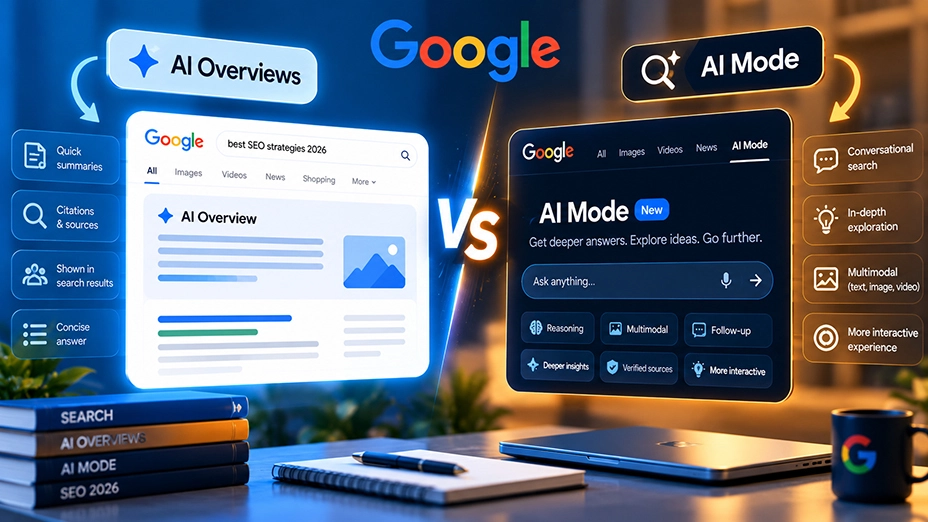
Both features help users find information, but they differ in how people interact with search.
- Google AI Overviews: Provide AI-generated summaries within regular Google Search, helping users understand a topic and explore links to relevant websites. For example, a search about improving website performance might display optimization tips alongside links to detailed guides.
- Google AI Mode: Offers a conversational search experience for complex questions, comparisons, and follow-up research. A business owner might compare technical SEO with content marketing before evaluating agencies.
- Query fan-out: Both features can generate related searches across subtopics and sources to develop a response. Their answers and supporting links may differ.
Google confirms that both experiences can display links to relevant webpages, but inclusion is not guaranteed. Strong traditional rankings alone do not ensure that a page will appear in an AI-generated response.
For additional guidance, explore Engage Coders resources on website design strategies that help businesses stand out online and AI SEO and how artificial intelligence is changing search optimization.
Key Differences Between Google AI Overviews and AI Mode
| Comparison factor | AI Overviews | AI Mode |
|---|---|---|
| Search experience | AI summary within regular Search | Conversational AI search |
| Main purpose | Explain a topic quickly | Explore complex questions |
| User interaction | Read a summary and explore links | Ask follow-up questions |
| Research depth | General overview | Deeper research and comparisons |
| SEO opportunity | Answer specific questions clearly | Provide useful context across related topics |
Google’s AI experiences can use different models and techniques, so their answers and supporting links may vary. Appearing in one does not guarantee visibility in the other.
Traditional rankings remain important, but they do not tell the whole story of AI search visibility. Read Engage Coders article on Google AI Mode and what SEO professionals should know.
How Do AI Mode and AI Overviews Affect Website Traffic?
The impact depends on the search query and whether users need information beyond the AI-generated response.
Can AI-Generated Answers Reduce Organic Clicks?
Yes. Users who find a complete answer directly in Search may have less reason to visit a website, particularly for simple informational queries.
However, people researching products, comparing services, or seeking expert guidance may still click through to supporting websites. The impact varies by search intent and website.
This relates to zero-click searches, where users find answers without visiting a website. Learn more in Engage Coders analysis of zero-click search and its effect on website traffic.
Do not judge performance through clicks alone. Monitor impressions, click-through rate, landing-page engagement, and conversions to understand the wider impact. Engage Coders also explains why clicks can fall while impressions increase.
Does AI Visibility Lead to More Conversions?
Not automatically. Appearing in an AI response may introduce users to your brand, but visibility alone does not guarantee website visits, enquiries, or sales.
Your website must provide useful information, demonstrate expertise, and make the next step clear. Explore Engage Coders guide to optimizing websites for AI-driven leads for more practical guidance.
How Should You Adapt Your SEO Strategy for AI Mode and AI Overviews?
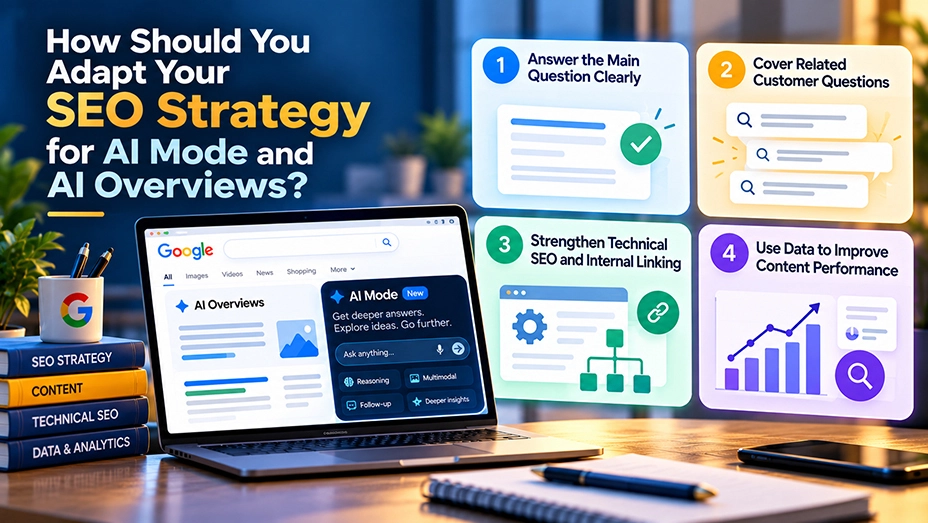
Google’s guidance emphasizes established SEO best practices for its AI search experiences. You do not need special AI markup to qualify for inclusion. Focus on these four priorities.
1. Answer the Main Question Clearly
Identify the questions customers ask before choosing a product or service. Answer the main question directly, then provide the details readers need to make informed decisions.
Use descriptive headings, clear explanations, and relevant examples. Avoid creating separate pages for every minor keyword variation. Each page should serve a distinct purpose and offer genuine value.
Learn more about: answer engine optimization and content visibility in AI search.
2. Cover Related Customer Questions
Customers often need comparisons, pricing considerations, limitations, and implementation guidance before making a decision. Organize related content logically and use internal links to help readers explore relevant topics.
For example, an SEO agency’s service page could explain which problems its services address, what the process involves, how performance is measured, and what clients can expect next. Supporting articles can cover technical SEO, content strategy, and reporting in greater detail, with links connecting readers to the relevant services.
If multiple pages target nearly identical search intent, consider differentiating or consolidating them. Engage Coders explains how to identify this issue in its guide to keyword cannibalization and how to fix it.
The goal is not to publish more pages. It is to provide useful, distinct content that addresses genuine customer needs.
3. Strengthen Technical SEO and Internal Linking
Make sure Google can access and index your important pages. Review crawlability, internal links, redirects, and whether essential information is available as readable text.
Structured data should accurately reflect visible page content. You do not need special AI schema or an llms.txt file for inclusion in Google AI Overviews or AI Mode.
For help maintaining a technically sound website, read Engage Coders beginner’s guide to redirects and setup best practices.
For Google’s official recommendations, consult its guide to optimizing websites for generative AI features.
4. Use Data to Improve Content Performance
Use Google Search Console to monitor impressions, clicks, click-through rates, and average position. Website analytics can help you assess landing-page engagement and conversions.
SEO tools can support keyword research and content analysis, but use their findings alongside real website performance data rather than relying on a single score.
Explore Engage Coders resources on SEO content optimization tools for AI visibility and its AI content marketing strategy guide for 2026.
How Can You Measure AI Search Visibility in 2026?
Google introduced a dedicated Generative AI performance report in Search Console to help website owners measure visibility in supported AI search features. As announced by Google in June 2026, the reports began rolling out to websites and were made available worldwide by August 31, 2026.
The reports provide data such as impressions, pages, countries, and performance trends. Available dimensions vary by report and feature. They help you understand where your content appears, but they do not provide complete attribution for leads or sales from individual AI experiences.
Combine AI visibility data with regular Search Console reporting and website analytics to understand how search performance relates to business outcomes.
A Practical Measurement Process
- Step 1: Identify priority pages.
- Step 2: Review AI search impressions.
- Step 3: Compare overall organic performance.
- Step 4: Track engagement and conversions.
- Step 5: Prioritize improvements.
Select the service pages, product pages, and articles most closely connected to your business goals.
Open the Generative AI performance report in Search Console and identify which pages receive impressions. Track changes over time.
Review clicks, impressions, click-through rate, and average position in the regular Search Console Performance report.
Use website analytics to measure enquiries, purchases, and other important outcomes. Examine landing-page performance and referral information where available. For keyword-related analysis, consult Engage Coders guide to finding website keywords in Google Analytics 4.
Investigate pages losing clicks, pages gaining impressions without meaningful engagement, and important pages with limited visibility. Review content quality, technical accessibility, and calls to action.
This approach connects search visibility with business performance without assuming that every conversion came from a particular AI feature.
Improve Your Visibility in Google AI Search
As Google AI Mode and AI Overviews reshape how people discover businesses, Engage Coders can help you strengthen your SEO strategy, improve search visibility, and attract the right audience with a focus on meaningful business results.
Explore Our SEO Services
How Can You Improve Your Website’s Visibility in Google AI Search?
Improving visibility in AI Overviews and AI Mode starts with helpful content, accessible pages, relevant internal links, and a clear website experience.
Review your priority pages, address content gaps, strengthen technical SEO, and track changes in visibility, traffic, and conversions. No strategy guarantees inclusion in an AI-generated response, so focus on sustainable improvements rather than shortcuts.
For a deeper look at AI search optimization, explore Engage Coders ultimate guide to generative engine optimization.
If you need professional support, Engage Coders SEO services can help you assess your website, identify optimization opportunities, and prioritize improvements aligned with your business goals.
Ultimately, the objective is not simply to appear in more search experiences. It is to help the right audience discover your business, understand your expertise, and take meaningful next steps.
FAQs
Neither is universally better. AI Overviews summarize information within regular Search, while AI Mode supports conversational research. The better opportunity depends on your audience, content, and business goals.
Yes. A website may appear in both experiences, but inclusion is not guaranteed. Each experience may display different supporting sources.
No special AI markup is required. Focus on established SEO practices, helpful and original content, accessible pages, and a good user experience.
Yes. Google’s Generative AI performance report provides visibility data for supported AI search features. Combine it with regular Search Console metrics and website analytics to understand broader performance and business outcomes.
Traditional SEO remains relevant, but ranking in regular search results does not guarantee inclusion in an AI response. Continue improving your content and technical SEO while monitoring performance across search experiences.


