
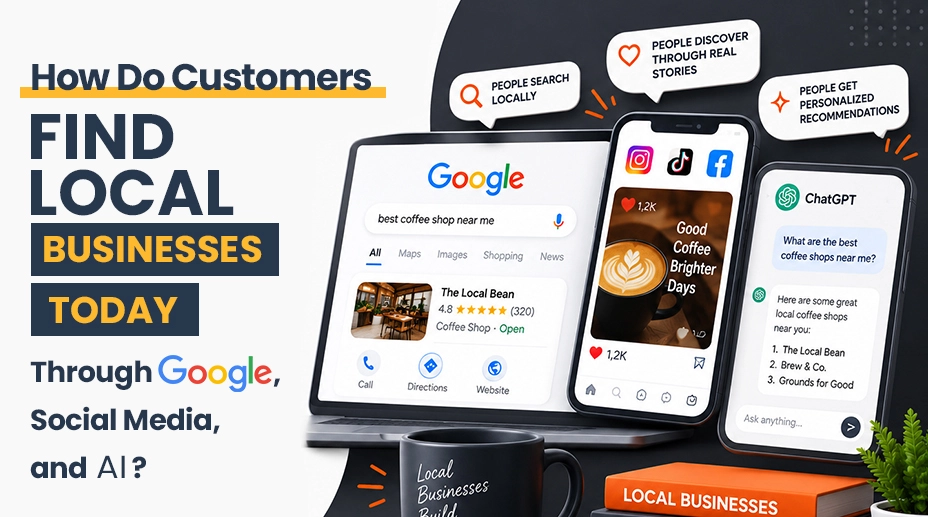
How Do Customers Find Local Businesses Today Through Google, Social Media, and AI?
Finding a local business used to start with Google. Today, a customer might discover a business on Google, check its Maps profile, read reviews, browse social media, visit the website, and even use AI to compare options.
So, how do customers find local businesses today?
The answer is increasingly multi-channel. Customers search, browse, compare, verify, and make decisions across different digital platforms. For local businesses, being visible in only one place can mean missing customers elsewhere.
Table of Contents
- How Does Google Business Profile Help Customers Find Local Businesses?
- How Is AI Changing the Way Customers Find Local Businesses?
- The Power of Social Media Communities in Driving Organic Local Growth
- Why Do Customer Reviews Matter So Much for Local Business Growth?
- A Winning Blueprint for Service Companies to Thrive Across Search, Social, and AI
-
FAQs
How Does Google Business Profile Help Customers Find Local Businesses?
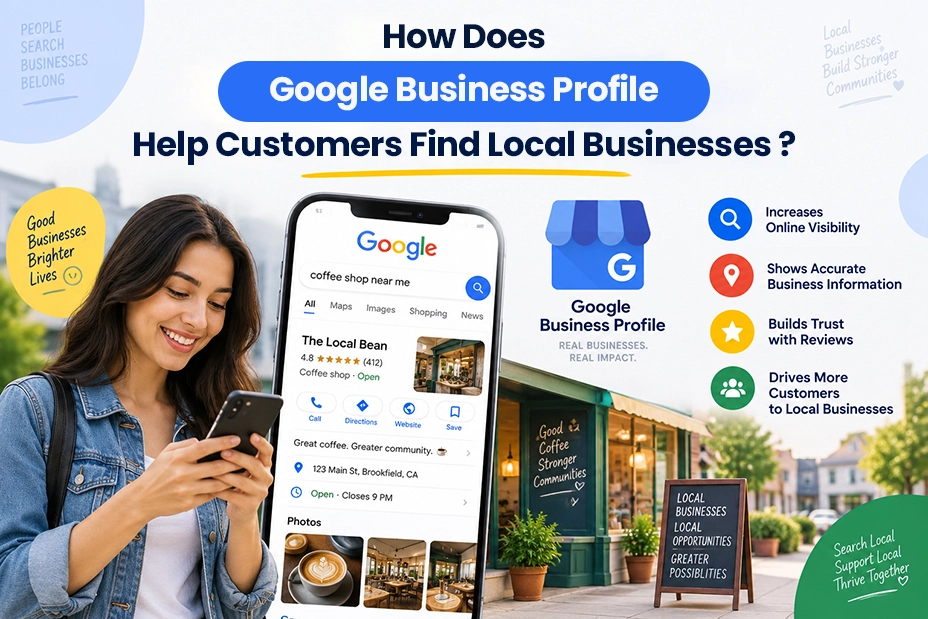
Google remains an important part of local discovery because it puts business information directly in front of people who are actively looking.
When someone searches for a service such as “dentist near me,” “HVAC company in Dallas,” or “Italian restaurant nearby,” Google can display relevant local businesses through Search and Maps.
A Google Business Profile can show information such as the business’s location, phone number, website, hours, photos, services, and customer reviews. Google says complete and accurate Business Profile information can help customers understand what a business does, where it is, and when they can visit.
That makes your Business Profile more than a directory listing. It can be one of the first places a potential customer evaluates your business.
What Do Customers See Before They Visit Your Website?
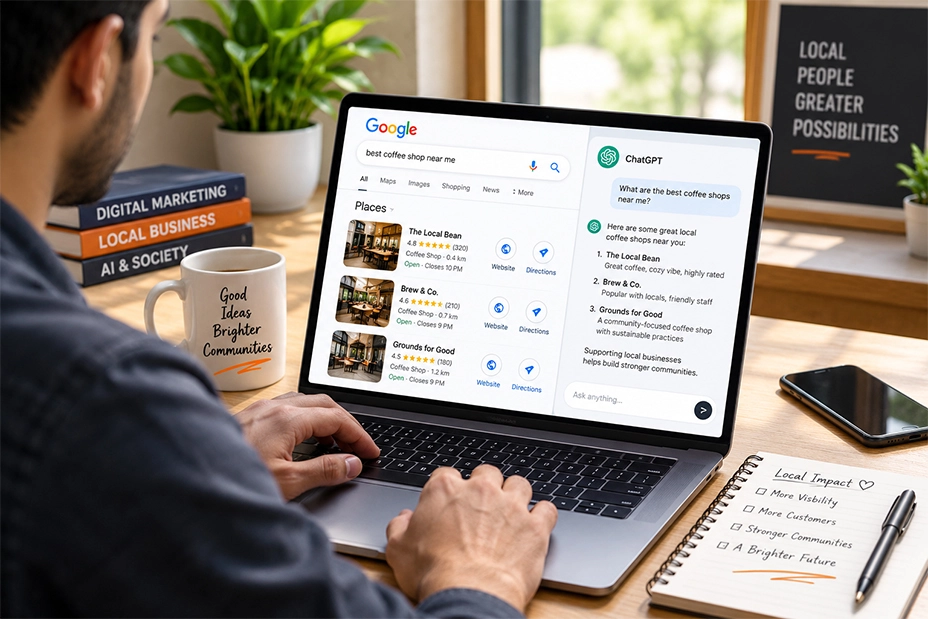
A customer may already have several questions answered before clicking your website.
They can see:
- Ratings and reviews to assess other customers’ experiences
- Location or service area to determine whether you serve them
- Business hours to know when they can reach you
- Photos and videos to see your business, products, or work
- Services to understand what you offer
- Phone and contact details to take the next step
- Website links to learn more
Google also explains that information shown in local profiles can come from multiple sources, including business owners, websites, users, and third-party data.
That means the information customers encounter around your business should be accurate and easy to understand.
Why Does Business Information Need to Stay Consistent?
Imagine a potential customer finds your business on Google but sees outdated hours on another platform. Or your website lists a different phone number from your Business Profile.
Even if the difference seems minor, it can create unnecessary uncertainty.
Keep important details accurate across your:
- Business name
- Location and service areas
- Phone number
- Business hours
- Services
- Website
- Social profiles
- Relevant directories
Google specifically recommends keeping Business Profile information complete and accurate, including details such as location, phone number, business type, and hours.
The Bigger Picture
Google can help a customer discover your business, but discovery is only the first stage.
After finding you, that customer may read reviews, look at your social content, visit your website, or compare you with another business.
That is why local visibility should not stop with your Google Business Profile.
How Is AI Changing the Way Customers Find Local Businesses?
Search is becoming more conversational.
Instead of typing a short phrase such as:
“Best family dentist near me”
a customer can ask:
“Can you recommend a family dentist near me with good reviews and weekend appointments?”
The second question gives an AI system more context about what the customer wants.
Traditional search generally gives users a set of results to evaluate. AI-powered search can summarize information or help users explore a question through a conversational response.
Are Customers Actually Using AI for Search?
Yes, AI-assisted search is already reaching a substantial portion of U.S. consumers.
A June 2026 Pew Research Center survey found that 60% of U.S. adults say they have read AI-generated summaries at the top of search engine results. The figure rises to 72% among adults ages 18 to 29 and 68% among those ages 30 to 49.
That does not mean AI has replaced Google or traditional search.
Instead, it shows that AI-generated information is becoming part of the search environment customers already use.
For a local business, the practical lesson is not to abandon search for AI. It is to make sure your business information is clear, accurate, useful, and consistent across the web.
What Happens After AI Recommends a Business?
An AI answer may introduce a customer to a business, but the customer can still do their own research.
They may:
- Search for the business on Google
- Open its Maps profile
- Read recent reviews
- Visit the website
- Check social media
- Compare other businesses
- Contact the business directly
Think of AI as another potential discovery or research touchpoint, not a guaranteed replacement for every other channel.
What Helps AI and Search Systems Understand a Local Business?
There is no guaranteed formula for getting an AI platform to recommend a particular business.
However, businesses can control the quality of the information they publish and maintain.
Make it easy to understand:
- What your business does
- Which services you provide
- Where you operate
- How customers can contact you
- What your business experience looks like
- What customers say about their experiences
Your website, Business Profile, reviews, social profiles, and other relevant online information should tell a consistent story about the business.
That approach also benefits customers. Clear information is useful whether someone discovers you through Google, social media, or an AI-powered search experience.
The Power of Social Media Communities in Driving Organic Local Growth
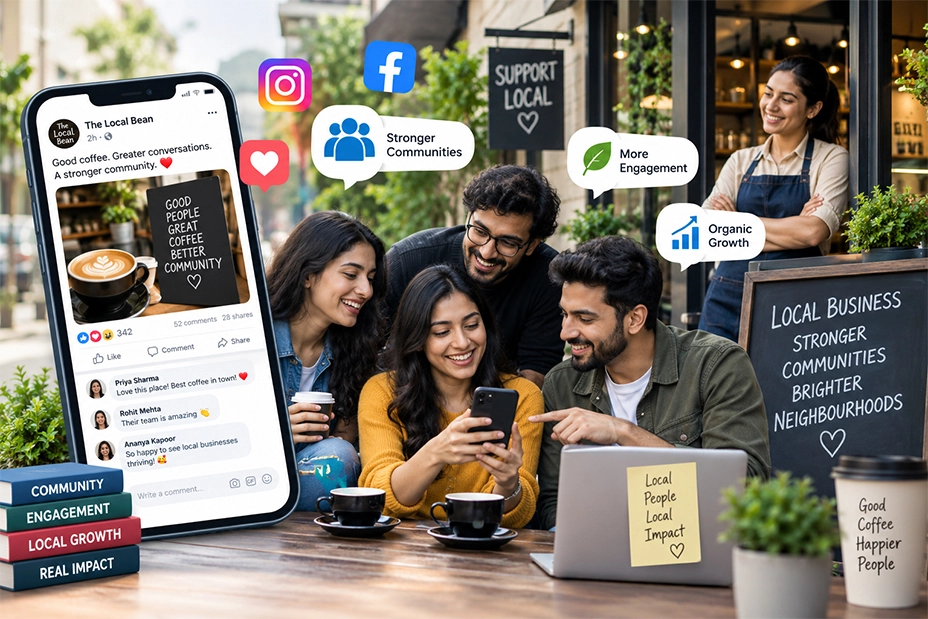
Not every customer begins with a search.
Someone might see a local restaurant on TikTok, discover a hairstylist through Instagram, or hear about a contractor through a neighborhood Facebook group.
In these situations, the customer discovers the business before actively searching for it.
Social platforms have a large reach in the U.S. Pew Research Center’s 2025 research found that 84% of U.S. adults use YouTube, 71% use Facebook, 50% use Instagram, and 37% use TikTok. Usage also varies significantly by age, with younger adults more likely to use several of these platforms.
The size of these audiences makes social media relevant to local customer discovery, but the opportunity is not simply about having more followers.
Are People Using Social Media to Discover Businesses?
Social platforms can expose customers to businesses while they are consuming content rather than actively looking for a provider.
A potential customer might encounter:
- A local recommendation
- A customer story
- A before-and-after result
- A service demonstration
- An educational video
- A local event
- A creator or community recommendation
This is what makes social media for local business different from traditional search.
Google often captures an existing need.
Social media can create awareness before the search happens.
What Makes Social Media Different From Traditional Search?
Consider someone who wants to renovate their bathroom.
They could search Google for:
“Bathroom remodeling company near me.”
But they might first encounter a local contractor’s before-and-after video on Instagram or TikTok.
They watch the video, visit the company’s profile, look at more projects, search the company on Google, read reviews, and eventually request a quote.
The journey might look like:
Social → Google → Reviews → Website → Contact
The exact path will vary from customer to customer. The important point is that social media can become the first touchpoint, while search, reviews, and websites help the customer evaluate the business.
Why Does Local Content Matter?
Local businesses have an advantage on social media because they can show customers what their work, service, products, or customer experience actually looks like.
Useful content can include:
- Before-and-after results
- Customer stories
- Educational videos
- Behind-the-scenes content
- Local events
- Product demonstrations
- Service explanations
- Answers to common questions
For example, a local roofing company could explain what happens during a roof inspection instead of simply posting, “We offer roofing services.”
That kind of content answers a real customer question while demonstrating practical knowledge.
The goal is not simply to post more. It is to create content that helps people discover your business, understand your expertise, and decide whether you are worth considering.
Why Do Customer Reviews Matter So Much for Local Business Growth?
Getting discovered does not guarantee a customer.
Once people find your business, they still need to decide whether they trust it.
Reviews help provide evidence from people who have already interacted with the business.
BrightLocal’s 2026 Local Consumer Review Survey found that 97% of consumers read reviews for local businesses, while 41% said they always read them.
That makes reviews an important part of the local customer journey.
Why Do Customers Read Online Reviews?
A business website tells customers what the company says about itself.
Reviews can show what customers say about their experience.
People may look at:
- Overall ratings
- Written experiences
- Recent reviews
- Recurring complaints
- Positive experiences
- Business responses
- How problems were handled
For example, imagine two local contractors offering similar services.
One has a strong collection of recent reviews describing the quality of its work and customer service. The other has very little recent feedback.
The difference may affect which company a customer feels more comfortable contacting.
Do Businesses Need Perfect Five-Star Reviews?
Not necessarily.
A perfect-looking profile is not the same thing as a trustworthy reputation.
Customers can evaluate the substance of reviews, how recent they are, and whether the experiences described seem relevant to their needs.
The better goal is not to manufacture perfect feedback. It is to deliver a strong customer experience and make it easy for genuine customers to leave honest reviews.
Why Does Responding to Reviews Matter?
Reviews also give businesses an opportunity to demonstrate how they communicate with customers.
A thoughtful response can:
- Thank customers for positive feedback
- Acknowledge concerns
- Provide appropriate context
- Show that feedback is being taken seriously
- Demonstrate professionalism
Google itself recommends responding to reviews and notes that helpful replies can help a business stand out.
A negative review does not automatically define a business. The response can become another piece of information that potential customers consider.
Reviews Connect the Entire Discovery Journey
Consider the journey:
Social → Google → Reviews → Website → AI
A customer may discover you on one platform and validate you on another.
Reviews can therefore serve as a bridge between visibility and trust.
That is why reputation management should not be treated as a separate task from local marketing. It is part of the customer decision process.
Also read: Google Business Profile Audit (2026): What Changed and Why You Are Not Ranking
A Winning Blueprint for Service Companies to Thrive Across Search, Social, and AI
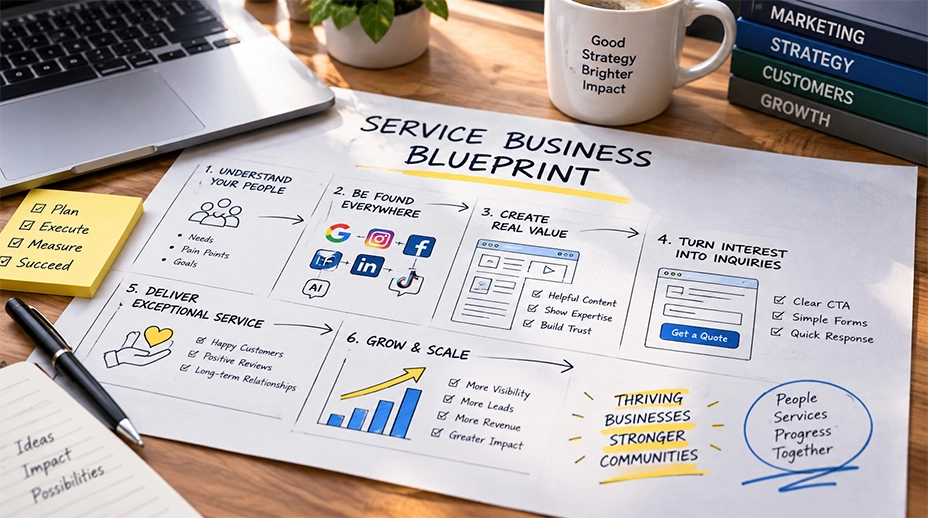
The goal is not to choose between Google, social media, reviews, or AI.
It is to build a digital presence where each channel supports the next stage of the customer journey.
1. Make Your Business Easy to Find
Start with the information customers need most.
Make sure you have:
- A complete and verified Google Business Profile
- Clear local SEO signals
- Accurate business hours
- Clearly defined services
- Accurate locations or service areas
- A useful website
- Relevant social profiles
- Consistent information across important platforms
Google recommends keeping Business Profile information complete and accurate because this helps customers understand what the business does, where it is, and when they can visit.
2. Give Customers a Reason to Trust You
Visibility gets you considered.
Credibility helps you get chosen.
Build that credibility through:
- Genuine customer reviews
- Real photos and videos
- Helpful educational content
- Customer experiences
- Case examples
- Professional review responses
- Evidence of your expertise
Do not rely entirely on claims such as “best,” “top-rated,” or “number one.”
Show customers why they should believe you.
3. Create Content That Helps Customers Choose
Customers often have questions before they are ready to contact a business.
Answer those questions directly.
For example:
- What does the service include?
- How does the process work?
- How long does it usually take?
- What should customers prepare?
- What problems can the service solve?
- What are the differences between available options?
- What should someone ask before hiring a provider?
This is where useful content can become a competitive advantage.
You are not simply targeting a keyword. You are helping a potential customer make a better decision.
4. Use Social Media for Discovery, Not Just Engagement
Likes and comments are not the entire purpose of local social media.
Your content should help move potential customers through a broader journey:
Discover → Remember → Research → Trust → Contact
A customer might see a video today, visit your profile next week, search your business later, read reviews, and eventually become a lead.
That makes local business social media marketing part of customer acquisition rather than simply a follower-growth exercise.
5. Prepare for AI Without Abandoning Search
AI is changing how people access information, but businesses do not need to chase every new AI tactic.
Focus on what you can control:
Accurate. Consistent. Helpful. Relevant. Trustworthy.
Keep your business information current. Explain your services clearly. Publish useful content. Maintain your reputation. Make your locations and service areas easy to understand.
There is no guaranteed shortcut to appearing in an AI recommendation.
The more durable strategy is to build a digital presence that gives customers and search systems reliable information wherever they encounter your business.
Make your business easier to find.
Be visible where your customers search, browse, compare, and decide. Reach more local customers with Brisbane digital marketing.
GET STARTED
Conclusion: Local Business Discovery Is No Longer Just About Google
Customers no longer have to follow one path to find a local business.
They might discover you through Google, find you on Maps, see your content on Instagram, read reviews, visit your website, and use AI to research their options.
Google still matters. Social media matters. Reviews matter. AI is becoming part of the picture too.
The businesses best positioned for this changing environment are not necessarily the ones trying to dominate one platform. They are the ones making their business easy to find, easy to understand, and easy to trust across the customer journey.
Ready to Make Your Business Easier to Find?
Your customers are already searching, browsing, comparing, and asking questions across multiple channels. Engage Coders can help connect your SEO, local search, social media, and AI visibility into a strategy designed around how customers discover and evaluate businesses today.
FAQs
Customers use several channels, including Google Search, Google Maps, online reviews, social media, websites, recommendations, and increasingly AI-powered search experiences. The exact journey depends on the customer’s needs and where they are in the buying process.
Yes. Social platforms can introduce customers to businesses before they actively search for them. Instagram, TikTok, Facebook, and YouTube give local businesses opportunities to showcase products, services, customer experiences, and useful content. Pew Research Center reports substantial U.S. adult usage across these platforms.
AI can help customers ask more detailed questions and receive summarized information or recommendations. However, AI does not eliminate the need for traditional search. Customers can still verify businesses through Google, Maps, reviews, websites, and social media.
Reviews give potential customers information about other people’s experiences. BrightLocal’s 2026 research found that 97% of consumers read reviews for local businesses. Reviews can therefore play an important role when customers compare local businesses.
Yes. Social media and AI add discovery opportunities, but they do not make local search irrelevant. Businesses still need accurate information, strong local visibility, useful website content, and a trustworthy reputation. The opportunity is to connect these channels rather than depend on only one.
Share this post
Related Posts

Beyond the Grim: Takeaways from Liquid Death’s Journey
Liquid Death, a canned water... read more


The Right Way to Achieve Representation in Marketing
Welcome to Breaking the Blueprint... read more

Social Proof Backfire: The Marketing Mistake Costing You Conversions
In the early 2000s, something... read more

How Businesses Can Thrive During an Economic Downturn
During times of economic uncertainty,... read more

How to Create Your Buyer Personas: the What, the Why, and the How
The most effective marketers go... read more