
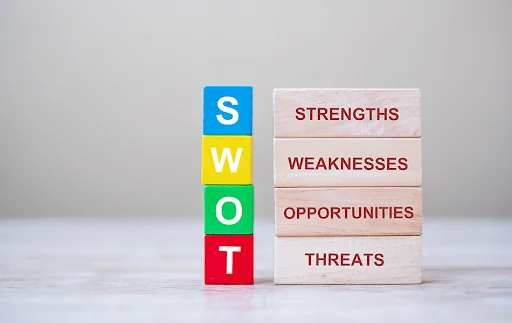
SWOT Analysis: How to Do It, Examples, & Free Template
A SWOT analysis is a method that looks at a business’s strengths, weaknesses, opportunities, and threats. Doing a SWOT analysis can help us make smarter choices for our business.
We usually create a chart with four parts:
- What we do well (strengths)
- What we need to improve (weaknesses)
- Chances we can take to grow (opportunities)
- Problems that might hurt our business (threats)
In this post, we’ll explain how to do a SWOT analysis. We’ll show examples and also share a free SWOT template. But first, let’s understand why doing this is useful.
Why Is It Important to Do a SWOT Analysis?
A SWOT analysis helps us look at our business from different sides. It lets us find ways to improve and grow faster.
When we do a SWOT analysis, we can:
- Use our strengths to stay ahead of others
- Fix our weaknesses before they create problems
- Find new chances to grow
- Prepare for problems that might happen
This means:
A SWOT analysis helps us plan better, avoid risks, and reach our goals faster.
What Are the Parts of a SWOT Analysis?
A SWOT analysis looks at four key areas: strengths, weaknesses, opportunities, and threats.
Here’s how to think about each part:
Strengths:
These are the good things that give our business an advantage—things we do well and are proud of.
Some examples of strengths are:
- Loyal customers
- A strong brand name
- A special product or service
- A skilled and happy team
- A good website
- Weaknesses
These are the things we don’t do well and need to work on. They can slow down our growth or cause issues.
Some examples of weaknesses are:
- Not enough money to grow
- Many employees are leaving often
- A weak online presence
- Unhappy customers
- A product that needs better quality
Opportunities
Opportunities are good chances or changes around us that we can use to reach our business goals. Some examples of opportunities in a SWOT analysis are:
- More people want our product or service
- Finding a new group of customers
- A new tool that saves time by doing simple tasks
- A chance to work with another company
Threats
Threats are outside problems that can hurt our business. We need to spot them early. Some examples of threats are:
- Fewer people wanting what we offer
- A new company selling similar products
- A new tool that replaces one of our services
- Bad news or poor reviews about our brand
- New rules or changes in policy
How to Do a SWOT Analysis (with Examples)
A SWOT analysis helps us look at our strengths, weaknesses, opportunities, and threats. But it’s more than just a list. It helps us plan smarter and move our business forward.
Here’s how to do it step by step:
1. Start with a Clear Purpose:
We need to know why we are doing the SWOT analysis. What decision do we want help with?
For example, we may want to:
- Decide if we should grow into a new area
- Think about offering new products or services
- Decide if we should change how we manage our team
2. Assess Strengths:
Now, we list what our business does well. Ask questions like:
- What do we do better than others?
- What tools or people give us an advantage?
- What helpful data or feedback do we already have?
- What resources do we own, like a skilled team or great photos?
Even small strengths count—write everything down.
Examples of Strengths (for paid ads)
- Strong brand that people know and trust
- A team that understands online marketing
- A big email list to use in ad targeting
- Great photos and videos of our products
- Low prices that we can highlight in ads
3. Uncover Weaknesses:
Next, we write down areas where we are not strong. This helps us find ways to improve.
Ask ourselves:
- Where are others doing better than us?
- What knowledge or tools are we missing?
- What parts of our business are not doing well?
- Are there any gaps in our plan?
The good thing is that weaknesses are within our control. We can fix them.
Examples of Weaknesses (for paid ads)
- Small marketing budget
- No clear idea of who our perfect customer is
- Old website design that’s hard to use
Sometimes, we need tools to spot weak points. For example, we might use Semrush’s Site Audit tool. It may show our website takes 4.2 seconds to load. That’s a problem because slow websites can lead to fewer sales.
4. Look at Opportunities:
Opportunities are outside changes or chances that can help us grow. Here are some questions to help us spot them:
- Are there new trends we can use?
- Can we try any new tools or technologies?
- Are there things our competitors aren’t doing?
- Are customer habits changing in a way that we can benefit from?
Examples of Opportunities
Here are some simple examples of good chances to use digital ads:
- A new social platform is becoming popular and now allows ads
- Some big competitors are cutting down their ad budgets
- Platforms like YouTube or TikTok have added new ways to target people
- More people are looking for learning content in our field
We can find these chances more easily with helpful tools. For example, we can use the Advertising Research tool to check the keywords that our competitors are using—and find ideas to try ourselves.
5. Find Threats:
Threats are outside things that might harm our business. But we can prepare for them. Ask these questions to spot threats:
- What are our competitors doing that could affect us?
- Are there any bad trends in our field?
- Are customer habits changing in a way that could hurt us?
- Are there any new rules or money problems that could be risky?
If we stay updated about our market, we likely know some of the major threats.
Examples of Threats
Here are some threats we might face with digital ads:
- Ad costs are going up on many platforms
- New companies are joining with big discounts
- People are starting to trust ads less
- An economic slowdown might reduce customer spending
We can use Traffic and Market tools to track new competitors, changes in traffic, or shifts in what people are interested in—all signs of possible threats.
6. Make a Decision and Plan Actions:
Once we have added enough points in each SWOT box, we can use them to decide what to do. If we choose to move forward, we also need a simple plan to reach our goal.
We can start by thinking about:
- Do the good parts (strengths and chances) beat the risks (weaknesses and threats)?
- Can we use our strengths to grow with the help of those chances?
- Can we fix or manage the weak points and threats?
For our digital ads example, let’s say we choose to go ahead with the plan.
Here’s a basic action plan we could follow:
Build on strengths:
- We already have brand awareness, so people may recognize our name.
- We can use our marketing team to make eye-catching ads.
- We can also use our email list to send ads to people who already know us.
Fix weaknesses:
- We should better understand who our target customer is.
- We can update our website so it’s easy to use.
- Let’s test small ad budgets on different platforms before going all in.
Use opportunities:
- Try ads on a new social media app while it’s still fresh.
- Make a short learning content series and use it to attract people.
- Use new ad tools to better reach the right people.
Handle threats:
Create a strong brand message that makes us stand out. Keep ad spending smart and track what works so we don’t waste money.
Free SWOT Analysis Template
Here’s a free SWOT template we can use to think clearly about each part.
This simple layout helps us organize thoughts in a useful way.
Tips to get more out of it:
- Use clear, specific words—not just general ideas
- Check each point with others in the team
- Think about how each box connects (like how a strength helps with a chance)
- After finishing the SWOT, decide if your goal is worth it—and if yes, make a plan
Real-Life SWOT Analysis Examples
Let’s see how a full SWOT analysis works with two examples:
- One big company that is making big plans
- One small business with a new idea
Meta’s AI Investment SWOT Example
In 2025, Meta is putting a lot of money into AI while facing strong rivals like OpenAI and Google.
Should Meta keep spending so much on AI to stay ahead?
Let’s do the SWOT:
Action Plan for Meta
Build on strengths:
Meta can use its huge number of users to test its AI tools. It has the money to invest more or buy smaller AI companies.
Fix weaknesses:
Meta needs to be open about how its AI uses data. The company also needs to move faster and cut delays.
Use opportunities:
Meta can create AI tools for special tasks like coding. They can share some of their tools as open source to gain trust.
Handle threats:
To stay ahead, Meta should launch tools often and improve based on feedback. They should also work with leaders to follow future rules on AI.
Fashion Boutique SWOT Example (Small Business)
Let’s say we run a small fashion shop that sells clothes from different designers. Now, we’re thinking about launching our own clothing line.
Our Goal: Decide if starting a private clothing line is a smart move.
Action Plan
Build on strengths:
- We know our customers and what they like.
- We understand fashion and what’s trending.
- Our brand is already well-known, and we know people in the fashion world.
Fix weaknesses:
- Start small with only 5–10 main items.
- Work with a local designer to create styles.
- Focus on making good-quality products.
Use opportunities:
- Share our story on social media to get people excited.
- Show how the clothes are made—it helps people feel connected to us.
Handle threats:
- Make classic pieces that don’t go out of style fast.
- Talk to the current designers we work with and stay open with them.
- Start with a small budget so we don’t risk too much money.
Partner with our Digital Marketing Agency
Ask Engage Coders to create a comprehensive and inclusive digital marketing plan that takes your business to new heights.
Contact Us
Understand Your Business & Reach Your Goals
A SWOT analysis helps us make smart choices. It lets us plan well and set goals that we can reach.
If we haven’t done it yet, let’s download the free SWOT template. Take your time. Think clearly. And use your SWOT to take the right steps forward.


