
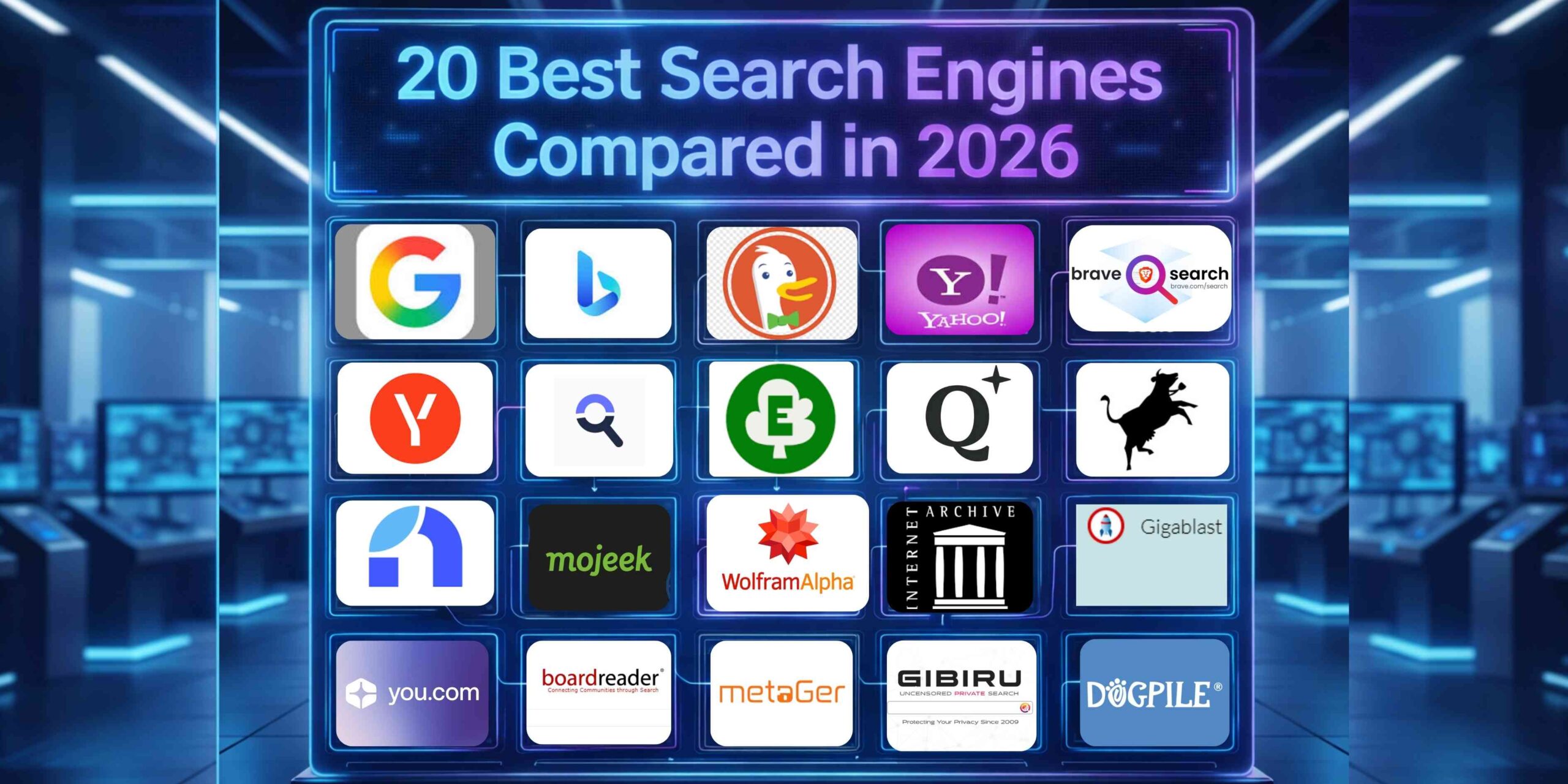
20 Best Search Engines Compared in 2026
Search engines are the primary gateways to the digital world. While Google continues to maintain its massive footprint, 2026 has seen a significant shift in user behavior. Privacy is no longer a “niche” concern, it’s a standard requirement. Furthermore, the integration of Generative AI has transformed search from a list of links into a conversational experience.
Whether you are a business owner looking for better visibility or a user seeking specialized results without data tracking, choosing the right tool is essential. Here is our in-depth comparison of the 20 best search engines in 2026, including their strengths, limitations, and ideal use cases.
Table of Content
The Top 20 Search Engines for 2026
1. Google
Google remains the most widely used and powerful search engine globally. Since its inception in 1998, it has consistently evolved, incorporating cutting-edge technologies like machine learning and natural language processing to deliver increasingly accurate results. Google’s personalized results, real-time indexing, and integration with services like Gmail, YouTube, and Maps make it the most convenient and comprehensive platform.
However, Google’s greatest strength—deep personalization—is also its biggest concern for privacy advocates. Google collects significant amounts of user data, and its search results are often crowded with ads. Despite these drawbacks, Google remains unmatched for general use, technical searches, and instant access to a vast library of indexed content.
Launched: 1998
Market Share: ~91% globally
Overview:
Google remains the world’s most-used search engine. Its AI-powered algorithms offer highly relevant results, and its ecosystem includes Maps, Gmail, YouTube, and Chrome, creating a deeply integrated experience.
Key Features:
- Advanced AI ranking systems (e.g., BERT, MUM)
- Voice, image, and visual search
- Personalized results based on browsing history
Limitations:
- Heavy data tracking
- Personalized results can limit exposure to new content
- Ad-heavy SERPs (Search Engine Results Pages)
Best For:
Anyone who values speed, comprehensiveness, and advanced functionality over privacy.
2. Bing
Microsoft’s Bing has become a respectable alternative to Google, offering competitive search functionality with a visual edge. It provides particularly strong image and video search results and seamless integration with Microsoft services like Windows, Edge, and Office. Bing’s AI enhancements, such as predictive search and visual lookup, continue to improve the overall experience.
Bing is also praised for its Microsoft Rewards program, which lets users earn points for searches. While it’s still not as strong in technical or academic queries, Bing is a good general-purpose search engine, especially for users embedded in Microsoft’s ecosystem.
Launched: 2009 (by Microsoft)
Market Share: ~3% globally
Overview:
Bing has matured significantly, offering high-quality image search and better integration with Microsoft services like Windows and Edge.
Key Features:
- AI-powered image and video previews
- Shopping and reward features (Microsoft Rewards)
- Copilot (AI chat integration)
Limitations:
- Less relevant for niche or technical searches
- Fewer localized results in some regions
Best For:
Users already in the Microsoft ecosystem or looking for a visually rich search.
3. DuckDuckGo
DuckDuckGo is a leading privacy-first search engine that refuses to track users or personalize search results based on past behavior. It relies on a mix of sources, including Bing and its own crawler, to deliver neutral results. This engine has gained popularity among users concerned about surveillance and targeted advertising.
Despite its simplicity, DuckDuckGo is remarkably effective for everyday searches and offers unique features like “!bang” shortcuts, which allow users to search specific websites directly. While it lacks advanced search tools and local customization, its appeal lies in offering a straightforward and private browsing experience.
Launched: 2008
Market Share: Growing, especially in privacy-conscious circles
Overview:
DuckDuckGo positions itself as a privacy-first search engine. It doesn’t collect user data or track search behavior.
Key Features:
- No tracking, ever
- Instant answers
- Bangs (shortcuts to search other sites)
Limitations:
- Relies heavily on Bing and other sources
- Lacks deep personalization
Best For:
Users who prioritize privacy and want a simplified, ad-minimized experience.
4. Yahoo
Yahoo once led the early days of internet search. Today, its search engine is powered by Bing, though the broader Yahoo platform still includes popular tools like Yahoo Finance, News, and Mail. Yahoo serves more as a media portal than a cutting-edge search engine, but millions of loyal users still use it.
Its user interface tends to be cluttered with ads and content blocks, which can slow down searches. Yahoo’s value lies in its familiar design and its bundled services, making it ideal for users who prefer an all-in-one homepage.
Launched: 1994
Current Technology: Powered by Bing
Overview:
Yahoo was once a dominant player in the early internet era. Now, it serves as a content hub with search powered by Bing.
Key Features:
- Integrated with Yahoo News, Mail, and Finance
- User-friendly interface
Limitations:
- Search quality is similar to Bing
- Cluttered layout
Best For:
Long-time Yahoo users or those looking for a portal-style homepage.
5. Brave Search
Launched by the team behind the Brave Browser, Brave Search is gaining ground as a privacy-focused, independent search engine. Unlike DuckDuckGo, which pulls from third-party indexes, Brave is building its own crawler-based index. It does not track users or rely on big tech infrastructure.
Brave’s results are improving over time, though the platform still lags in niche and long-tail search queries. The company also offers “Goggles,” a tool that lets users customize how results are filtered and ranked. Brave Search is best suited for users who want total transparency and control over their search experience.
Launched: 2021
Overview:
Built by the makers of the Brave browser, Brave Search is privacy-first and independent, with its own index.
Key Features:
- 100% private
- Independent indexing
- No search profiling
Limitations:
- Still building scale and depth
- May lack niche content
Best For:
Privacy enthusiasts looking for a non-Google, non-Bing experience.
6. Yandex
Yandex is Russia’s most popular search engine and a major tech company in its own right. It provides a wide range of services, including email, maps, and cloud storage. Yandex is highly optimized for the Russian language and regional search, often outperforming Google in that context.
It offers innovative tools like an AI-powered assistant named Alice and advanced translation features. While Yandex may not be ideal for English-speaking users outside of Eastern Europe, it remains the go-to engine in its native market. Privacy concerns and limited global relevance are its main limitations.
Launched: 1997 (Russia)
Overview:
Yandex is the most used search engine in Russia, with powerful AI tools and localized features.
Key Features:
- Strong in Russian language content
- AI assistant (Alice)
- Mapping and navigation
Limitations:
- Privacy concerns outside of Russia
- Limited relevance in English-language searches
Best For:
Russian-speaking users and those needing local Russian content.
7. Startpage
Startpage provides a unique blend of privacy and search quality. It delivers Google search results but strips away trackers, cookies, and identifiable data. Based in the Netherlands and subject to strict EU privacy laws, Startpage is transparent about its practices and offers private browsing with a built-in proxy.
Although the results mirror Google’s results, the lack of personalization may make them feel less tailored. For users who want Google’s powerful results without sacrificing privacy, Startpage is an excellent choice.
Launched: 1998 (Netherlands)
Overview:
Startpage delivers Google search results while stripping away trackers and IP logging.
Key Features:
- Google-powered results
- Full privacy protection
- Proxy browsing
Limitations:
- Slower due to privacy processes
- No personalized results
Best For:
Users who want Google-level results without compromising their data.
8. Ecosia
Ecosia is a search engine with an environmental mission: it uses profits from ad revenue to plant trees. Based on Bing’s search technology, Ecosia has funded millions of trees globally through user searches. It’s transparent about its finances and publishes monthly financial reports.
The engine is simple to use and offers a pleasant UI, although it may lack the depth of Google or Bing when it comes to complex queries. Still, for eco-conscious users who want their online habits to contribute to sustainability, Ecosia is an inspiring and practical alternative.
Launched: 2009
Mission: Reinvests ad revenue into tree planting
Overview:
Ecosia uses Bing’s engine and donates 80% of profits to environmental projects.
Key Features:
- Transparent donations
- Carbon-neutral operations
- Chrome and Firefox extension
Limitations
- Depends on Bing’s accuracy
- Not ideal for technical or niche queries
Best For:
Eco-conscious users want to make a small impact while browsing.
9. Qwant
Qwant is a European search engine based in France, with a firm commitment to privacy and neutrality. It does not track users or apply behavioral profiling, making it compliant with GDPR and attractive to privacy-aware users in the EU.
Its interface includes categories like News, Social, and Music, aiming to provide a more diversified search experience. Though Qwant is slower than larger engines and sometimes returns less relevant results, its clean data practices make it a trusted choice for families and educators.
Launched: 2013 (France)
Overview:
Focused on user privacy and neutrality, Qwant is popular in the EU.
Key Features:
- No tracking or cookies
- Music and social tabs
- Kid-safe filtering (Qwant Junior)
Limitations:
- Slower result generation
- Less advanced ranking algorithm
Best For:
Families, schools, and EU-based users valuing local regulation-compliant privacy.
10. Swisscows
Swisscows is another privacy-focused engine, headquartered in Switzerland—a country known for its strict data protection laws. It markets itself as a family-friendly option, filtering out explicit content and avoiding data collection entirely.
Unlike most engines, Swisscows uses semantic search to better understand user intent, though this system may not always return the most accurate or up-to-date results. It’s best for casual searches, safe environments, and users who value online anonymity.
Launched: 2014 (Switzerland)
Overview:
Promotes privacy and semantic search without storing personal data.
Key Features:
- Semantic map of search topics
- Based in a privacy-focused country
- Family-friendly filtering
Limitations:
- Not great for deep research
- Smaller index
Best For:
Educational institutions, families, and general users in need of a safe browsing space.
11. Neeva (Discontinued 2023)
Neeva was a bold experiment in subscription-based search. Created by former Google executives, it promised an ad-free, privacy-respecting experience. While the product gained attention, it ultimately shut down in 2023 due to scalability and adoption challenges.
Neeva’s legacy lies in showing that users are willing to pay for a better search experience. Its emphasis on removing clutter and improving result quality inspired new models in search development.
Overview:
Neeva offered an ad-free, subscription-based search engine model. Though shut down, it helped inspire better user-focused innovations.
Legacy Impact:
- Introduced clean SERPs
- Advocated for consumer-first search models
12. Mojeek
Mojeek is a rare example of a fully independent search engine—it crawls and indexes the web with its own technology. Founded in the UK, Mojeek offers a privacy-focused alternative that does not track users or rely on third-party engines.
Its index is smaller than those of the giants, so it may not always surface the most relevant or timely content. However, for researchers and tech-savvy users who want to break away from big tech influence, Mojeek offers a truly independent perspective.
Launched: 2004 (UK)
Overview:
One of the few search engines with its own independent crawler and index.
Key Features:
- No user tracking
- Fully independent index
- Based in the UK
Limitations:
- Limited index coverage
- Slower updates
Best For:
Researchers or users wanting true search independence.
13. WolframAlpha
WolframAlpha is not a traditional search engine. Instead, it functions as a computational knowledge engine. It’s designed to answer factual, scientific, and mathematical questions using a massive database of curated information.
Rather than returning a list of links, it delivers computed answers, graphs, and visual models. WolframAlpha is ideal for students, engineers, data analysts, and anyone needing direct, analytical answers—not general web content.
Launched: 2009
Overview:
Not a traditional search engine—WolframAlpha is a “computational knowledge engine” best for math and science.
Key Features:
- Solves equations
- Provides visual data representations
- Academic-grade data
Limitations:
- Not useful for general browsing
- Requires structured input
Best For:
Students, researchers, and professionals in STEM.
14. Internet Archive (Wayback Machine)
The Internet Archive’s search engine isn’t meant for live browsing but is essential for anyone conducting digital history or research. Its Wayback Machine lets users view old versions of websites, providing a snapshot of the internet over time.
It’s not a substitute for real-time search but is invaluable for tracking content changes, verifying citations, or studying how web presence has evolved. Researchers, journalists, and archivists often turn to this tool for its unparalleled access to internet history.
Launched: 2001
Overview:
Provides snapshots of over 600 billion web pages across time.
Key Features:
- Historical site archives
- Open-source library access
- No commercial intent
Limitations:
- Not a live search engine
- Data may be outdated
Best For:
Web historians, researchers, and journalists.
15. Gigablast
Gigablast is an open-source search engine with its own web crawler. Though not as refined or widely known, it’s popular in the academic and developer communities due to its transparency and flexibility.
Its UI is basic, and search results can be inconsistent, but Gigablast represents an important effort in search decentralization. It allows independent researchers to test and experiment with alternative indexing models.
Launched: Early 2000s
Overview:
An open-source engine that indexes independently but lacks polish.
Key Features:
- API access for developers
- Lightweight infrastructure
Limitations:
- Outdated interface
- Inconsistent results
Best For:
Technical users or developers exploring open-source search.
16. You.com
You.com is a modern, AI-powered search engine focusing on productivity and personalization. It offers “apps” within the results page, letting users view code snippets, summaries, Reddit posts, or YouTube videos all in one place.
Its integrated AI tools help summarize answers or write content on the fly, making it appealing for creators, students, and professionals. While it’s still growing its user base, You.com offers a unique, modular search experience.
Launched: 2021
Overview:
An AI-powered search engine that integrates apps directly into results.
Key Features:
- Customizable results
- Chat AI integration
- Summarized answers
Limitations:
- Newer engine with limited user base
- May not return traditional results
Best For:
Tech-savvy users and professionals who multitask across platforms.
17. Boardreader
Boardreader specializes in scanning forums and message boards. It surfaces user-generated content from places that standard search engines often overlook. This makes it ideal for finding community discussions, product reviews, or historical forums.
However, its relevance has declined as more discussions have moved to platforms like Reddit and Discord. Boardreader still remains useful for those researching older or niche forum content.
Overview:
Searches forums, message boards, and community discussions.
Key Features:
- Searches unique user-generated content
- Filters by source and time
Limitations:
- Doesn’t cover modern social platforms
- The interface is outdated
Best For:
Finding discussions on niche or legacy topics.
18. MetaGer
MetaGer is a German-based metasearch engine that aggregates results from multiple sources without logging personal information. It offers transparency in how results are ranked and allows anonymous proxy viewing of websites.
Though slower than mainstream engines, MetaGer serves privacy-conscious users well, especially in Europe where data compliance is strictly enforced.
Launched: 1996 (Germany)
Overview:
A metasearch engine that combines multiple sources with strong privacy policies.
Key Features:
- Open-source platform
- Proxy browsing
- Does not profile users
Limitations:
- The interface can feel clunky
- Slower than modern engines
Best For:
EU users or those looking for transparency and multi-source results.
19. Gibiru
Gibiru brands itself as an uncensored search engine that doesn’t track users. It claims to show results that might otherwise be filtered by mainstream engines. While it appeals to users seeking alternative viewpoints, its interface and index are less polished.
Due to a lack of documentation and third-party verification, its claims should be viewed critically. Still, it provides an option for those curious about less filtered search experiences.
Overview:
Markets itself as a censorship-resistant search engine.
Key Features:
- No logs or user tracking
- Emphasizes uncensored results
Limitations:
- Lacks quality assurance
- Lower index depth
Best For:
Users seeking alternative perspectives or information beyond mainstream SERPs.
20. Dogpile
Dogpile is a nostalgic metasearch engine aggregating results from Google, Yahoo, Yandex, and others. Originally popular in the early 2000s, it offers a minimalist interface and simple result merging.
While it may feel outdated by today’s standards, Dogpile still functions reliably and can be helpful for cross-checking results from multiple engines in one go.
Launched: 1996
Overview:
A metasearch engine that aggregates results from Google, Yahoo, and Yandex.
Key Features:
- Combining top search engines
- Simple, classic interface
Limitations:
- Outdated design
- Not optimized for mobile
Best For:
Users nostalgic for early 2000s-style search layouts or those who want combined SERPs
Partner with our Digital Marketing Agency
Ask Engage Coders to create a comprehensive and inclusive digital marketing plan that takes your business to new heights.
Contact Us
Why Your Choice of Search Engine Affects Your Business Growth
As a Growth Catalyst, we at Engage Coders look beyond just the “user” side. For business owners, the diversity of search engines in 2026 means your Digital Marketing Strategy must be multi-faceted.
If you only optimize for Google, you miss the privacy-first audience on DuckDuckGo or the AI-driven traffic from Bing and You.com. In 2026, “Search” is about visibility across platforms, not just ranking for a single keyword.
The Rise of Generative Search Optimization (GSO)
In 2026, traditional SEO has evolved into GSO. This involves ensuring your brand’s data is easily digestible by AI crawlers (like those used by Bing and Google SGE) so that your business is recommended in conversational answers.
Final Thoughts: Choosing the Right Search Engine
In 2026, the best search engine depends on your priorities. Google and Bing still lead if you want the most comprehensive and seamless experience. For privacy, DuckDuckGo, Brave, and Startpage are excellent alternatives. Ecosia gives you an eco-friendly reason to search, while WolframAlpha and the Internet Archive serve academic and research-focused needs.
No single engine fits everyone. Try a few and find the one that best matches your goals, speed, accuracy, ethics, or control.
Let me know if you’d like this as a downloadable document, ready-to-upload HTML, or social media snippets from this blog!
FAQs
Google remains the dominant leader with over 90% market share. Its massive index and advanced AI integration make it the primary choice for the vast majority of users globally.
Yes, engines like DuckDuckGo, Startpage, and Brave Search prioritize privacy. They do not track your IP address, search history, or create user profiles for advertising.
AI-powered engines, such as Bing (with Copilot) and You.com, use large language models to provide conversational answers and summaries rather than just a list of website links.
Yes, because each engine uses a unique algorithm and index. Factors like your location, search history (on personalized engines), and the engine’s data sources influence the final results.
Search engines like Ecosia use their profits to fund environmental projects like tree planting. While the impact per search is small, collectively they have planted over 200 million trees.
WolframAlpha is excellent for data and math, while Google Scholar and the Internet Archive are indispensable for finding peer-reviewed papers and historical data.
Engines like You.com and Brave (via “Goggles”) allow you to prioritize certain sources, such as Reddit or tech blogs, to make results more relevant to your specific needs.
Google and Bing are generally best for business due to their integration with productivity suites, while You.com is favored by developers for its integrated code-snippet apps.
Bing and Google are currently the leaders in visual search, offering advanced filters for licensing, size, and even the ability to search using an image as the query.
Most alternative search engines are free and supported by non-tracking ads. Some, like the now-defunct Neeva, explored subscription models, but the current market remains largely free-to-use.
Share this post
Related Posts

20+ Awesome SEO Blogs and Websites You’ll Want to Bookmark in 2026
SEO is always changing. Search... read more


Maximizing Efficiency: Top 15 Benefits of Cloud Computing for Businesses
Cloud computing has emerged as... read more


Why Mastering SEO Essentials Drives Digital Success in 2025
In a digital world buzzing... read more