
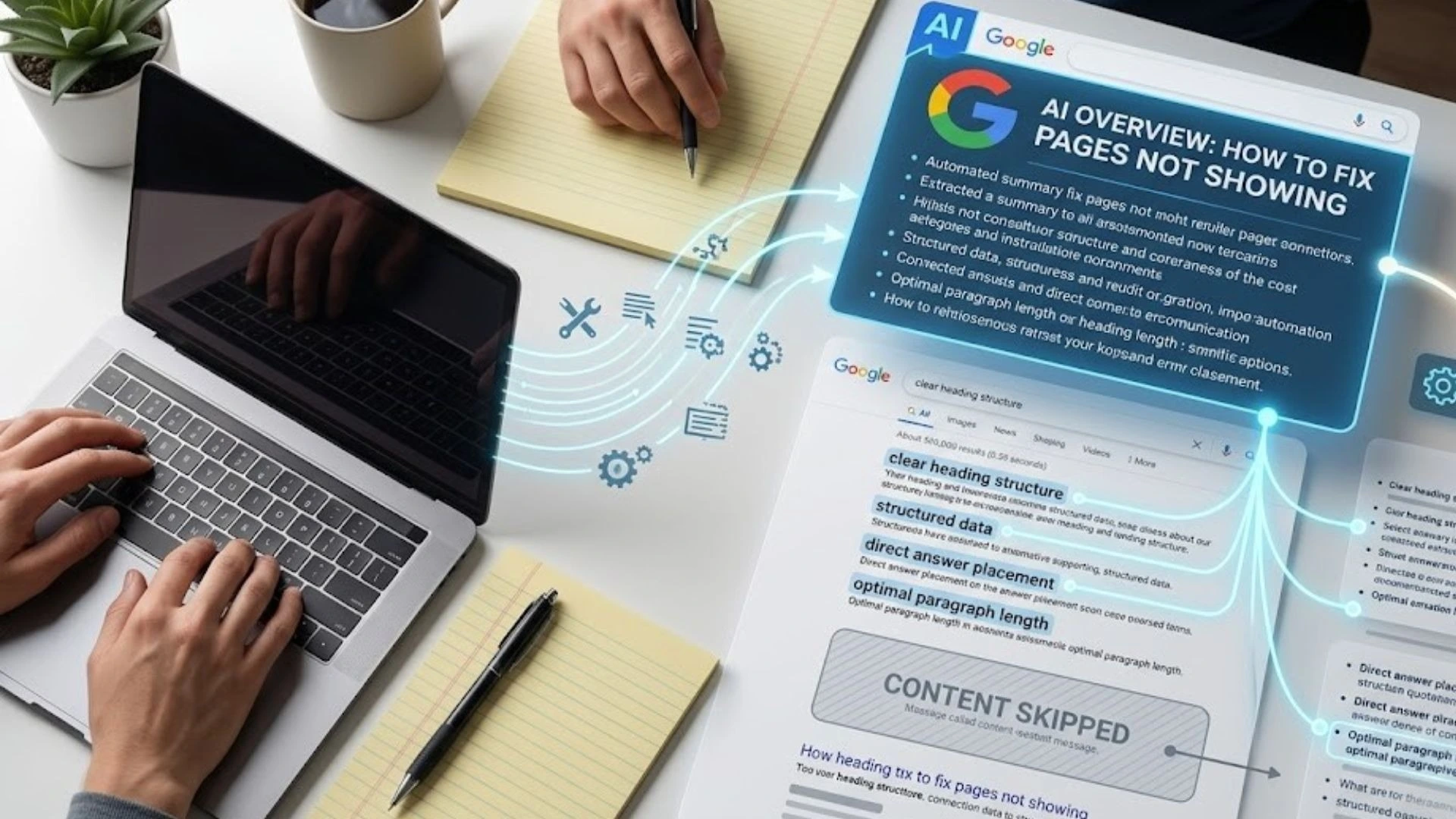
Why Your Content Isn’t Showing in AI Overviews (Even If It Ranks)
Why does your content rank on Google but still fail to appear in AI Overviews?
It is a frustrating situation. You invest time in writing, follow SEO best practices, and even secure a top position on the search results page. Yet, when Google generates its AI-powered summary, your content is missing.
The reason lies in a fundamental shift in how search works today. Google is no longer just ranking pages; it is selecting the most usable answers. AI Overviews are designed to pull quick, reliable, and easy-to-understand information. If your content is not built in a way that supports that, it simply gets skipped.
Understanding this difference is the first step toward fixing the problem.
Table of Contents
Why Does Google Skip Your Content for AI Overviews?
Is your answer buried instead of clearly visible?
AI Overviews prioritize content that answers the query immediately. If your page takes too long to get to the point, it gets ignored.
Most blogs still follow a traditional format:
- Long introductions
- Background context
- Answer placed further down
This does not work for AI systems.
They look for:
- A clear answer within the first 50–100 words.
- A statement that can be directly extracted and shown.
If your content delays the answer, Google will choose another source that provides it faster and more clearly.
Is your content structured in a way AI can easily understand?
Content structure plays a critical role in whether your page is selected. AI systems do not interpret content the way humans do; they rely on patterns, hierarchy, and formatting to identify useful information.
When your content consists of long, dense paragraphs without clear breaks, it becomes difficult for AI to extract meaningful insights. On the other hand, well-structured content signals clarity and organization.
Effective structure includes:
- Short, readable paragraphs
- Clear headings that define each section
- Bullet points or lists for key information
This type of formatting not only improves readability; it also increases the likelihood that specific sections of your content can be selected and summarized accurately.
Are you truly matching the user’s intent?
Another common issue is the gap between keywords and actual user intent. Ranking for a keyword does not necessarily mean your content answers the exact question a user is asking.
AI Overviews are highly intent-driven. They focus on conversational queries and expect precise answers. If your content is broad or slightly off-topic, it may still rank, but it won’t be selected.
For example, a general article may discuss multiple aspects of a topic, but if it does not clearly address the specific question, it becomes less useful for AI extraction.
To improve this, your content should:
- Address the exact question directly
- Use clear, conversational phrasing
- Avoid vague or generalized explanations
Does your content provide clear, quotable answers?
AI Overviews rely on extracting information that can be presented quickly and accurately. This means your content needs to include statements that are easy to quote and understand without additional context.
If your writing is overly complex, indirect, or filled with filler phrases, it becomes harder for AI to use. Strong content, on the other hand, presents information in a way that is both simple and precise.
For instance, instead of introducing an idea with multiple qualifiers, a direct statement delivers immediate value. This clarity not only benefits AI systems but also improves the user experience by reducing confusion.
Are you demonstrating real expertise and trust?
Google places a strong emphasis on E-E-A-T—Experience, Expertise, Authority, and Trust. This is especially important for AI Overviews, where accuracy and reliability are critical.
Content that lacks depth or feels generic is less likely to be selected. AI systems favor information that reflects real understanding and practical knowledge.
You can strengthen this by:
- Including real-world examples or use cases
- Sharing insights based on experience
- Providing clear and confident explanations
When your content shows that it comes from a knowledgeable source, it becomes more trustworthy and more likely to be used.
Is your content both concise and comprehensive?
There is an important balance to maintain. AI Overviews prefer concise answers, but they also prioritize pages that demonstrate depth and authority.
This means your content should work on two levels:
- A short, direct answer at the beginning
- A detailed explanation that follows
If your page is too short, it may lack credibility. If it is too long without a clear structure, it becomes difficult to extract information. The goal is to combine clarity with completeness, giving both quick answers and deeper insights.
Are technical factors limiting your visibility?
Sometimes, the issue is not just the content but how the content is presented behind the scenes.
Technical SEO plays a role in helping AI systems understand your page. Without proper structure, even high-quality content can be overlooked.
Important elements include:
- Schema markup (such as FAQ or Article schema)
- Clean HTML structure
- Accessible content that isn’t hidden behind scripts
These factors help search engines interpret your content more effectively and improve your chances of being included in AI-generated summaries.
Are you targeting queries that actually trigger AI Overviews?
Not every search result includes an AI Overview. These features are more commonly shown for informational queries rather than transactional ones.
If your content is heavily focused on selling or promoting a product or service, it may not align with the type of queries that trigger AI responses.
AI Overviews typically appear for:
- “What is…” questions
- “Why does…” queries
- “How to…” searches
Focusing on these types of queries increases the likelihood that your content will be considered.
How Can You Improve Your Chances of Being Selected?
Can you deliver the answer immediately?
AI Overviews prioritize content that answers the query without delay. If your page takes too long to get to the point, it is more likely to be ignored. The answer should appear within the first 50–100 words, written in a clear and direct way that can be easily extracted and understood without additional context.
Is your content structured for easy extraction?
Structure plays a key role in how AI systems interpret content. Well-defined headings, short paragraphs, and clearly separated sections make it easier for Google to identify important information. If your content feels dense or unorganized, it becomes harder for AI to extract useful answers from it.
Are you covering more than just one question?
AI Overviews often pull information from content that addresses a topic from multiple angles. Focusing on a single question limits your chances of being selected. Expanding your content to include closely related questions helps improve relevance and shows a deeper understanding of the topic.
Are you adding real, specific value?
Content that feels generic or overly broad is less likely to be used. AI systems prefer information that is clear, specific, and meaningful. Adding precise explanations or relevant examples makes your content more useful and increases its chances of being selected.
Are you supporting your content technically?
Even well-written content needs proper technical support. Clear heading structure, clean HTML, and the use of schema markup help search engines understand your page better. When your content is easy to interpret at a technical level, it becomes easier for AI systems to extract and use it.
Final Thoughts
AI Overviews clearly show how search is evolving. It is no longer just about rankings or keyword placement; it is about how effectively your content answers questions and how easily it can be understood and extracted.
Partner with our Digital Marketing Agency
Ask Engage Coders to create a comprehensive and inclusive digital marketing plan that takes your business to new heights.
Contact Us
For businesses and content creators, this shift requires a more focused approach. Content needs to be clear, well-structured, and aligned with real user intent. When your content delivers direct answers and meaningful insights, it becomes far more likely to be selected by AI systems regardless of its position in traditional rankings.
At Engage Coders, we help businesses improve their online visibility through SEO, content marketing, and website optimization. Our approach focuses on creating structured, high-quality content and performance-driven websites that align with how modern search systems work, including AI-powered results.
FAQs
AI Overviews are short summaries shown at the top of Google search results. They use AI to combine information from multiple sources and provide quick answers to user queries.
Your content may not appear if it lacks a clear answer upfront, is difficult to read, or does not match user intent closely.
No, ranking #1 is not required. Google selects content that is clear, relevant, and easy to understand—even if it’s not the top-ranking result.
Content that directly answers questions, uses simple language, and follows a clear structure has the best chance of being featured.
Yes, balance is important. Provide a concise answer first while supporting it with detailed information in the rest of the content.
Yes, they improve visibility and can drive traffic even if your page is not ranking at the top of search results.
Yes, proper use of headings, schema markup, and clean site structure helps search engines understand your content better and improves your chances of being featured.
Yes, updating older content with a clear summary or direct answer at the top, along with improved structure using headings and bullet points, can increase its chances of being selected.
Yes, AI Overviews often include citations or link cards that attribute information to sources, helping build brand visibility and authority.
AI Overviews are more common in informational sectors such as health, finance, and educational content, where users seek clear and authoritative answers.


