
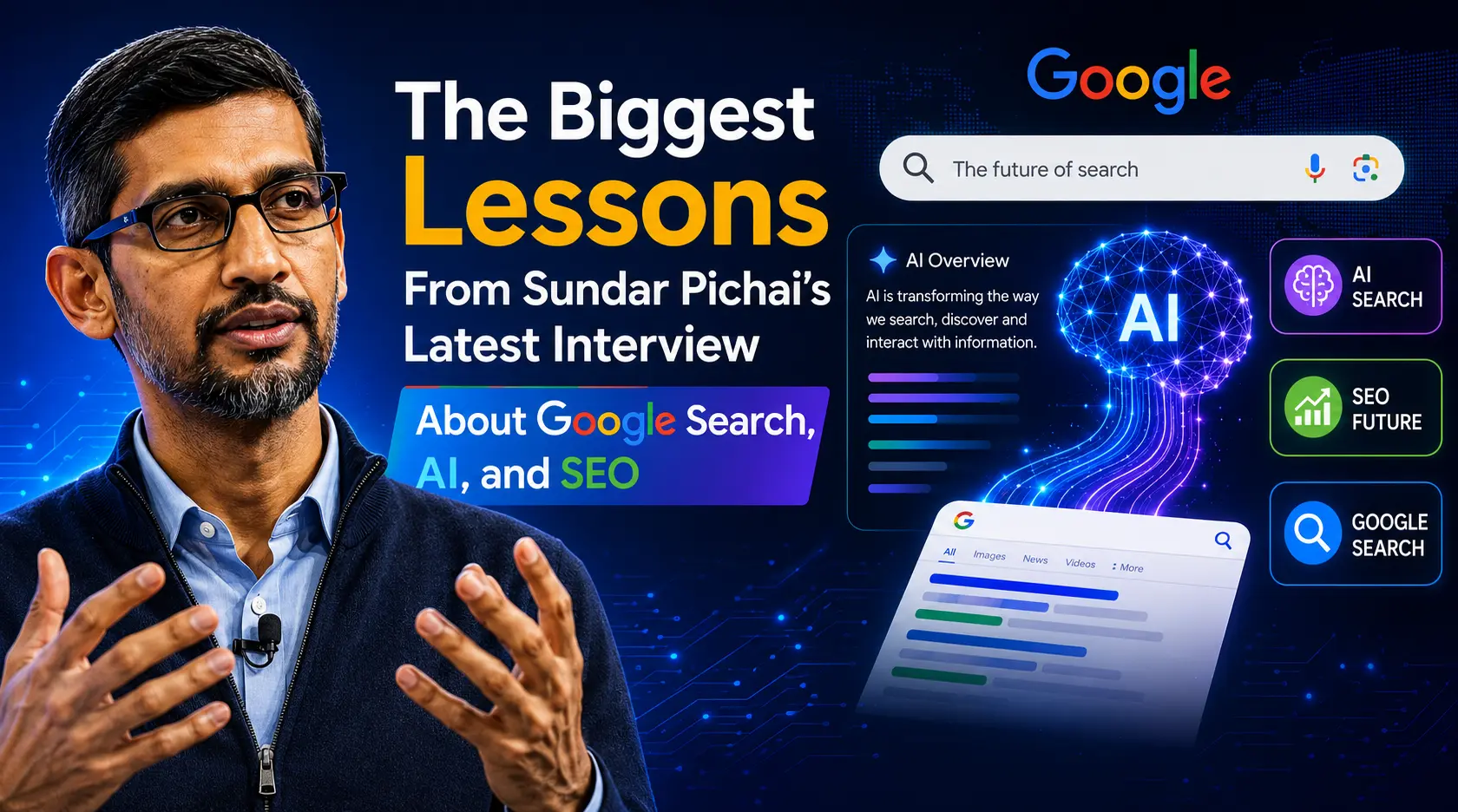
The Biggest Lessons From Sundar Pichai’s Latest Interview About Google Search, AI, and SEO
The Future Of SEO Isn’t More Content. It’s More Expertise.
For 25 years, Google has been trying to answer a surprisingly simple question:
Did the user find what they were looking for? Recently, Google’s CEO, Sundar Pichai, explained that Google’s search systems have spent decades measuring user satisfaction through signals such as engagement, return visits, sessions, and whether people bounce back to search for a different answer.
His point was straightforward. Google’s goal isn’t simply to rank pages. It’s to understand whether users are genuinely satisfied. That statement may sound obvious. Yet it reveals something many businesses have overlooked for years.
The internet is drowning in content. At the same time, it is starving for expertise. And as AI continues to flood the web with more information than ever before, that gap is becoming impossible to ignore.
The businesses that understand this shift will gain an enormous advantage. The businesses that don’t may find themselves producing more content than ever while generating less trust, less engagement, and ultimately fewer customers.
Table of Contents
- Why Generic SEO Content Struggles in the AI Era
- Why Most Business Content Looks the Same Online
- How AI Has Changed Content Marketing and SEO
- Why Experience and Expertise Matter More Than AI-Generated Content
- What Google’s User Satisfaction Signals Mean for Businesses
- The Future of SEO: Expertise, Trust, and Original Insights
- How to Create Content That Aligns With Google’s E-E-A-T Guidelines
- Key Takeaways for Businesses Using AI and SEO
- Let’s Help You Create Content That Google and Customers Trust!
- FAQs
Why Generic SEO Content Struggles in the AI Era?
Let’s start with an uncomfortable truth. AI didn’t create the content problem.
It exposed it. Long before ChatGPT existed, businesses were already publishing content that looked remarkably similar.
- A company would identify a keyword.
- A writer would search Google.
They would study the highest-ranking articles. They would use the same headings.
- Answer the same questions.
- Cover the same subtopics.
Then publish another version of what already existed. The result was content that technically checked every box.
But it rarely offered anything new.
- No unique perspective.
- No firsthand experience.
- No hard-earned insight.
- No reason to remember it.
For years, search engines tolerated this because information itself was valuable. Today, information is abundant. The game has changed.
Why Most Business Content Looks the Same Online
Imagine a homeowner searching for roofing advice. They open one article. Then another.
Then another. Before long, they realize they’re reading the same article over and over again with different logos attached.
- The recommendations are identical.
- The examples are identical.
- The structure is identical.
- Even the wording often feels familiar.
Now ask yourself a difficult question. If someone removed your company name from your latest blog post, would readers still know it came from you?
For many businesses, the answer is no. That isn’t a writing problem. It’s a positioning problem.
Too many companies are creating content based on what competitors have already published instead of what customers actually need to hear.
When everyone follows the same blueprint, everyone ends up building the same house.
How AI Has Changed Content Marketing and SEO
There was a time when simply having information created value. Those days are gone. Today, anyone can ask an AI tool a question and receive a reasonably accurate answer in seconds.
- Need a checklist? Done.
- Need definitions? Done.
- Need a summary? Done.
Information has become a commodity.
And when something becomes a commodity, it loses its ability to differentiate. Think about it this way. Nobody pays premium prices for something everyone can get for free. The same principle applies to content.
If your article merely summarizes information available everywhere else, you’re competing in a race to the bottom.
That is not where businesses win.
Why Experience and Expertise Matter More Than AI-Generated Content
This is where things get interesting. While AI can summarize knowledge, it cannot replicate experience.
- It cannot spend twenty years installing roofs.
- It cannot operate a successful dental practice.
- It cannot manage a transportation company through economic uncertainty.
It cannot sit across the table from thousands of customers and recognize patterns that never appear in a Google search.
- Experience creates insights.
- Insights create trust.
- Trust creates customers.
That’s the chain many businesses forget. When a potential client reads content written by someone who has actually solved the problem they’re facing, the difference is obvious.
The advice feels more practical. The examples feel more relevant. The recommendations feel more credible. That’s because experience adds something algorithms cannot easily reproduce. Judgment.
And judgment is becoming one of the most valuable assets in modern marketing.
What Google’s User Satisfaction Signals Mean for Businesses
One section of Pichai’s interview stood out. He emphasized that Google continues to evaluate long-term user satisfaction.
- Not short-term clicks.
- Not vanity metrics.
- Not temporary spikes.
Long-term satisfaction. That’s an important distinction. Because satisfied users rarely reward generic content.
- They reward useful content.
- They reward clear answers.
- They reward expertise.
- They reward people who help them make better decisions.
In other words, Google may be measuring user behavior, but the underlying principle remains human.People gravitate toward value.
Technology may evolve. Human psychology doesn’t.
The Future of SEO: Expertise, Trust, and Original Insights
Many companies believe they need more content. In reality, they need more substance.
Publishing twenty generic articles every month won’t create a competitive advantage if none of them contain original thinking.
Meanwhile, a business that shares genuine expertise can outperform larger competitors with a fraction of the content volume. The future belongs to companies willing to say something worth hearing.
- Companies willing to share lessons from the field.
- Companies willing to challenge assumptions.
- Companies willing to explain not only what works, but why.
Most importantly, the future belongs to businesses that understand a simple truth:
- Customers aren’t searching for content.
- They’re searching for confidence.
Every article, video, guide, and case study should help them move closer to a decision.
That’s where trust is built. And trust is where growth begins.
How to Create Content That Aligns With Google’s E-E-A-T Guidelines
As Google continues prioritizing user satisfaction, businesses should focus on creating content that demonstrates experience, expertise, authority, and trustworthiness. Here are several practical ways to align your content strategy with Google’s evolving search ecosystem:
-
Share First-Hand Experience
Include examples, lessons learned, case studies, and real-world outcomes from your own work rather than simply summarizing information from other websites. -
Answer Real Customer Questions
Build content around the questions prospects ask during sales calls, consultations, support conversations, and discovery meetings. -
Demonstrate Subject Matter Expertise
Ensure content is written or reviewed by people with genuine industry knowledge and practical experience. -
Support Claims With Evidence
Use statistics, research, examples, screenshots, data, and case studies to support recommendations and conclusions. -
Create Original Insights
Don’t simply repeat what competitors are publishing. Add perspectives, observations, and conclusions based on your own experience. -
Prioritize User Intent Over Keywords
Keywords remain important, but content should primarily focus on helping users solve a problem, make a decision, or achieve an objective. -
Keep Content Accurate and Updated
Regularly review articles to ensure recommendations, statistics, and industry information remain current and relevant. -
Build Topical Authority
Develop clusters of related content around your core services and expertise rather than publishing unrelated topics solely for traffic.
This is the kind of content strategy that aligns with Google’s emphasis on long-term user satisfaction and positions businesses for greater visibility in both traditional search results and AI-powered search experiences.
Key Takeaways for Businesses Using AI and SEO
Sundar Pichai’s comments weren’t really about SEO. They were about satisfaction.
And satisfaction comes from helping people solve real problems. As AI continues to make information easier to access, expertise becomes more valuable, not less.
The businesses that thrive won’t be the ones producing the most content. They’ll be the ones contributing the most insight.
Because when information is everywhere, experience becomes the thing people are actually looking for. And that’s something no algorithm can fake.
AI-Powered Digital Marketing Services for Growing Businesses!
Engage Coders combines SEO, content marketing, AI optimization, local search, PPC advertising, website development, and conversion-focused strategies to help businesses increase visibility, attract qualified leads, and drive sustainable growth.
Talk to Our Digital Marketing Experts
Let’s Help You Create Content That Google and Customers Trust!
At Engage Coders, we help businesses create SEO content, website experiences, and digital marketing services built around expertise, trust, and user satisfaction. Our SEO and content writing experts in USA combine content strategy, SEO, AI-driven optimization, local search, and conversion-focused marketing to help businesses attract qualified traffic and generate measurable growth.
If you’re ready to build a stronger online presence, request a consultation with our team today.
Read more:
- How to Rank Your Brand or Business #1 on ChatGPT
- How to Improve My Brand Visibility in AI Search Results?
- How Businesses Can Optimize Websites for AI-Driven Leads
- Blog Optimization Blueprint: Transforming Your Small Business
FAQs
Absolutely. But SEO is no longer about publishing the most content or targeting the most keywords. Businesses that win are the ones creating content that demonstrates expertise and helps customers make decisions. SEO still drives visibility, but trust and usefulness are becoming bigger competitive advantages than volume.
Google wants to know whether people found a useful answer and felt confident enough to stop searching. If visitors leave your website with their questions answered, spend time engaging with your content, and return to your business later, that’s the type of experience Google wants to reward.
E-E-A-T helps Google determine whether your business is qualified to speak on a topic. If your content demonstrates real experience, industry knowledge, credibility, and trustworthiness, you’re more likely to earn visibility in search results and build confidence with potential customers.
Yes, but AI should help you create content, not replace your expertise. The businesses seeing the best results use AI for research, drafting, and organization while adding their own experience, examples, insights, and professional judgment before publishing.
Because rankings alone don’t create customers. Many businesses attract traffic with content that answers basic questions but fails to build trust or demonstrate expertise. Visitors may find information, but they never become confident enough to contact the company.
Focus on publishing content that clearly answers customer questions, demonstrates expertise, includes supporting evidence, and provides information that is genuinely useful. AI systems are more likely to reference businesses that consistently publish trustworthy and authoritative content.
Your experience. AI can generate information, but it cannot replicate years of working with customers, solving problems, learning from mistakes, and developing industry expertise. Those real-world insights are often what separate memorable content from forgettable content.
Better content almost always wins. One article that answers customer questions, demonstrates expertise, and builds trust can outperform dozens of generic articles that simply repeat information already available elsewhere online.
Content that helps people make decisions. Case studies, lessons learned, customer success stories, expert insights, industry guidance, and practical advice tend to build more trust than generic educational content because they demonstrate real-world experience.
Stop asking how to create more content and start asking how to create more valuable content. Focus on sharing expertise, answering customer questions, solving real problems, and helping people make informed decisions. Those are the qualities that build trust with both customers and search engines.


