
Why is Your Renovation Business Struggling to Attract New Customers?
A renovation business can deliver excellent workmanship, complete projects to a high standard and earn recommendations from satisfied clients, yet still struggle to secure its next project.
The issue often becomes noticeable when the current workload starts winding down. Enquiries become less frequent, upcoming schedules look uncertain, and the business begins searching for new work at short notice.
For many renovation companies, this happens because attracting customers is treated as something to focus on when work is quiet, rather than an ongoing part of running the business.
Referrals and repeat customers are valuable, but they are not always predictable. To build a more consistent project pipeline, renovation businesses need to understand who they want to reach, where potential customers discover their services and how to create opportunities beyond their existing network.
Table of Contents
- Why Do Renovation Businesses Struggle to Find New Customers?
- Are You Reaching the Right Renovation Customers in Melbourne?
- What Happens When Your Renovation Business Relies on Referrals Alone?
- How Can You Build a More Consistent Customer Acquisition Process?
- How Does Better Digital Visibility Help Renovation Businesses Attract New Customers?
- How Can You Tell Whether Your Renovation Business Is Attracting Enough New Customers?
- Are You Building a Consistent Source of New Renovation Customers?
- FAQs
Why Do Renovation Businesses Struggle to Find New Customers?
There is rarely one reason a renovation business struggles to attract new customers. More often, several small gaps combine to limit the number of opportunities reaching the business.
Some of the most common include:
- Dependence on referrals: Recommendations can bring valuable projects, but the business has limited control over when previous customers or industry contacts make them.
- Limited awareness: A company may be well known among its existing clients but remain unfamiliar to homeowners who have never worked with it.
- Unclear positioning: When a business does not communicate the types of renovation projects it wants to undertake, potential customers may not recognise whether its services are relevant to their needs.
- Inconsistent marketing activity: Promoting the business only when the project pipeline slows down can make it difficult to maintain awareness among future customers.
- Limited understanding of enquiry sources: Without knowing where new customers come from, business owners may struggle to identify which activities are introducing new opportunities.
These issues are connected. A renovation company might have strong demand through referrals but limited visibility beyond that network. Another might be active online but attract enquiries for projects that do not match its services.
The first step is to understand where the gap exists instead of assuming that the business simply needs more advertising.
Are You Reaching the Right Renovation Customers in Melbourne?
Attracting more people is not necessarily the same as attracting more potential customers.
A renovation company operating in Melbourne needs to consider the projects it wants to undertake, the customers it can serve and the areas it can realistically cover. For example, a business specialising in kitchen renovations may want to reach homeowners planning substantial kitchen upgrades. A company focused on extensions may be more interested in customers considering larger residential projects.
Both businesses operate in the renovation industry, but their ideal customers and the way they communicate their services may differ.
Before trying to increase customer enquiries, consider three questions:
Looking to Attract More Renovation Customers in Melbourne?
Explore Engage Coders’ digital marketing services in Melbourne and discover how a structured digital marketing approach can improve your online visibility, reach potential customers and create more opportunities for your renovation business.
Request A Free Quote Now
1. Which projects do you want more of?
Identify the renovation services that best match your experience, team capabilities, preferred project size and commercial priorities.
2. Which customers are most suitable?
Consider the types of homeowners, property owners or other clients whose requirements align with your services. Think about project expectations, location and likely timelines.
3. Which areas can you realistically serve?
Define your actual service area. Depending on your team’s capacity and project requirements, this might include selected Melbourne suburbs or a wider part of Victoria.
This level of clarity helps businesses focus their customer acquisition efforts. It also makes it easier to communicate relevant services to the people they want to reach.
The objective is not to attract every homeowner searching for renovation services. It is to become discoverable to people whose projects make sense for the business. Australian Bureau of Statistics data also provides a broader view of renovation activity: the value of residential alterations and additions approved reached $1.32 billion in September 2026, on a seasonally adjusted basis. This is market context, not a measure of available customers in Melbourne.
What Happens When Your Renovation Business Relies on Referrals Alone?
Referrals are one of the most valuable ways for a renovation company to attract new work. A recommendation from a previous customer, architect, designer or industry contact can introduce the business to someone who is already interested in renovation services.
However, referral activity is difficult to predict.
A business might receive several recommendations in one month and very few the next. Previous customers may not know anyone planning a renovation, and professional contacts may have changing workloads of their own.
The risk becomes greater when referrals are the business’s only consistent source of new opportunities.
Consider a simple example.
A renovation company completes several projects and receives regular recommendations. Because the team is fully occupied, the owner has little reason to focus on attracting new customers. Over time, the completed projects begin to reduce, but the expected referrals do not arrive at the same pace.
The business then has to find new opportunities quickly.
This is the difference between having a strong referral network and having a balanced customer acquisition process.
Referrals should remain an important source of work. The aim is to complement them with additional ways for potential customers to discover the business.
Australian consumer research supports the importance of using more than one discovery route. Thryv’s 2025 ANZ Business Index and Consumer Report found that 59% of Australian consumers surveyed used word of mouth or recommendations to discover small businesses. Online searches such as Google were also reported by 43%, while 35% identified social media.
These figures cover small businesses across industries, not renovation companies specifically. However, they illustrate why relying on recommendations alone may leave other discovery opportunities unexplored.
For renovation businesses, the practical takeaway is straightforward: maintain relationships that generate referrals while building visibility among people who do not yet know the company.
How Can You Build a More Consistent Customer Acquisition Process?
A consistent approach does not require a complicated marketing operation. It starts with understanding what the business wants to attract and creating a repeatable way to reach potential customers.
1. Define the Customers and Projects You Want to Attract
Start with the work you want your business to become known for.
Review previous projects and identify which ones were the best fit. Consider project value, profitability, timelines, location and the capabilities required to deliver the work.
This gives your business a clearer direction when planning its marketing strategy.
It can also help you understand how your services should be presented to different audiences. A renovation company does not necessarily need to promote every service in the same way or to the same group of people.
2. Identify Where Potential Customers Discover Renovation Businesses
Your existing customers can provide useful information about how people find renovation services.
Ask new clients where they first heard about the business. Review whether enquiries come from recommendations, Google searches, social media, professional relationships or other sources.
This is a practical way to identify which discovery routes are already contributing to your pipeline.
Understanding how customers find local businesses through Google, social media and AI can help renovation companies identify where they need to build awareness. The important point is not to copy every channel. It is to understand where your potential customers are likely to look.
3. Build Awareness Beyond Your Existing Network
A business that only reaches previous customers and industry contacts has a limited audience.
To expand that reach, consider how people who have never heard of your company could discover it.
For example, homeowners may search online for renovation services, explore local businesses, or come across a company through social media. Maintaining a presence across relevant discovery points can help introduce your business to a wider audience.
A renovation business can take a more structured approach by identifying its target customers, choosing relevant ways to reach them and planning its marketing activities around its business goals.
The approach should be appropriate for your audience and business capacity. Consistency matters more than trying to maintain every possible marketing activity.
4. Set Practical Customer Acquisition Goals
Instead of setting a general target to get more customers, define what a useful improvement would look like.
For example, a renovation business might aim to:
- Increase enquiries for a particular renovation service.
- Reach potential customers in selected service areas.
- Reduce dependence on a single source of new work.
- Generate a steadier flow of suitable project enquiries.
- Understand how many new opportunities are being introduced each month.
These goals make customer acquisition easier to review. They also give the business a clearer basis for planning its digital marketing activities.
5. Track Where New Opportunities Come From
You do not need an advanced reporting system to understand your customer acquisition activity.
Start by recording a few basic details for every new enquiry:
| What to record | Why it matters |
|---|---|
| Enquiry source | Shows how the customer discovered the business |
| Requested service | Identifies the type of renovation work being sought |
| Customer location | Helps assess whether the enquiry fits the service area |
| Enquiry date | Helps identify changes in enquiry patterns |
| Project outcome | Shows whether the opportunity progressed into actual work |
Over time, this information can reveal patterns.
You might discover that recommendations generate most of your enquiries, but online searches introduce customers for a different type of project. Or you may find that certain service areas generate more relevant opportunities than others.
A simple marketing funnel can help business owners understand how someone moves from first discovering a company to making an enquiry and becoming a customer.
An illustrative customer acquisition funnel.
| Stage | Example for a renovation business |
|---|---|
| Awareness | A homeowner discovers the company through Google or a recommendation |
| Interest | The homeowner explores the renovation services offered |
| Enquiry | The homeowner contacts the business about a project |
| Opportunity | The business identifies whether the project is suitable |
| Project | The customer proceeds with the renovation company |
This is a simple illustration, not an industry conversion benchmark. Actual results will depend on the business, its services, the market and the way enquiries are handled.
The purpose is to understand how new opportunities enter the business and what happens to them afterwards.
How Does Better Digital Visibility Help Renovation Businesses Attract New Customers?
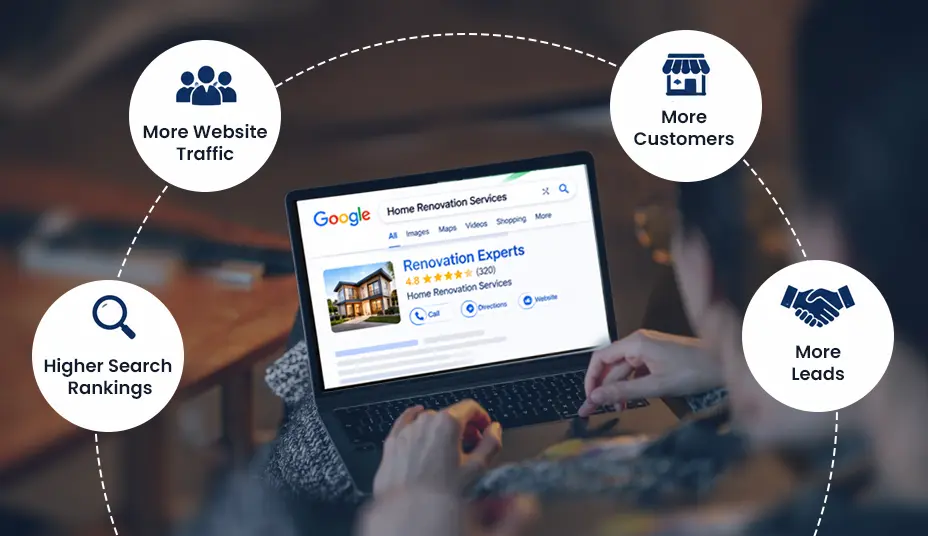
Digital visibility gives renovation businesses another way to reach potential customers beyond referrals and existing relationships.
When someone starts looking for renovation services, they may use Google to explore available companies, search for a particular service or find businesses operating in their area.
If your company is difficult to discover in those searches, potential customers may never encounter it. Local search is one part of this picture. Google’s guidance explains that local results are influenced by relevance, distance and prominence. Complete and accurate business information can help Google understand how a business relates to what someone is searching for.
For renovation companies, this makes accurate service information and a relevant local presence important starting points. You can learn more about local SEO ranking factors and how businesses approach a local SEO audit.
A properly maintained Google Business Profile can also help eligible businesses appear in relevant local searches. Google’s own guidance explains the information and factors that influence local visibility.
Other digital activities can contribute to awareness too. Depending on the audience, a renovation business may use social platforms to introduce its services and maintain a connection with potential customers. The role of social media marketing is not necessarily to generate an immediate enquiry every time. It can also help people become familiar with the business before they need its services.
For businesses exploring organic discovery, SEO for service-based businesses and content marketing offer further context on building visibility over time.
The important distinction is that digital visibility is not simply about getting more website visitors. It is about making the business easier for relevant potential customers to discover. For further guidance, see Google’s official advice on improving local rankings through Google Business Profile.
If you’re assessing how to reach more renovation customers in Melbourne, it is worth looking at how your online visibility and wider marketing activity support that goal. You can explore Engage Coders’ digital marketing services in Melbourne to understand how a structured digital approach can support business visibility and customer acquisition.
How Can You Tell Whether Your Renovation Business Is Attracting Enough New Customers?
Before changing your marketing activity, take a closer look at how new opportunities are currently reaching your business.
Use these questions as a practical starting point:
- How many new customer enquiries did the business receive last month?
- Where did those enquiries originate?
- How many came from outside your existing referral network?
- Are you attracting the types of renovation projects you want to undertake?
- Are potential customers discovering your business in the areas you serve?
- Does your business maintain visibility when the project schedule is already full?
- Can you identify which activities are introducing new opportunities?
Your answers can help identify whether the main issue is limited awareness, unclear targeting, inconsistent activity or a lack of information about enquiry sources.
You do not need to change everything at once. Start with the biggest gap and establish a practical way to address it.
For example, if most enquiries come from recommendations, your next priority might be expanding how new customers discover the business. If you already receive enquiries but very few relate to your preferred projects, revisit the services and audiences your marketing is reaching.
A clearer picture of the current situation makes it easier to decide what needs attention.
Are You Building a Consistent Source of New Renovation Customers?
A renovation business should not have to wait for the next referral before thinking about its next project.
Good workmanship and a strong reputation remain essential, but they are only part of customer acquisition. Businesses also need to reach people beyond their existing network, communicate the services they want to grow and maintain visibility among potential customers.
For renovation companies in Melbourne, that means understanding the areas they serve, the projects they want to attract and how homeowners can discover their services.
A consistent customer acquisition process does not guarantee a fixed number of enquiries or projects. It does, however, give business owners a more informed way to create opportunities and understand where new work comes from.
The objective is not simply to get busier. It is to build a business that has a clearer, more dependable way to find its next suitable customer.
FAQs
Start by identifying the renovation projects you want to attract and the customers most likely to need those services. Then review how people currently discover your business and look for ways to expand your visibility beyond referrals. Tracking enquiry sources can help you understand whether your efforts are creating new opportunities.
Possible reasons include limited awareness, inconsistent marketing activity, unclear service positioning or a reliance on referrals. Review where previous enquiries originated and whether your business is reaching potential customers in the areas and project categories you want to serve.
Renovation companies can attract customers through recommendations, repeat business, online searches, local business visibility, social media and professional relationships. The right combination depends on the services offered, target customers and areas served.
Word of mouth can be a valuable source of new projects, but relying on it alone can make enquiry levels unpredictable. Building additional ways for potential customers to discover the business can help reduce dependence on a single source of work.
Focus on reaching relevant customers, maintaining visibility and understanding where enquiries originate. Set practical acquisition goals and review enquiry patterns regularly. Consistency comes from treating customer acquisition as an ongoing business activity rather than something to address only when work slows down.


