

Affiliate Ad Hijacking: How Fraudsters Steal Your Ad Dollars and How to Stop Them
Affiliate ad hijacking is a calculated heist, targeting your marketing budget, siphoning revenue, and tarnishing your brand’s hard-earned trust. This isn’t a vague threat—it’s a pervasive scam costing businesses millions annually. At Engage Coders, we’ve watched clients—from startups scaling online to enterprises optimizing e-commerce stores—lose thousands to online ad fraud before fighting back. This guide exposes affiliate ad hijacking, its brutal impact on branded search results, and proven strategies to reclaim control with brand and keyword monitoring. Let’s dive in.
Table of Contents
The Scam Defined: What is Affiliate Ad Hijacking?
Why It Hurts: The Stakes for Your Business
How They Pull It Off: The Mechanics of Fraud
The Fallout: Digital Marketing Under Siege
Spotting the Enemy: Signs of Hijacking
Fighting Back: Strategies to Crush Ad Hijacking
Safeguarding Your Online Reputation
Tech as Your Ally: Outsmarting Fraudsters
Adidas Exposed: A Wake-Up Call
- FAQs
The Scam Defined: What is Affiliate Ad Hijacking?
Affiliate ad hijacking happens when rogue affiliates mimic your ads—copying headlines, text, and even your domain with sly tweaks—to trick users into clicking their links. They redirect traffic through cloaked affiliate URLs, pocketing commissions on sales you’d have earned. A 2025 Bluepear study caught over 100 hijacking attempts on Adidas’s branded search results in 40 days, with 245 ad variations designed to dodge detection. This isn’t petty theft; it’s a sophisticated racket exploiting your marketing efforts.
The numbers back this up: industry estimates peg online ad fraud losses at $84 billion globally in 2023, with affiliate hijacking a growing slice of that pie. For businesses relying on SEO, PPC, and SEM, this is a direct attack on your bottom line.
Why It Hurts: The Stakes for Your Business
Every click stolen by a hijacker bleeds your budget dry. Picture a small business owner pouring their last $5,000 into a PPC campaign, only to see half vanish into a fraudster’s pocket. Here’s the damage:
- Revenue Theft: Hijackers claim commissions—often 5-20% per sale—on transactions you’d have secured organically.
- Ad Cost Surge: They bid on your brand keywords, spiking CPCs by up to 30% (per 2024 PPC trends), forcing you to pay more to compete.
- Data Sabotage: Inflated affiliate stats mislead your analytics, pushing you to overpay or misjudge campaign success.
- Trust Erosion: Shoddy hijacker ads confuse customers, chipping away at your online reputation.
We’ve seen this firsthand—clients were blindsided by losses until our brand monitoring tools exposed the culprits. This isn’t just a cost; it’s a betrayal of your digital investment.
How They Pull It Off: The Mechanics of Fraud
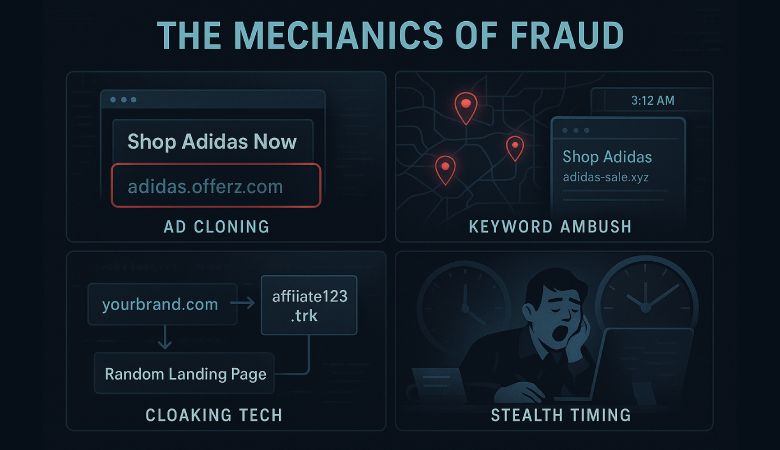
Hijackers don’t stumble into success—they execute with precision. Here’s their playbook:
- Ad Cloning: They replicate your ad—e.g., “Shop Adidas Now” becomes “Shop Adidas Now!” with a cloaked link (adidas.offerz.com vs. adidas.com).
- Keyword Ambush: They target branded search results like “YourBrand Shoes,” outbidding you in overlooked regions (think rural markets at 3 AM).
- Cloaking Tech: Tools mask redirects—e.g., a click on “yourbrand.com” bounces through “affiliate123.trk” before landing—hiding their tracks.
- Stealth Timing: They strike during off-hours or in low-traffic zones, evading manual checks.
Take this mock-up: Your ad reads, “Buy Premium Widgets – 20% Off!” Their site says, “Buy Premium Widgets – 20% Off Now!” with a URL like “premium-widgets.dealz.com.” The difference is subtle, but the theft is blatant.
The Fallout: Digital Marketing Under Siege
For businesses leaning on full-scale digital marketing strategies, this is war. Your performance-optimized website drives traffic, but hijackers intercept it. Your e-commerce solutions boost sales, but fraudsters skim the profits. Specific hits include:
- SEO Damage: Fake ads crowd out your organic rankings on branded search results.
- PPC Losses: A 2024 study found hijacking can inflate ad spend by 15-25% on brand terms.
- Growth Block: Every stolen sale stalls your customer acquisition momentum.
We’ve tracked clients losing up to $10,000 monthly before our data-driven digital transformation tools intervened. This isn’t a glitch—it’s a gut punch to your growth.
Spotting the Enemy: Signs of Hijacking
Catching online ad fraud demands sharp eyes and smarter tech. Watch for:
- Clone Ads: Ads echoing your copy but linking elsewhere—check display URLs closely.
- Sales Anomalies: A 50% affiliate sales jump with no campaign tweak? Red flag.
- Redirect Trails: Analytics showing odd referral paths (e.g., “trk123.com” before your site).
- Ad Rank Drops: Third-party ads topping yours on branded search results.
Manual scans catch some, but scale requires automation. Our monitoring systems flag these in real time, saving clients from blind losses.
Fighting Back: Strategies to Crush Ad Hijacking

Defense isn’t enough—you need to strike back. Here’s how we arm clients to win:
- 1. Lock Down Brand Monitoring: Track your digital footprint 24/7. Tools we deploy catch affiliate ad hijacking across time zones, exposing fraudsters hiding in the shadows. Actionable Step: Set Google Alerts for your brand terms and audit ad placements weekly.
- 2. Master Keyword Monitoring: Own your branded search results. We analyze bids and trends to block hijackers from your turf. Actionable Step: Use Google Ads’ Auction Insights to spot competitors on your keywords—report violators.
- 3. Tighten Affiliate Control: Vet partners ruthlessly. Our seven-step process bans cloaking and demands transparent tracking. Actionable Step: Add a “no ad hijacking” clause to affiliate contracts—enforce it with audits.
- 4. Weaponize Data: Clean analytics fuel smart decisions. We filter out fraud to keep your ROI optimization on track. Actionable Step: Segment affiliate traffic in Google Analytics—flag spikes for review.
- 5. Hit Back Hard: Report hijackers to Google Ads (via the Policy Violation form) and blacklist offending affiliates. Legal warnings can deter repeat offenders—our team crafts these for maximum impact. Actionable Step: Document hijacked ads with screenshots and escalate to your ad platform.
Safeguarding Your Online Reputation
A hijacker’s sloppy ad isn’t just theft—it’s a smear on your online reputation. Customers clicking “YourBrand Deals!” only to land on a sketchy site lose faith fast. Our user-centric websites and mobile app solutions rebuild trust, while brand monitoring ensures your voice stays clear.
Aligning with Google’s Standards
Google rewards E-E-A-T—expertise, experience, authoritativeness, trustworthiness. Our content, like this guide, reflects that, using AI only to enhance facts, not fake rankings. Hijackers violate Google’s spam policies; we don’t. Your branded search results thrive when fraud’s out of the picture.
Tech as Your Ally: Outsmarting Fraudsters
Our full-service digital solutions leverage AI to:
- Scan global ad placements, catching online ad fraud in obscure markets.
- Unmask cloaked links with precision.
- Deliver evidence to shut down violators fast.
For e-commerce brands, our scalable e-commerce solutions embed fraud detection, protecting your store from launch.
Adidas Exposed: A Wake-Up Call
Bluepear’s 2025 Adidas audit—100+ hijacks, 245 ad variants in 40 days—proves even giants bleed. Hijackers hit during off-hours, adapting after each block. Our keyword monitoring mirrors this vigilance, keeping clients one step ahead.
Partner with our Digital Marketing Agency
Ask Engage Coders to create a comprehensive and inclusive digital marketing plan that takes your business to new heights.
Conclusion: Take Back Your Turf
Affiliate ad hijacking isn’t a hurdle; it’s a parasite you can crush. With brand monitoring, keyword monitoring, and a relentless counterattack, you can bury these fraudsters and reclaim your ad dollars. At Engage Coders, we’ve turned this fight into a science, protecting startups, enterprises, and e-commerce brands with battle-tested digital marketing strategies. Don’t settle for defense, strike back. Book a free audit with us today, and let’s dismantle the scam draining your growth. Your digital future isn’t negotiable.
FAQs:
Legal recourse typically starts with cease-and-desist letters sent to both the affiliate and the network for unauthorized trademark use. If the activity continues, businesses can escalate to trademark infringement or unfair competition lawsuits.
Yes. PPC fraud can distort user engagement signals and siphon branded clicks, which may indirectly weaken organic authority and long-term SEO performance.
Strict bidding rules deter basic abuse, but advanced PPC hijacking schemes often use cloaking and automation to bypass standard policy enforcement.
Yes. Fraudsters frequently hide in low-priority regions, making geo-specific scanning essential for detecting ad cloaking and uncovering unauthorized campaigns.
Manual searches can catch obvious violations, but most hijacking is automated and time-sensitive. Dedicated brand monitoring tools are the most reliable way to detect ongoing abuse.
Small businesses may lose $5,000–$20,000 annually, while large enterprises can lose millions. In some sectors, affiliate fraud accounts for up to 10% of total ad spend.
Yes. Most cases begin with cease-and-desist letters, which resolve the issue in the majority of situations. Legal escalation is effective when fraud becomes persistent or large-scale.
Platforms like Google can catch obvious abuse, but cloaking techniques and ad volume overwhelm automated filters. Brand monitoring tools fill these detection gaps.
With proactive monitoring and enforcement, many businesses recover up to 80% of lost traffic within 30 days. Recovery speed depends on early detection.


