
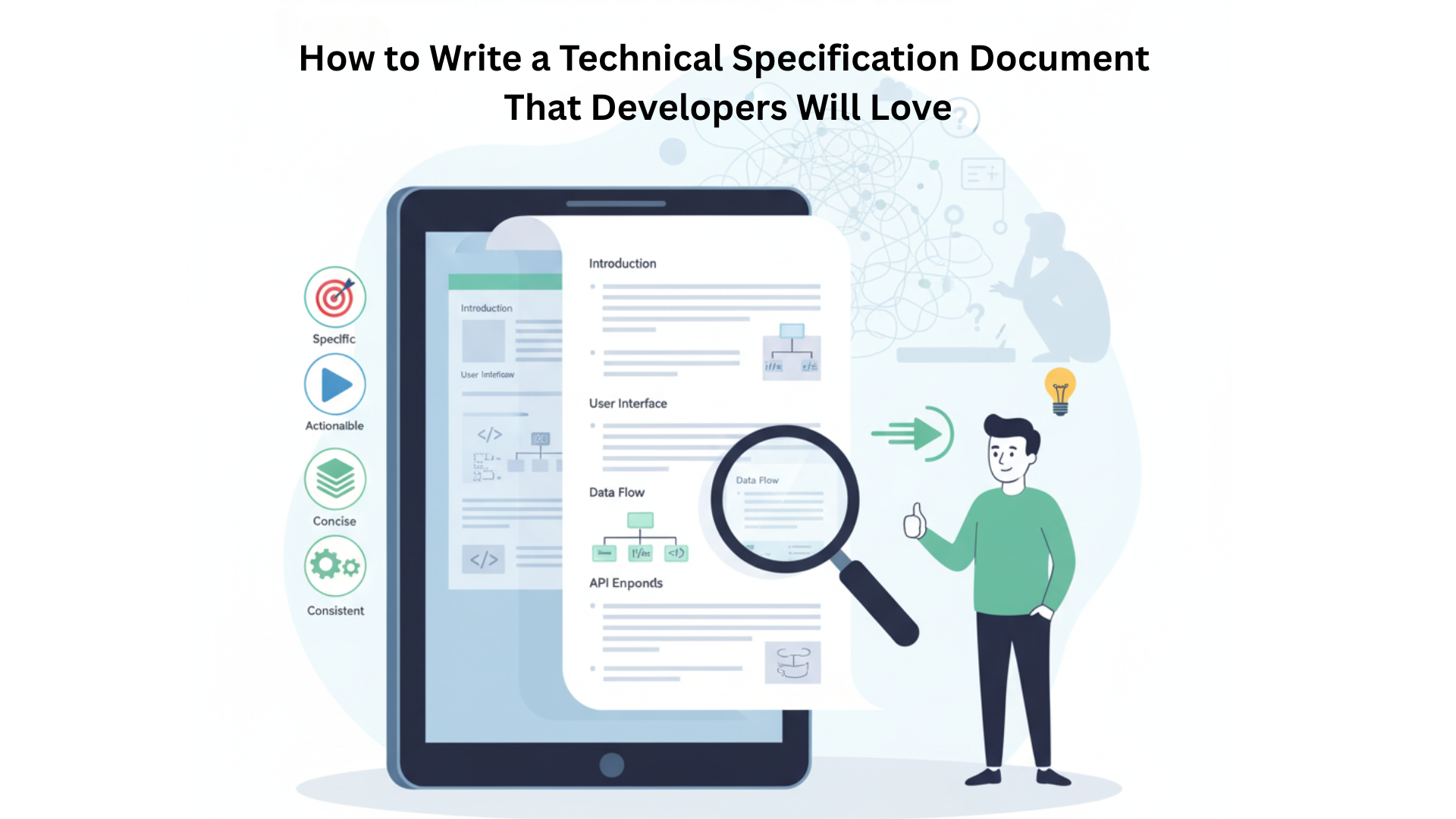
How to Write a Technical Specification Document That Developers Will Love
At Engage Coders, our team has seen it happen: a six-figure project derails over a single, misunderstood word. The business team asks for an “export” feature. The development team builds a simple CSV download. It turns out that the business actually needed a fully formatted, multi-sheet Excel report with live formulas, destined for a C-suite audience.
The rework cost tens of thousands of dollars and, more importantly, destroyed the trust between the teams. The root cause wasn’t bad developers or an indecisive client. It was a failure of translation. It was a failure to write things down with relentless, unambiguous clarity.
The antidote to this kind of preventable disaster is the Technical Specification Document (TSD), or tech spec. When done right, it’s not a bureaucratic hurdle; it’s the strategic blueprint that saves a fortune in time, money, and morale.
But we’re not just talking about a document that developers tolerate. We’re talking about one they will love. This guide, another chapter in our From Idea to Launch & Beyond series, will show you how to create one.
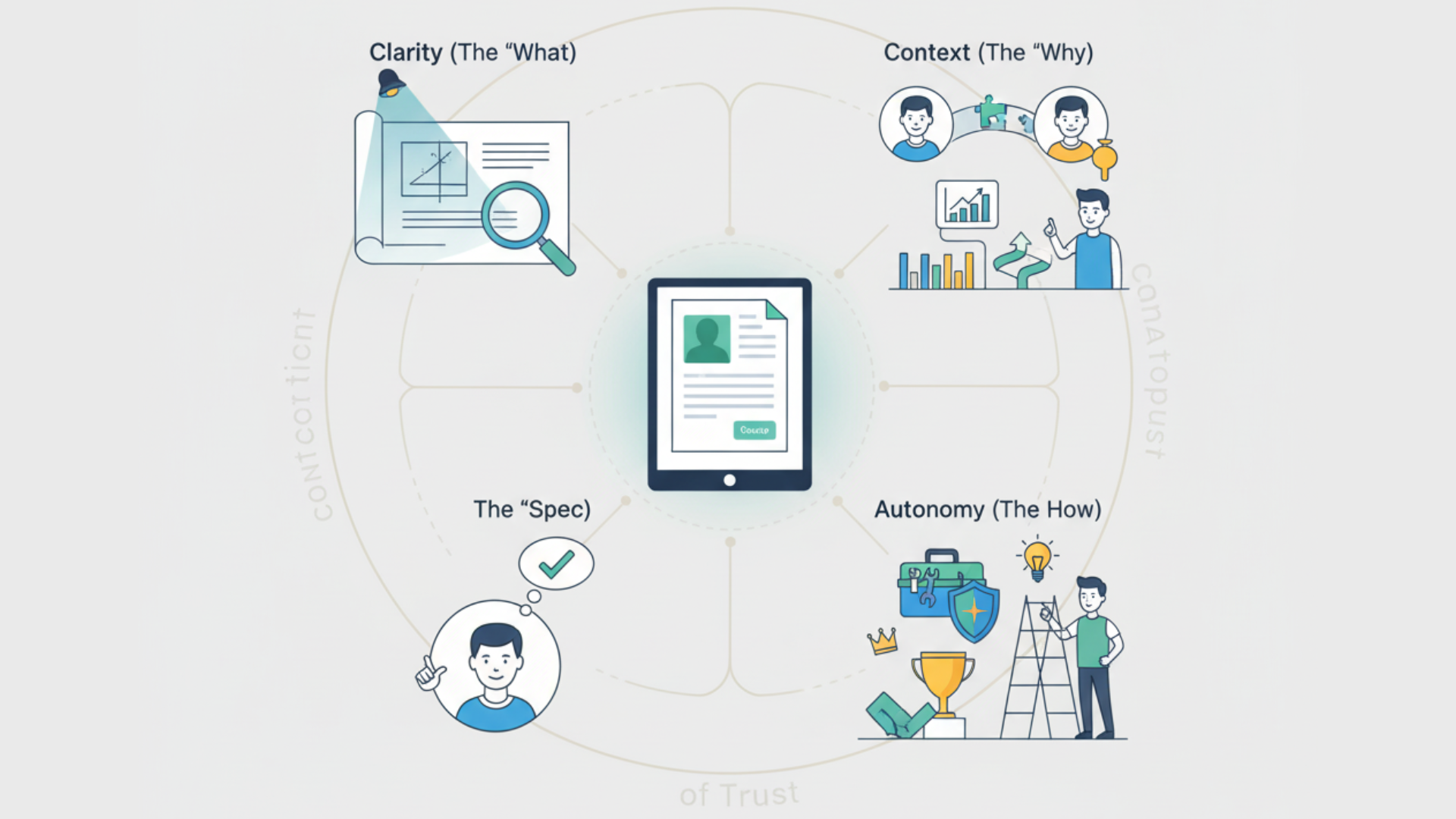
The Philosophy – Why Developers “Love” a Good Spec
The idea of “loving” a document might sound strange, but it’s not about flowery language. It’s about respect. Developers appreciate a tech spec that respects their intelligence, provides them with the necessary context to be effective problem-solvers, and empowers them to do their best work.
This boils down to three core principles:
Clarity (The “What”)
Ambiguity is the enemy of engineering. A great spec is relentlessly precise. It provides a crystal-clear blueprint of the requirements, boundaries, and expected outcomes, eliminating the guesswork that leads to bugs and frustration.
Context (The “Why”)
A spec that is just a list of technical tasks is a failure. It treats a developer like a short-order cook. Developers are creative problem-solvers. To make smart implementation decisions, they need to understand the business goal and the user’s pain point. Providing the “why” elevates them from a coder to a strategic partner.
Autonomy (The “How”)
The worst specs are overly prescriptive, dictating every class name and algorithm. This is micromanagement masquerading as documentation. A spec that developers love defines the constraints—the API contracts, the performance targets—and then trusts the engineer’s expertise to craft the best solution within those boundaries.
Reality Check: A Spec is a Contract of Trust. A weak spec treats a developer like a cog in a machine. A great spec is a contract of trust. It says, “Here is the problem, here are the guardrails, and here is what success looks like. We trust you, the expert, to build the best possible solution.” This sense of ownership is the secret ingredient to a motivated and high-performing engineering team.
Anatomy of a Bulletproof Tech Spec
A developer-centric tech spec follows a logical, predictable structure. Here is a battle-tested blueprint to ensure nothing falls through the cracks.
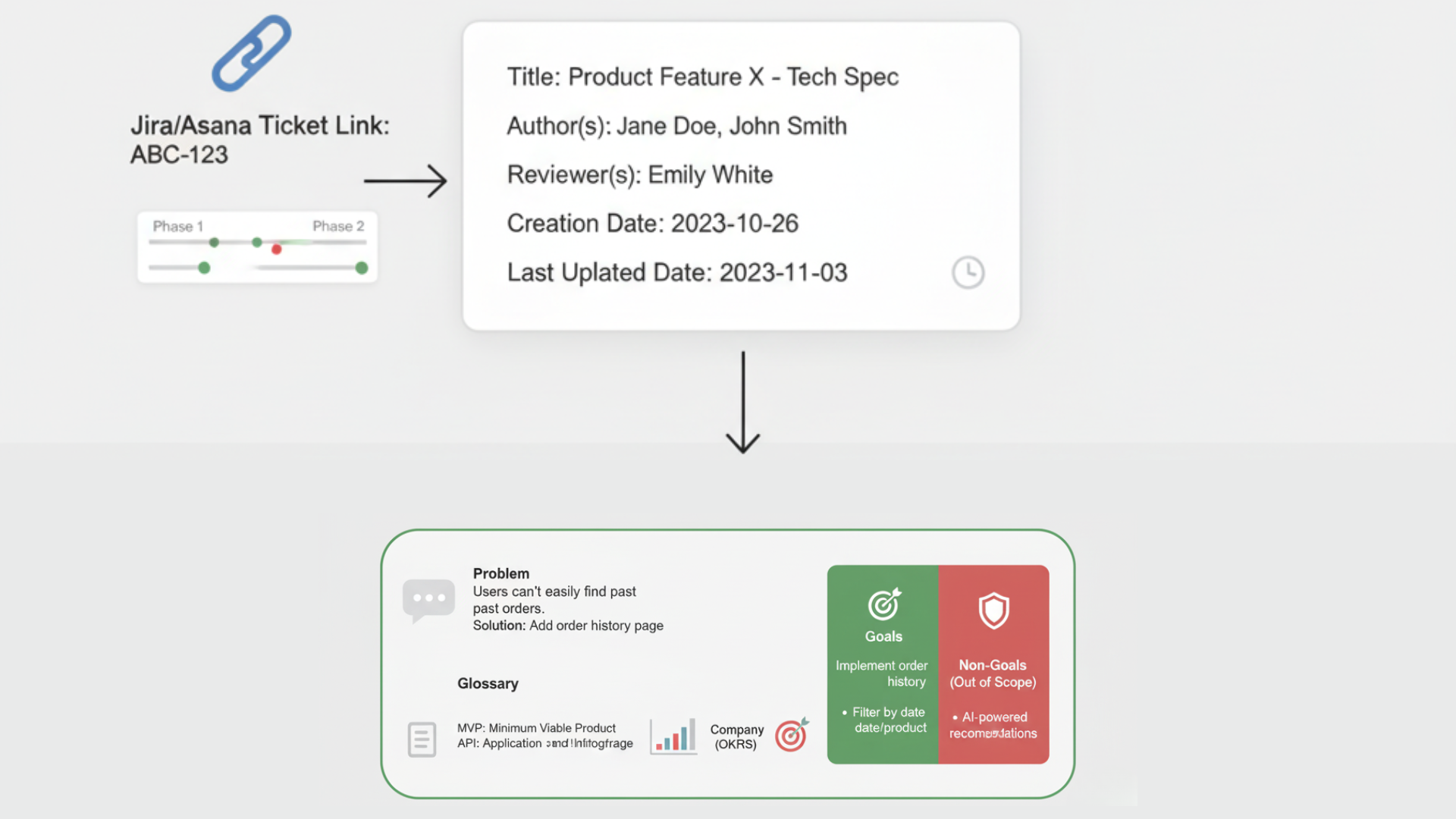
The Front Matter (First Impressions)
This is the metadata that provides instant context.
- Essentials: Clear Title, Author(s), Reviewer(s), Creation & Last Updated Date.
- Crucial Link: A direct link to the primary ticket (e.g., in Jira or Asana).
Why it Matters: The “Last Updated” date immediately tells a developer if the document is trustworthy or potentially obsolete. The ticket link provides traceability, connecting the high-level task to the deep-level plan.
The Introduction (Setting the Stage)
This is the executive summary that grounds the reader in the “why.”
- Problem Statement: A concise, one-paragraph summary of the user problem, the business context, and the proposed solution.
- Glossary: A non-negotiable list of all acronyms, internal project names, and technical jargon. This simple act of empathy prevents massive confusion.
- Business Context: Explain why this project matters now. How does it tie into company goals (OKRs)?
Goals & Non-Goals: This is arguably the most powerful section in the entire document.
- Goals: A clear, bulleted list of what the project will achieve.
- Non-Goals (Out of Scope): An explicit, bulleted list of what the project will not address.
The Secret Weapon Against Scope Creep: The “Non-Goals” list is your shield. Scope creep happens when stakeholders have unstated assumptions. By explicitly stating, “This feature will not support Internet Explorer 11,” or “Payment integration with PayPal is a non-goal for this version,” you preemptively close the door on ambiguity. It provides the team with the air cover to protect the timeline and budget.
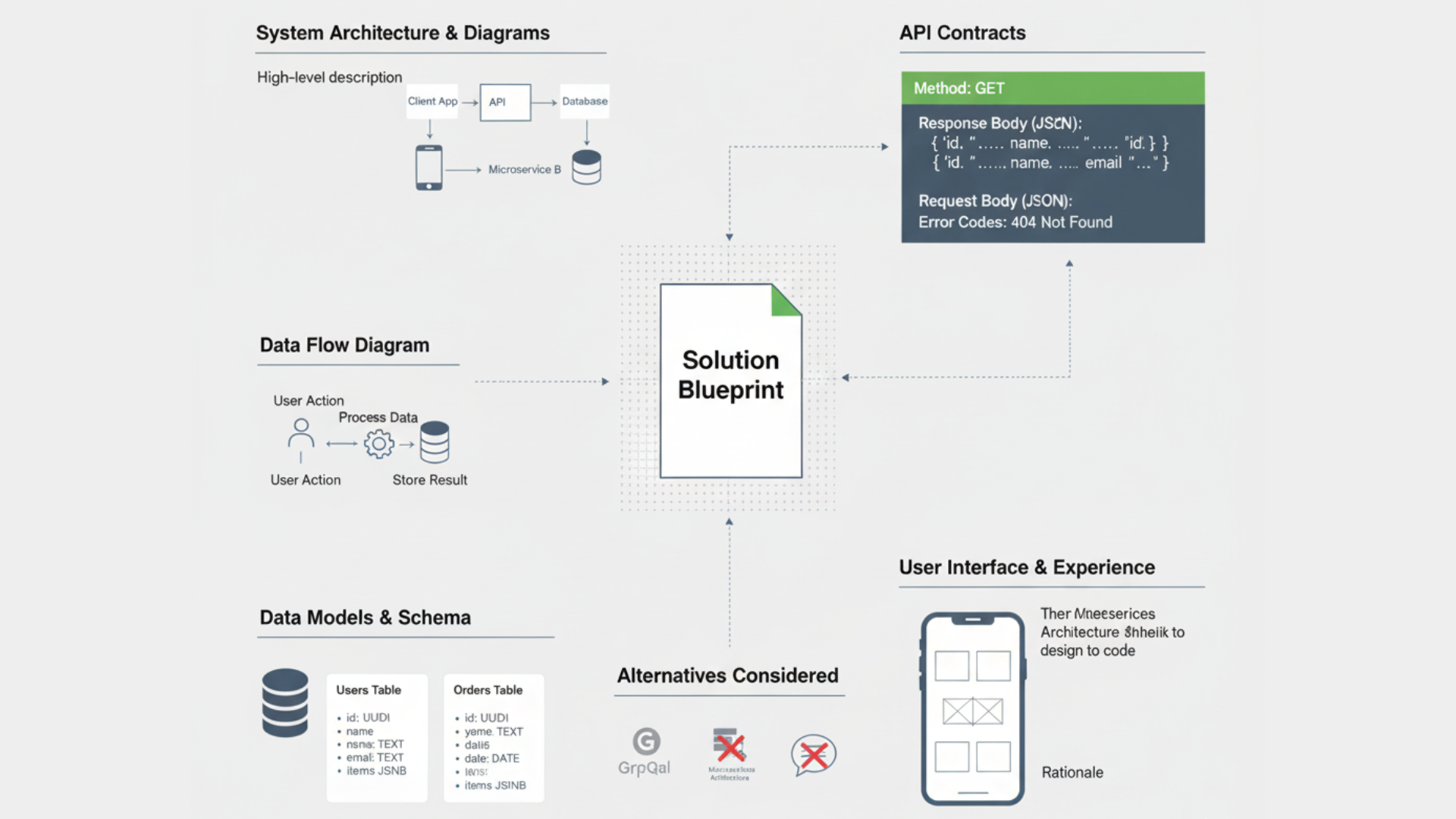
The Proposed Solution (The Technical Deep Dive)
This is the heart of the spec, where the plan becomes concrete.
- System Architecture & Diagrams: A high-level description of the technical approach, always supported by diagrams (system architecture, data flow, etc.). Words alone cannot effectively describe a complex system.
- Data Models & Schema: For any feature touching the database, this is mandatory. Detail any new tables, columns, and data types.
- API Contracts: Precise specifications for any new or changed API endpoints, including methods, request/response bodies (with examples), and error codes.
- User Interface & Experience: Include wireframes or mockups. This connects the backend work to the tangible user experience.
- Alternatives Considered: Briefly describe other technical paths you explored and provide a clear rationale for why you rejected them. This shows rigor and preempts debate.
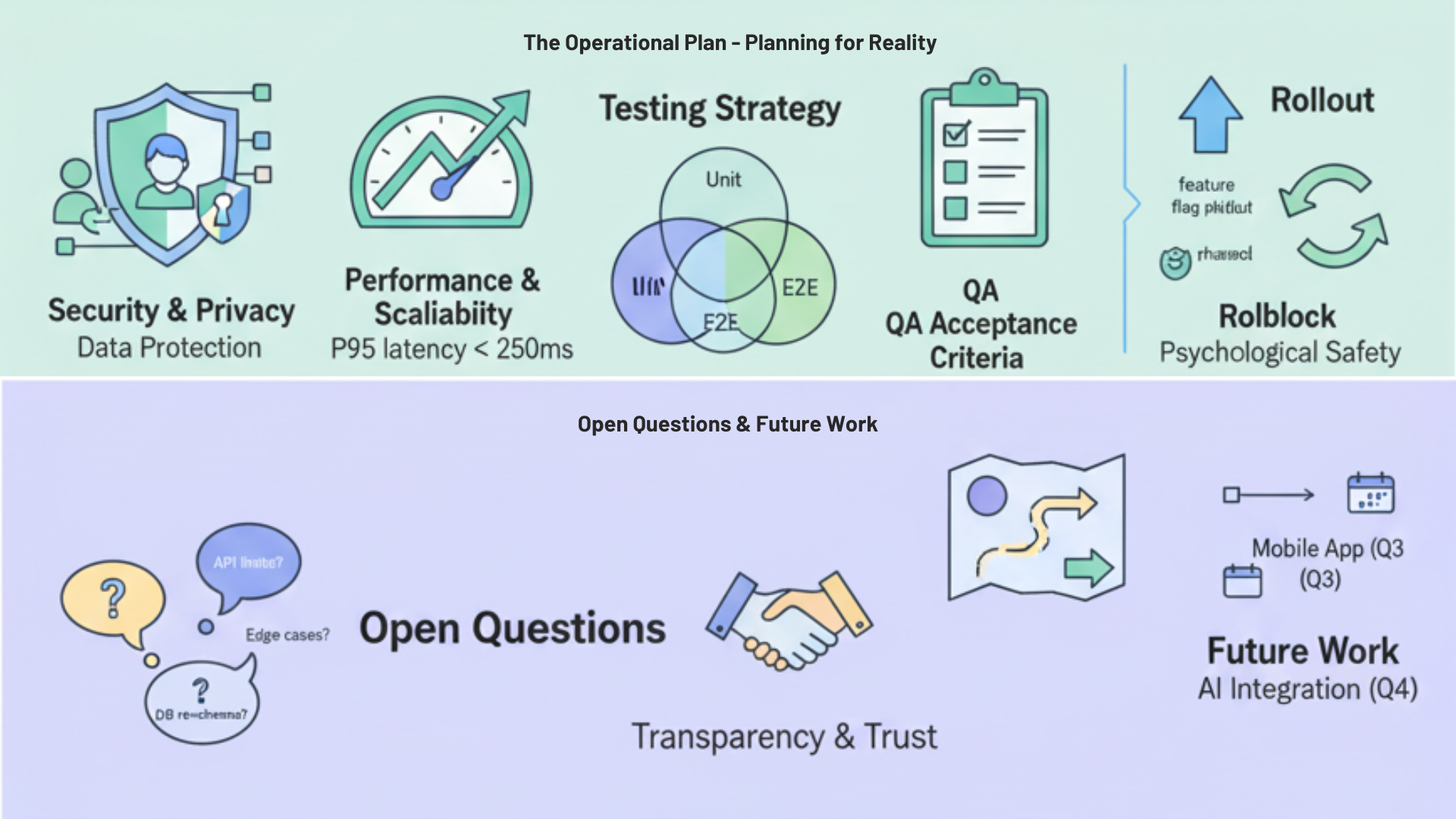
The Operational Plan (Planning for Reality)
A great spec doesn’t stop at “build.” It plans for the entire lifecycle.
- Security & Privacy: How will user data be protected? What are the specific security threats and mitigations?
- Performance & Scalability: Define quantitative, testable targets. Don’t say “fast”; say “P95 latency must be under 250ms.”
- Testing Strategy: Outline the plan for unit, integration, and end-to-end testing. Define the acceptance criteria for QA.
- Rollout & Rollback Plan: How will this be deployed (feature flag, phased rollout)? Critically, what is the step-by-step plan to revert the change if something goes catastrophically wrong? Having a rollback plan provides immense psychological safety for the team.
Open Questions & Future Work
No spec is perfect. Acknowledge what’s still unknown. List any open questions that need answers and any potential future work that is related but out of scope for now. This transparency builds trust.
The Blueprint in Action – A Mini-Spec Example
Theory is good, but seeing it in action makes it stick. Here’s an abbreviated spec for a common “Forgot Password” feature to make the template tangible.
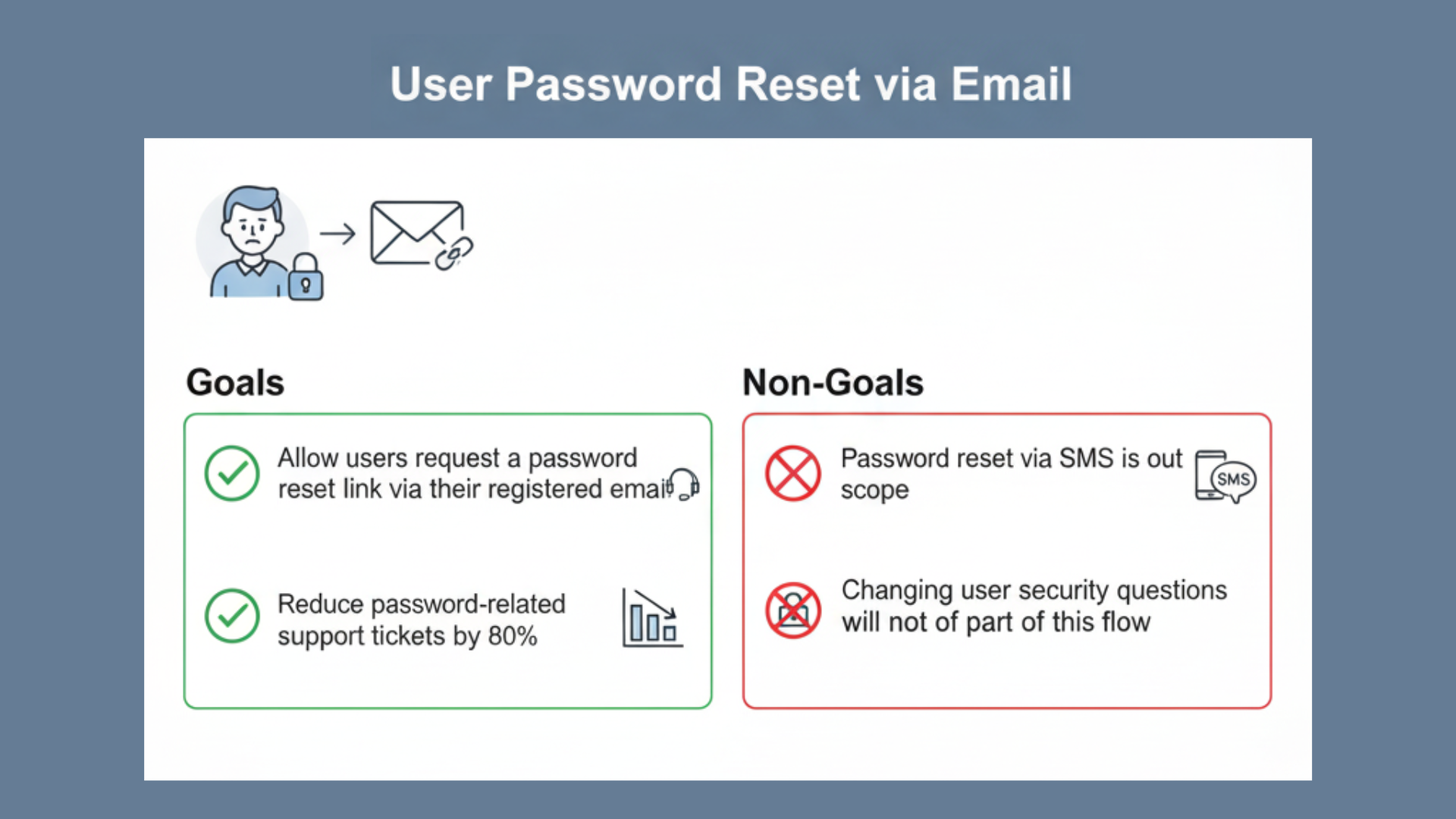
Title: User Password Reset via Email
1. Introduction
Problem Statement: Users who have forgotten their password have no self-service way to regain access to their account, leading to frustration and an increase in support tickets. This project will implement a secure, email-based password reset flow.
- Goals:
- Allow users to request a password reset link via their registered email.
- Reduce password-related support tickets by 80%.
- Non-Goals:
- Password reset via SMS is out of scope.
- Changing user security questions will not be part of this flow.
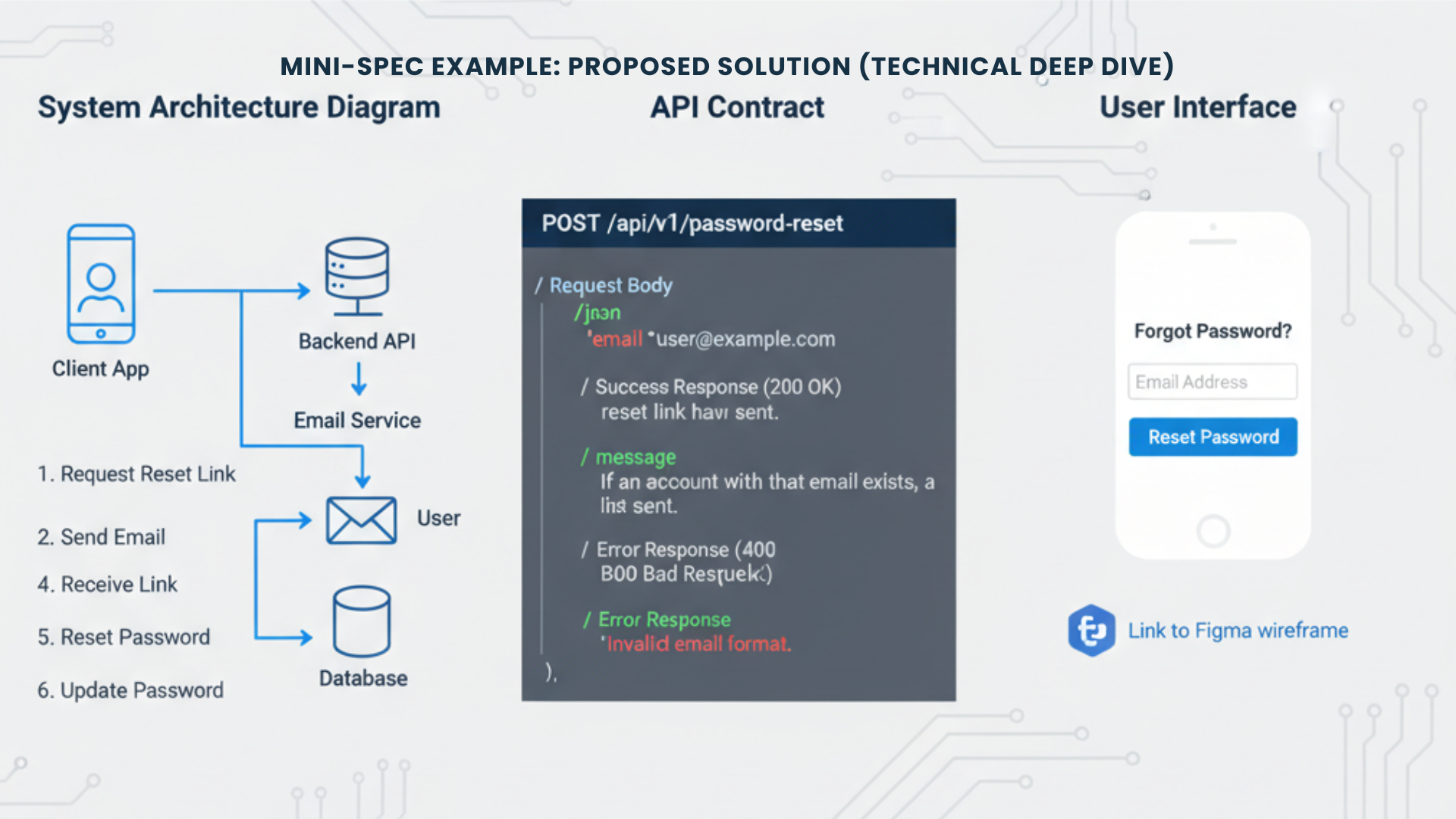
2. Proposed Solution
System Architecture Diagram:
API Contract:
- Endpoint:
POST /api/v1/password-reset - Request Body:
{ "email": "[email protected]" } - Success Response (200 OK):
{ "message": "If an account with that email exists, a reset link has been sent." } - Error Response (400 Bad Request):
{ "error": "Invalid email format." }
User Interface:
(Link to Figma wireframe for the “Forgot Password” screen).
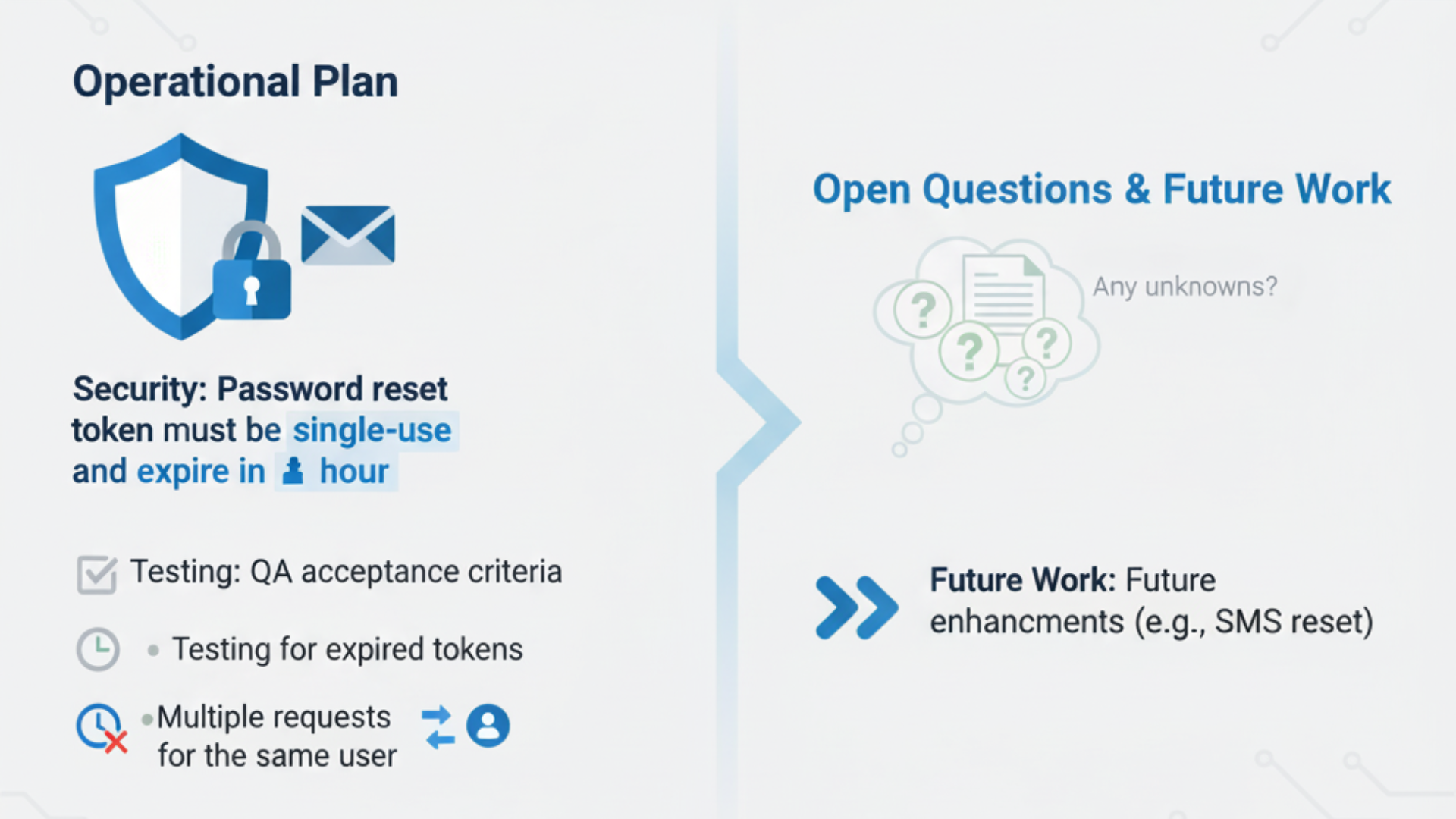
3. Operational Plan
- Security: The password reset token sent via email must be single-use and expire in 1 hour.
- Testing: QA acceptance criteria include testing for expired tokens and multiple requests for the same user.
Conclusion: The Blueprint is a Cultural Artifact
A tech spec that developers love isn’t just a document; it’s the output of a healthy engineering culture. It’s a culture that values clarity, respects expertise, and plans for reality.
Writing a great TSD is an investment of time and effort. It requires discipline and time upfront. But that investment pays for itself tenfold in reduced rework, faster development cycles, and a team that is empowered to build amazing things. It’s the most effective insurance policy you can buy against the chaos of software development.
FAQs
This sounds slow and expensive. Can’t we just be “Agile” and figure it out as we go?
This is a common and dangerous misconception. “Agile” is not an excuse for “no planning.” In fact, a great tech spec enables true agility. It provides clear guardrails and a well-defined backlog, allowing sprints to be focused and productive. The time spent writing a spec is a fraction of the time you’ll save by preventing the team from building the wrong thing, undoing work, and sitting in endless clarification meetings.
I’m not a technical person. How can I contribute to or approve a tech spec?
A well-written tech spec is designed for you, too. While you can skip the deep dive on API contracts, the Introduction, Business Context, Goals/Non-Goals, and User Interface sections should be perfectly clear and understandable to any stakeholder. If they aren’t, the spec has failed. Your role is to validate that the document accurately captures the business and user needs.
How long should a tech spec be?
As long as it needs to be to remove all critical ambiguity, and not one word longer. For a simple feature, this might be 3-4 pages. For a complex, multi-system project, it could be 20 pages or more. The length is irrelevant; its only measure of success is the clarity it provides.
Who is responsible for writing the tech spec?
Typically, a tech lead or senior engineer on the project takes ownership of the TSD. However, it is a highly collaborative process. They will work closely with the product manager to define the goals, the UX designer for the interface, and other engineers to validate the technical approach. It’s a team effort, owned by engineering.


