
Understanding a Statement of Work (SOW): What Should Be Included to Protect Your Project
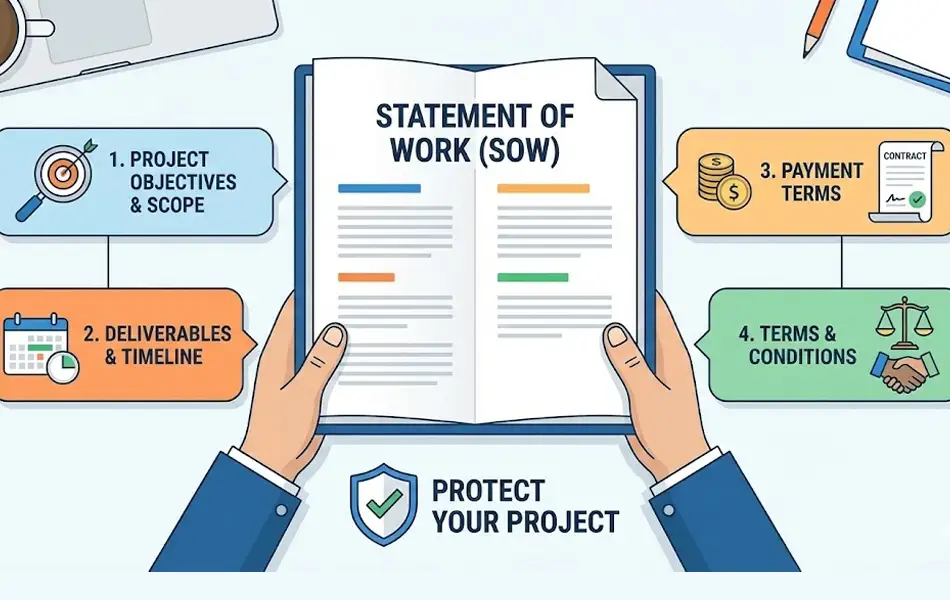
When you hire a web development agency, you will encounter many documents, but none is more important than the Statement of Work (SOW). A well-drafted SOW is the single most critical contractual document in your entire engagement. It is a formal, legally binding agreement that serves as the project’s single source of truth, meticulously defining the scope, deliverables, timeline, costs, and responsibilities of both the client and the agency.
A vague, one-page agreement is a massive red flag. A comprehensive SOW, on the other hand, is your primary tool for managing expectations, controlling the dreaded “scope creep,” and creating a clear, objective framework for resolving any disputes that may arise. It transforms verbal agreements and high-level goals into an actionable, enforceable project plan.
Understanding its key components is essential to protecting your project, your timeline, and your budget. Let’s break down the anatomy of a robust SOW.
Table of Contents
1. Introduction / Project Overview and Objectives
This section sets the stage and provides strategic context. It should be a concise summary of the project, explaining the “why” behind the work. It must clearly state the core business objectives the project is designed to achieve.
- Example: “This Statement of Work details the project to design and develop a new B2B marketing website for Company ABC. The primary business objectives for this project are to (1) increase marketing qualified leads by 30% in the first six months post-launch, (2) improve mobile user engagement by reducing the mobile bounce rate by 50%, and (3) streamline the content update process for the internal marketing team.”
2. Detailed Scope of Work
This is the heart and soul of the SOW. It must provide a highly detailed, specific, and unambiguous description of all the work the agency will perform. This should include a complete list of all features and functionalities to be developed, often broken down by major sections of the application (e.g., User Authentication, Admin Dashboard, Public-Facing Pages).
Crucially, this section must also explicitly state what is out of scope. This proactive exclusion is your most effective defense against scope creep and future misunderstandings.
- Example (In Scope): “Development of a custom WordPress theme based on the approved designs. The theme will include 5 unique page templates: Home, About, Services, Blog, and Contact.”
- Example (Out of Scope): “This SOW does not include: (1) content creation, copywriting, or data entry; (2) ongoing SEO services post-launch; (3) translation of the website into any other languages; or (4) migration of existing blog posts from the legacy system.”
3. Deliverables
While the Scope of Work describes the “work,” the Deliverables section lists the specific, itemized, tangible outputs the agency will produce and hand over to you. This creates a non-negotiable checklist for the project.
Example Deliverables:
- User Personas and User Journey Map document.
- Complete set of project wireframes in Figma.
- High-fidelity visual design mockups for all page templates in Figma.
- A fully tested and functioning website deployed to a staging server for client review.
- Complete source code for the custom theme and plugins.
- Technical documentation and a 1-hour admin training session via Zoom.
4. Period of Performance / Timeline & Milestones
This section outlines the entire project schedule. It should not be a single, vague end date. A professional SOW will provide a detailed timeline with key phases, specific milestones, and deadlines for both agency deliverables and, critically, for client responsibilities (such as providing feedback or approving designs). Tying payment installments to the successful completion of these milestones is a highly effective and common practice.
5. Cost and Payment Schedule
This section must provide a complete and transparent breakdown of all project costs, leaving no room for ambiguity.
- For a Fixed-Price project, it will state the total, final cost.
- For a Time & Materials project, it will specify the fully-loaded hourly rates for all roles involved (e.g., Project Manager: $150/hr, Senior Developer: $175/hr, QA Tester: $100/hr).
It must also detail the payment schedule. A common structure is:
- 30% Deposit: Due upon signing of the SOW to commence work.
- 30% Milestone Payment: Due upon client approval of the final visual designs.
- 40% Final Payment: Due upon final project approval and before deployment to the live server.
6. Acceptance Criteria
This is a frequently overlooked but vital section that protects both parties. It defines the objective, measurable standards that will be used to determine if a deliverable is “complete” and “acceptable.” This removes subjectivity from the approval process.
- Example: “The final website deliverable will be considered complete and accepted when it: (1) passes all documented test cases on the latest versions of Chrome, Firefox, and Safari on desktop and mobile; (2) achieves a Google PageSpeed Insights score of 90 or higher on mobile for the homepage; and (3) has been approved in writing by the client’s designated project lead.”
7. Roles and Responsibilities
This section clearly defines who does what, preventing delays caused by confusion. It should specify the designated project manager and primary point of contact on both the client and agency side, who has the final authority to approve deliverables, and who is responsible for providing necessary assets (content, images, API keys, etc.).
8. Assumptions
Every project plan is built on a set of assumptions. This section lists them explicitly to protect both parties if an assumption turns out to be incorrect.
- Example: “This project’s timeline and budget are based on the assumption that the client will provide all website text and image content within 10 business days of the final design approval. Delays in providing content may impact the project timeline.”
9. Governance and Change Control Process
No matter how detailed the SOW, changes are sometimes necessary. This section defines the formal, structured process for managing those changes. It outlines how a change request must be submitted (usually in writing), how the agency will assess its impact on the project’s timeline and budget, and how the change must be approved in writing by the client before any new work begins. This provides a controlled mechanism for adapting the project while preventing chaotic and uncontrolled scope creep.
A thorough SOW takes time and effort to create, but the clarity, alignment, and protection it provides are invaluable. It is the foundation of a professional and successful development partnership.
To learn more about how the SOW fits into the larger picture of a successful partnership, read our Ultimate Guide to Hiring and Managing a Web Development Agency.
Partner with our Digital Marketing Agency
Ask Engage Coders to create a comprehensive and inclusive digital marketing plan that takes your business to new heights.
Contact Us
Have questions about creating a Scope of Work for your project?
A clear and comprehensive SOW is the hallmark of a professional agency. Contact Engage Coders today for a free consultation. We can help you define the scope of your project and understand how a detailed SOW protects your investment and ensures a successful outcome.


