
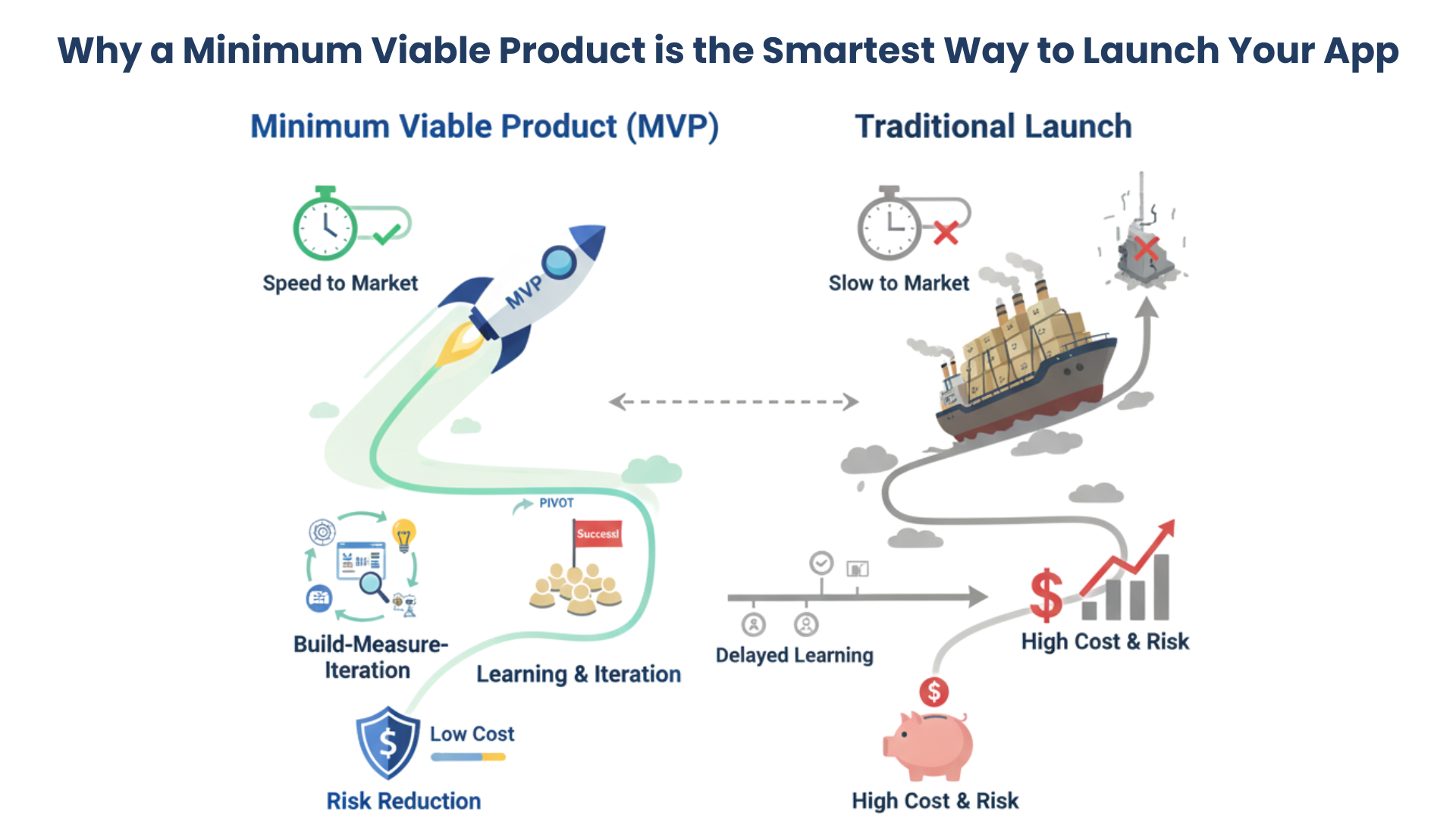
Why a Minimum Viable Product is the Smartest Way to Launch Your App
The startup graveyard is vast and unforgiving. The data is brutal: 90% of new ventures fail. And the number one killer, responsible for more than a third of those failures, isn’t a lack of funding or a brilliant competitor. It’s a simple, tragic, and entirely avoidable mistake: they built something nobody wanted.
This is the catastrophic outcome of the “build it and they will come” fallacy. It’s the result of founders falling in love with their solution, investing months of time and incinerating their seed round on a feature-perfect product, only to launch to the sound of crickets.
There is an escape route from this fate. It’s a disciplined, scientific, and battle-tested strategy called the Minimum Viable Product (MVP).
Let’s be blunt: an MVP isn’t a cheaper version of your app or an excuse to launch a buggy product. It’s a strategic weapon. It’s a methodology for navigating extreme uncertainty by focusing on one thing: validated learning. This guide, a key part of our From Idea to Launch & Beyond series, will show you how to wield that weapon effectively.
Deconstructing the MVP – It’s a Process, Not a Product
To leverage the MVP, you have to understand its soul. Coined by Frank Robinson and popularized by the Lean Startup movement, the MVP is a fundamental shift in thinking.
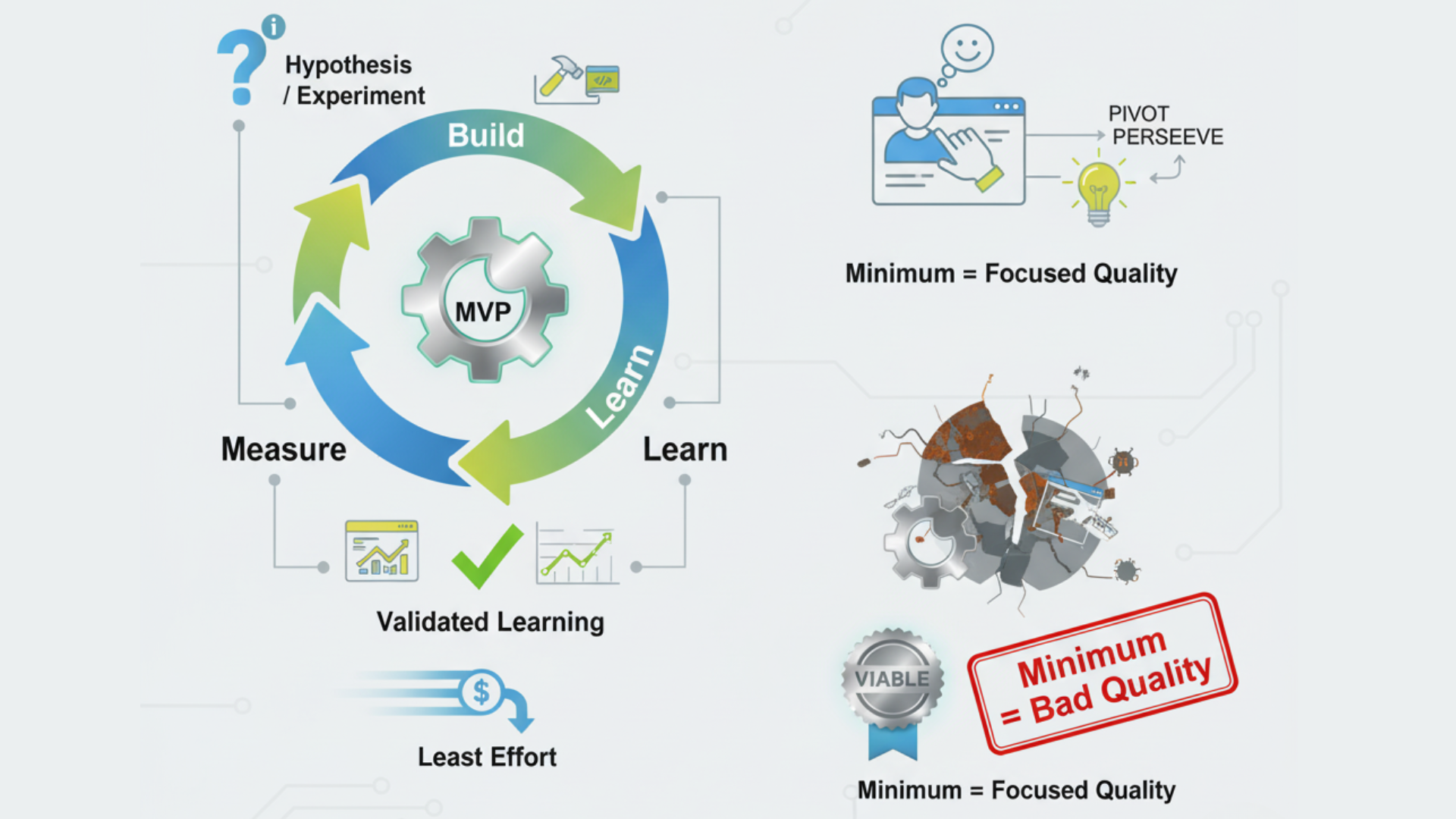
The goal is not to build your full vision. The goal is to build the smallest possible experiment to test your most critical business hypothesis. The classic definition from Eric Ries says it all: an MVP is the version of your product that lets you “collect the maximum amount of validated learning about customers with the least effort.”
- Validated Learning: This isn’t asking people in a focus group if they would use your app. It’s watching to see if they actually do. Real user behavior is the only currency that matters.
- Least Effort: This is about ruthless efficiency. Every feature, every line of code, and every dollar spent must be an investment in answering a core question about your market. Anything else is waste.
This entire process is powered by the Build-Measure-Learn feedback loop: you build an experiment (the MVP), you measure how users react, and you learn whether to persevere or pivot.
Reality Check: “Minimum” Does Not Mean “Bad.” It Means FOCUSED. This is the single most damaging misconception about the MVP, and it needs to be put to rest. “Minimum” refers to the feature set, not the quality. The “V” for “Viable” is non-negotiable. Your MVP must be stable, well-designed, and solve a core problem effectively. If it’s buggy or confusing, your experiment is contaminated. You’ll never know if users rejected your idea or were just repelled by your poor execution. It must be a high-quality slice of the final product, not a low-quality version of the whole thing.
The Strategic Payoff – Why the MVP is a No-Brainer
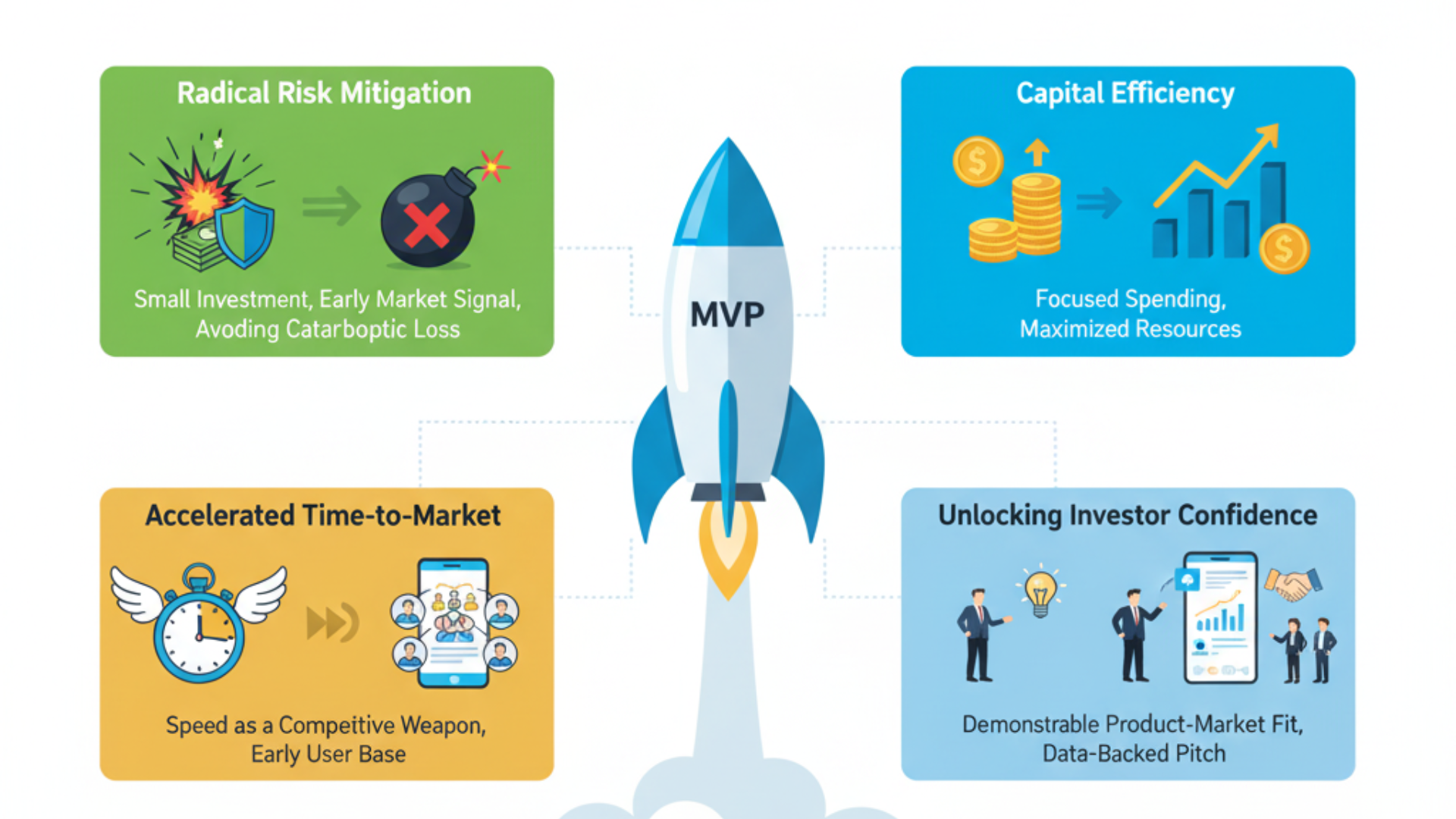
Adopting the MVP approach isn’t a development tactic; it’s a C-suite-level business strategy that delivers a powerful cascade of benefits.
1. Radical Risk Mitigation
The biggest risk you face is building the wrong product. The MVP is designed to confront this risk head-on. By investing a small, controlled amount of capital to test your core concept, you get an early signal from the market. If the response is negative, you’ve just saved yourself from a catastrophic financial loss. This ability to “fail fast” and cheaply is the cornerstone of smart innovation.
2. Capital Efficiency
For most new ventures, cash is oxygen. The MVP model ensures you don’t burn through it building features based on unproven guesses. Every dollar is spent on validating your riskiest assumptions. You only make the big investment in scaling and adding secondary features after you have data proving you’re on the right track.
3. Accelerated Time-to-Market
Speed is a weapon. A focused MVP has a drastically shorter development cycle, getting you into the market and in front of real users months ahead of slower competitors. This allows you to start building a user base, generating feedback, and establishing a market presence while others are still perfecting features no one has asked for.
4. Unlocking Investor Confidence
Imagine walking into a venture capital pitch. Which is more powerful?
- Scenario A: “Here’s our 50-page business plan and our idea for an app.”
- Scenario B: “Here’s our live MVP, our first 1,000 users, and the data showing they love our core feature and are asking for more.”
An MVP with real-world traction transforms your pitch from an abstract idea into a de-risked business with demonstrable product-market fit. It’s the most powerful fundraising tool you can have.
The MVP Blueprint – A Messy But Methodical Guide
Building an MVP requires discipline. While the blueprint looks linear, the reality is a chaotic, iterative cycle of building, testing, arguing, and going back to the drawing board.
Phase 1: The Foundation (Strategy & Discovery)
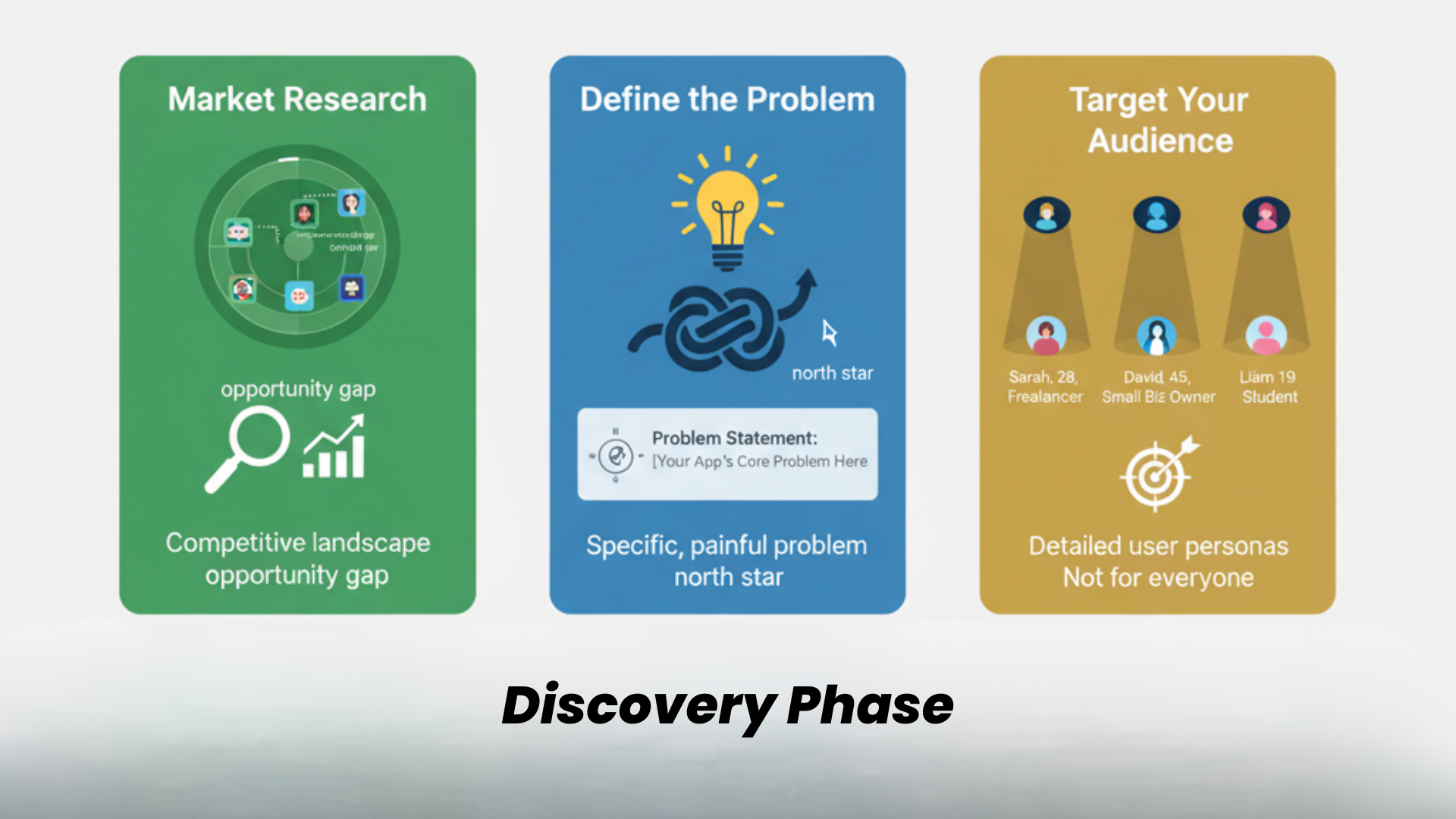
This is where you define the “why” and “who.” It all begins with a rigorous Discovery Phase, where you validate the problem and define the scope.
- Market Research: Get a clear view of the competitive landscape and identify a real opportunity gap.
- Define the Problem: Articulate the specific, painful problem your app will solve. This is your north star.
- Target Your Audience: Create detailed user personas for your ideal early adopters. You can’t be for everyone.
Further Reading: A successful MVP is born from a successful Discovery Phase. Dive deep into our process with The Discovery Phase Blueprint: How to Define Your App’s Scope to Prevent Budget Creep.
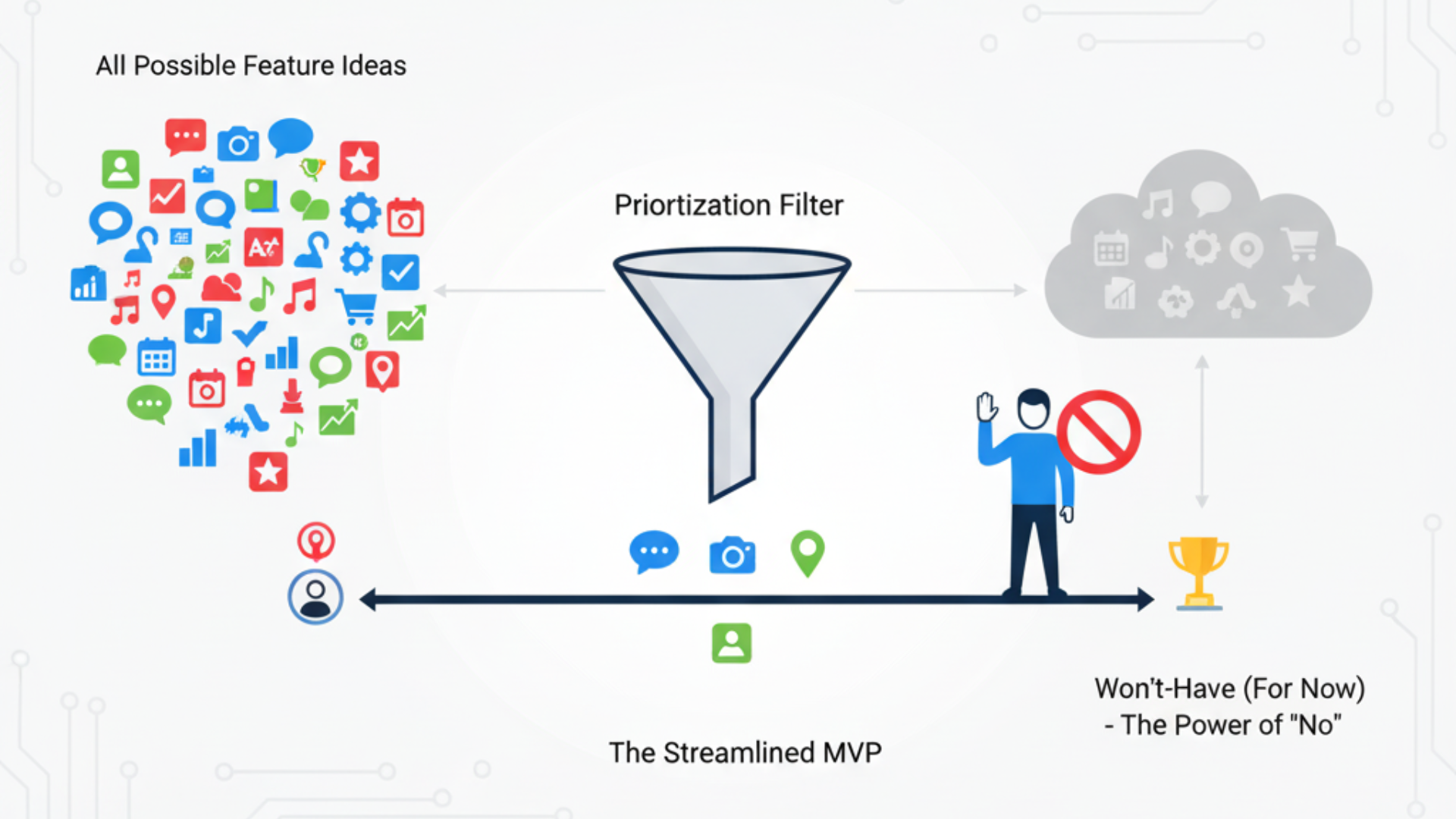
Phase 2: The “Minimum” (The Art of Saying No)
This is where the brutal, gut-wrenching, and absolutely necessary work of prioritization happens.
- Map the Core User Journey: Outline the single most important “job” a user will do in your app. What are the absolute essential steps to get from their problem to a successful outcome?
- Prioritize Features Aggressively: Frameworks like MoSCoW are a good start, but often too permissive. We advocate for a more aggressive approach: every feature must be a “must-have” for that single, core user journey. Everything else goes on the “Won’t-Have (For Now)” list. This requires a product owner with the backbone to say “no”—repeatedly.
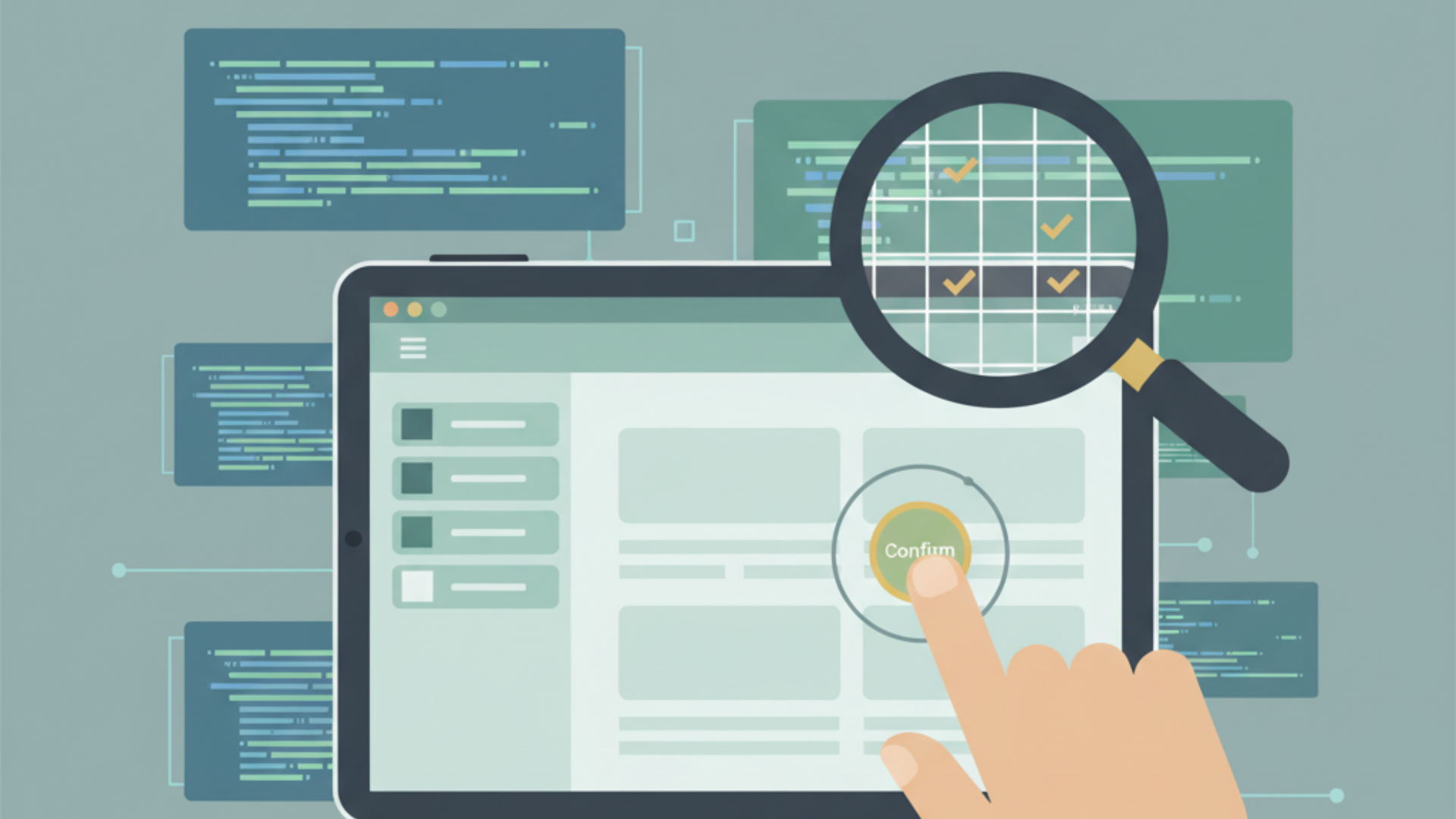
Phase 3: The “Viable” (Quality Execution)
Now you build, but with a focus on quality, not quantity.
- Prototype & Test the UX: Before writing code, build a clickable prototype. Test it with real users. Fixing a confusing user flow in a prototype costs almost nothing; fixing it in a coded app is expensive rework.
- Develop the Core: Build the “must-have” feature set with a focus on stability and a clean user experience.
- Rigorous QA: Test, test, and test again. A viable product cannot be a buggy one.
Further Reading: Quality isn’t an afterthought. Learn why it’s crucial from day one in The Role of Quality Assurance (QA) Testing in a Successful Launch.
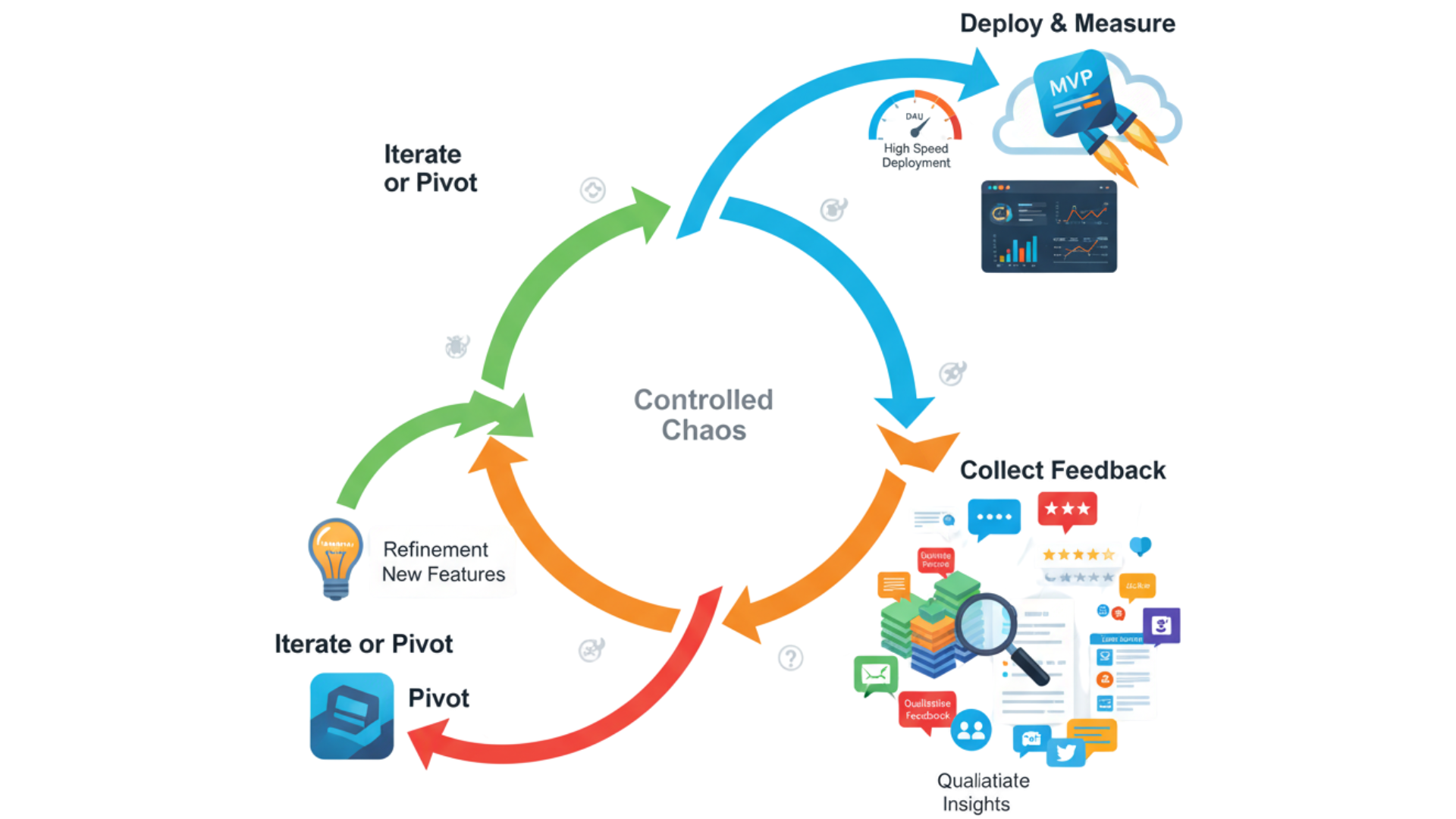
Phase 4: The Launch & The (Chaotic) Loop
The launch isn’t the end; it’s the beginning of the real work. The “Build-Measure-Learn” loop sounds clean on paper. In reality, it’s often a “Build-Measure-Argue-Panic-Rebuild” cycle. Embrace the chaos.
- Deploy & Measure: Get the MVP into the hands of early adopters and track behavior with analytics tools.
- Collect Feedback: Use a mix of quantitative data and qualitative feedback to understand the “what” and the “why.”
- Iterate or Pivot: Use your validated learning to make the next informed, and often difficult, decision.
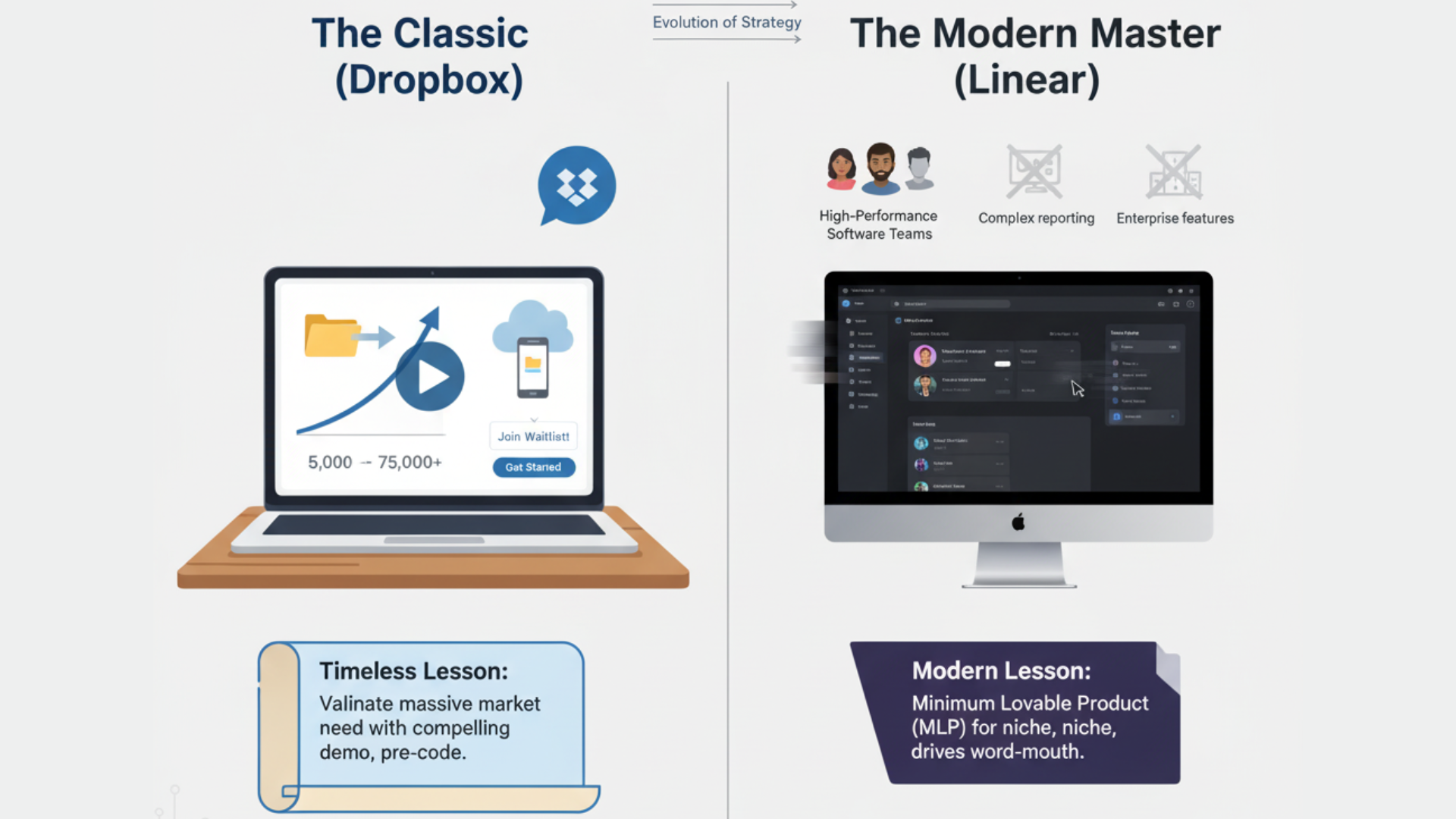
Learning from the Masters – Classic and Modern MVP Execution
The overused examples of Dropbox and Zappos are classics for a reason—they teach fundamental lessons. But to prove this strategy is more relevant than ever, let’s look at a modern titan.
The Classic (Dropbox)
Didn’t build a product. They made a 3-minute “explainer video” demonstrating their file-syncing concept. The beta sign-up list exploded from 5,000 to 75,000 overnight. The Timeless Lesson: You can validate a massive market need with a compelling demonstration of value before writing a single line of production code.
The Modern Master (Linear)
In a market saturated with project management tools like Jira, Linear launched an MVP in 2019 with a hyper-focused, opinionated approach. Their MVP was built for a niche audience—high-performance software teams—and focused on two things: speed and a flawless user experience for the core issue-tracking loop. They ignored enterprise features, complex reporting, and broad integrations. The Modern Lesson: In a crowded market, a “minimum viable” product is no longer enough. You need a Minimum Lovable Product. By creating a beautiful, lightning-fast experience for a specific niche, they built a cult following that drove explosive word-of-mouth growth.
The MVP Playbook – Counter-Intuitive Truths to Embrace
The standard advice is useful, but the real breakthroughs come from embracing ideas that feel wrong but are strategically right.
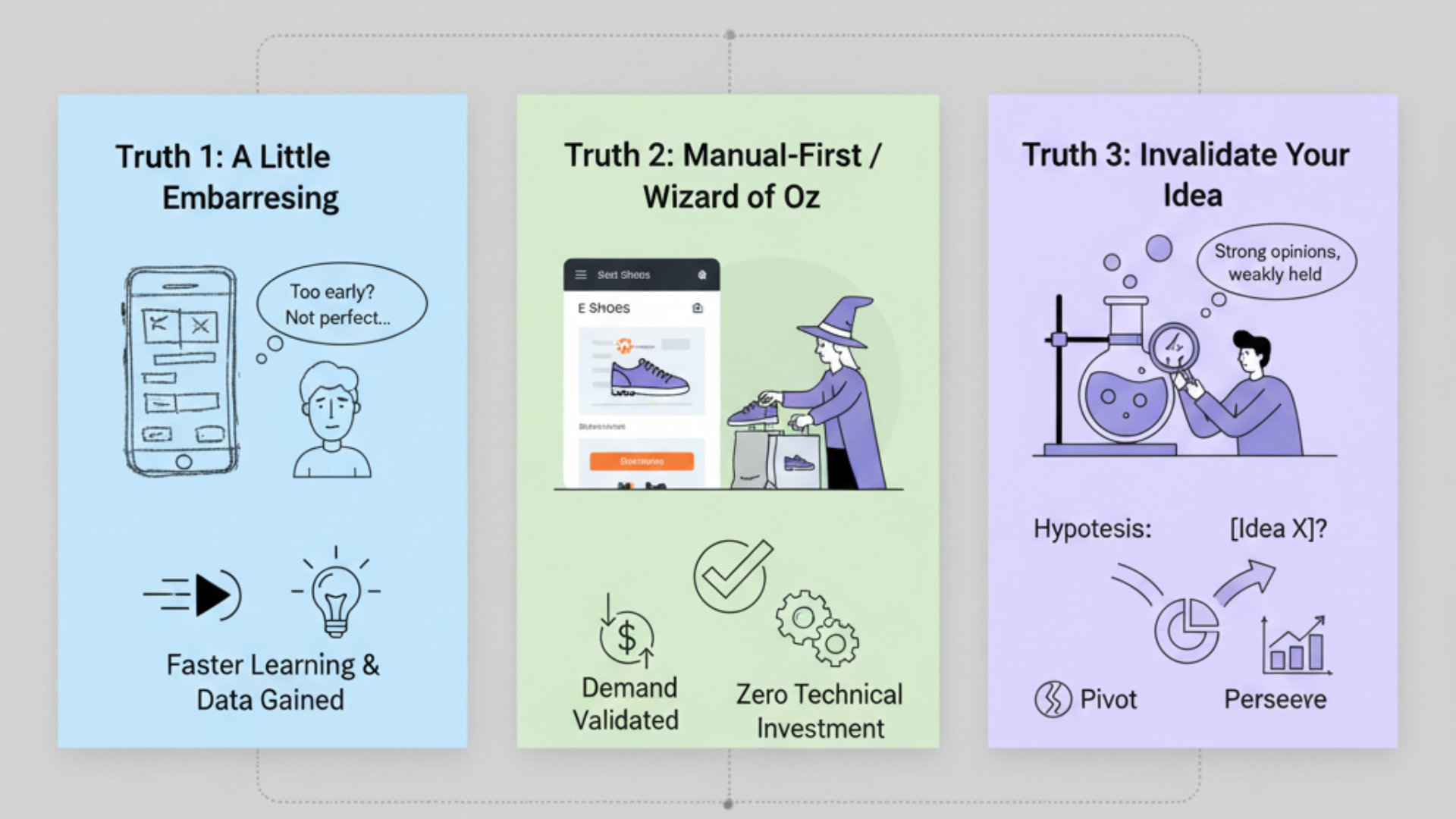
1. Your First MVP Should Be a Little Embarrassing
Reid Hoffman, the founder of LinkedIn, famously said, “If you are not embarrassed by the first version of your product, you’ve launched too late.” This isn’t about shipping a bad product. It’s a psychological check against perfectionism. Your MVP’s purpose is to learn. If you wait until it’s perfect, you’ve waited too long and likely built features based on assumptions, not data.
2. The Power of “Manual-First” (The Wizard of Oz)
Before building complex, automated backend systems, ask: “Can we do this by hand first?” This is the Zappos model. They didn’t build a massive inventory system; the founder went to the store and bought the shoes himself. This “Wizard of Oz” approach allows you to validate a business model with almost zero technical investment. It’s a powerful way to test demand for a service before you invest hundreds of thousands in automating it.
3. Your Goal Should Be to Invalidate Your Idea
This is the hardest truth for a passionate founder to accept. You shouldn’t be running experiments to prove you’re right; you should be running them to find out if you’re wrong, as quickly and cheaply as possible. This mindset of “strong opinions, weakly held” forces you to follow the data, even when it leads to a painful but necessary pivot. It’s the difference between building a business and defending a pet project.
Conclusion: It’s a Mindset, Not Just a Method
The MVP is more than a product development tactic; it’s a business philosophy. It’s a commitment to intellectual honesty—treating your assumptions as hypotheses to be tested, not facts to be defended. It’s a dedication to customer-centricity, letting their behavior, not your ego, guide your path.
Launching an MVP is the starting line. The real work—and the real value—is in the iterative cycles of learning and adapting that follow. At Engage Coders, we don’t just help you build an MVP; we help you adopt the mindset and implement the process that turns a brilliant idea into a business built to last. If you’re ready to build your business the smart way, our team is ready to help.
Ready to Launch Smarter, Not Harder?
Building an MVP requires discipline, focus, and an experienced partner who knows how to separate the essential from the noise. We’ve guided dozens of startups and established companies through this process, helping them get to market faster and with less risk.
If you’re ready to stop guessing and start learning, let’s talk about your MVP.
Frequently Asked Questions (FAQs)
My investors want to see a big, impressive launch. Won’t an MVP disappoint them?
Just the opposite. Sophisticated investors aren’t impressed by a bloated product built on assumptions; they’re impressed by traction. An MVP with a small but passionate user base and data-backed evidence of product-market fit is infinitely more valuable than a feature-packed app with zero users. It shows you’re a disciplined, capital-efficient founder who makes data-driven decisions—and that’s exactly who they want to fund.
How do we decide which features make it into the MVP?
This requires ruthless prioritization, and frankly, a strong stomach to say “no.” It starts by defining the single most important problem you solve for your user. Then, you map the absolute minimum steps they need to take to solve it. Any feature not on that critical path goes into the “Won’t-Have (for now)” list. It’s a process we facilitate in our Discovery Phase, ensuring the final MVP scope is lean, focused, and built to learn.
What happens after the MVP? Do we just keep adding features?
No. You follow the data. The Build-Measure-Learn loop dictates your next move. The feedback and analytics from your MVP might tell you to double-down on the core feature, pivot to serve a different user need that you discovered, or even add a feature from your backlog. The point is, you’re no longer guessing. Every subsequent step is an informed, strategic decision backed by real-world user behavior.
Is an MVP suitable for large, enterprise projects?
Absolutely. The principles of de-risking and validated learning are even more critical when budgets are in the millions. For enterprises, an MVP can be an internal pilot program to test a new tool with a single department before a company-wide rollout. It’s a way to validate adoption, gather feedback from real employees, and prove the business case for a larger investment, preventing the kind of costly, large-scale failures that make headlines.


