
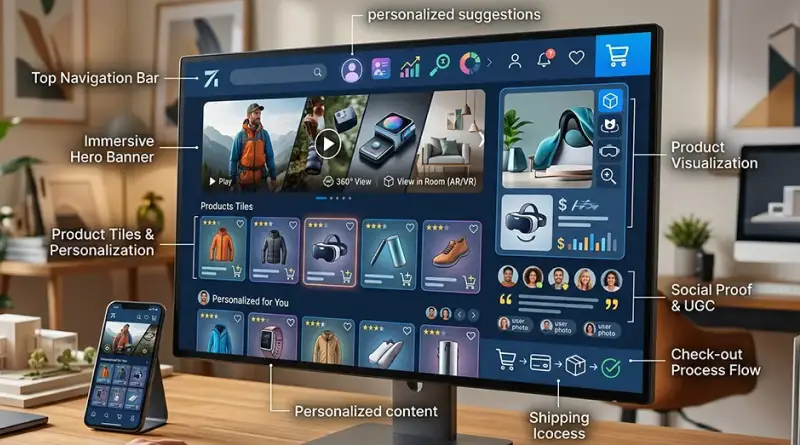
Top E-Commerce Website Design Trends to Boost Online Sales
In today’s competitive online market, customers expect more than just a functional e-commerce website. They want a shopping experience that feels fast, simple, visually appealing, and trustworthy. If an online store feels outdated or difficult to navigate, most users leave within seconds and continue shopping elsewhere.
This is why modern businesses are investing heavily in e-commerce website design that improves customer experience while supporting higher conversions. Design decisions now influence everything from product discovery to checkout completion, making website performance a major part of e-commerce success.
As customer expectations continue to evolve, businesses must stay updated with the latest design approaches that improve usability, mobile performance, and overall shopping experience.
Below are some of the most important e-commerce website design trends that are helping online stores increase engagement and drive more sales.
Table of Contents
-
1. Mobile First Design Is Becoming the Standard
-
2. Simpler Navigation Improves Product Discovery
-
3. Clean Product Pages Are Replacing Cluttered Layouts
-
4. Faster Websites Are Driving Higher Conversions
-
5. Personalized Shopping Experiences Are Increasing Engagement
-
6. Minimal Design Is Improving User Experience
-
7. Streamlined Checkout Experiences Reduce Cart Abandonment
- Conclusion
- FAQ
1. Mobile First Design Is Becoming the Standard
Most online shoppers now browse and purchase products directly from their smartphones. Because of this shift, businesses can no longer treat mobile optimization as an afterthought.
A strong mobile e-commerce website should provide a smooth shopping experience across all screen sizes. Users should be able to browse products, read descriptions, and complete purchases comfortably without unnecessary zooming or navigation issues.
Modern mobile-focused design usually includes:
- Responsive product layouts
- Fast mobile loading speeds
- Sticky navigation menus
- Simplified checkout processes
- Mobile-friendly product galleries
Businesses that prioritize mobile usability often see stronger engagement because customers can shop more conveniently from any device.
2. Simpler Navigation Improves Product Discovery
Customers should never struggle to find products on an e-commerce website. Complicated menus and cluttered category structures often create frustration, leading users to leave before making a purchase.
Modern e-commerce UX design focuses heavily on simplicity and organization. The goal is to help customers move through the website naturally while reducing unnecessary clicks.
Effective navigation strategies often include:
| Navigation Feature | Benefit |
|---|---|
| Clear product categories | Helps users browse faster |
| Predictive search bars | Improves product discovery |
| Product filters | Simplifies shopping experience |
| Sticky menus | Keeps navigation accessible |
| Breadcrumb navigation | Helps users track their location |
When navigation feels intuitive, customers spend more time exploring products and are more likely to complete purchases.
3. Clean Product Pages Are Replacing Cluttered Layouts
Many older e-commerce websites attempted to display too much information at once. However, modern shoppers prefer cleaner product pages that highlight important details without overwhelming them.
Today’s online store design trends focus on improving readability and visual balance. Businesses are now using larger product images, organized descriptions, and strategic spacing to create a more comfortable browsing experience.
Strong product pages often include:
- High Quality Product Images: Customers rely heavily on visuals when shopping online, especially when they cannot physically see the product.
- Clear Pricing and Product Details: Important information should be immediately visible without forcing users to search through long paragraphs.
- Focused Call to Action Buttons: Add to Cart and Buy Now buttons should stand out clearly on the page.
- Customer Reviews: Reviews help shoppers feel more confident before making purchasing decisions.
These improvements not only make product pages more attractive but also support better conversion performance.
4. Faster Websites Are Driving Higher Conversions
Website speed continues to play a major role in e-commerce performance. Online shoppers expect websites to load quickly, and even small delays can reduce sales opportunities.
Slow-loading pages often increase bounce rates because users lose patience when product pages take too long to appear. This becomes even more important for mobile users, who expect quick and seamless browsing experiences.
Businesses focused on conversion rate optimization, e-commerce strategies often prioritize:
- Compressed product images
- Faster hosting infrastructure
- Lightweight website elements
- Optimized code and scripts
- Simplified checkout functionality
A faster e-commerce website creates a smoother customer journey while reducing friction during browsing and checkout.
5. Personalized Shopping Experiences Are Increasing Engagement
Modern e-commerce websites are becoming more personalized to improve customer engagement and retention. Instead of showing the same experience to every visitor, businesses now tailor content based on user behavior and shopping preferences.
Personalization can appear in several ways, including:
- Recommended products based on browsing history
- Recently viewed product sections
- Personalized email signups
- Location-based promotions
- Customized product suggestions
These personalized experiences make online shopping feel more relevant to customers, which often increases both engagement and repeat purchases.
6. Minimal Design Is Improving User Experience
One of the biggest shifts in e-commerce website development is the move toward minimal and distraction-free design. Businesses are reducing unnecessary visual clutter so customers can focus more clearly on products and purchasing decisions.
Minimal design does not mean empty or boring websites. Instead, it focuses on clarity, spacing, and simplicity.
Modern minimal ecommerce design often includes:
- Clean typography
- Neutral color palettes
- Large product imagery
- Simplified layouts
- Consistent branding
These design choices improve readability while making websites feel more modern and professional.
7. Streamlined Checkout Experiences Reduce Cart Abandonment
Many e-commerce businesses lose potential sales during checkout because the process feels too long or complicated. Modern e-commerce websites are now simplifying checkout experiences to reduce abandonment rates and improve conversions.
Customers expect checkout processes to feel quick, secure, and easy to complete.
Strong checkout optimization strategies include:
| Checkout Improvement | Purpose |
|---|---|
| Guest checkout options | Reduces friction for new users |
| Multiple payment methods | Improves convenience |
| Autofill form support | Speeds up checkout |
| Progress indicators | Helps users understand steps |
| Simplified form fields | Reduces user frustration |
A smoother checkout process creates a better customer experience while improving completed purchases.
Conclusion
Modern E-commerce Website Design is no longer just about appearance. Customers now expect online stores to feel fast, mobile-friendly, easy to navigate, and simple to shop from. Businesses that improve user experience through better design, faster performance, and smoother checkout processes are more likely to increase customer engagement and online sales.
Let Us Help You Build a Better E-commerce Experience
Work with Engage Coders to create an e-commerce website focused on modern design, mobile usability, smoother shopping experiences, and performance-driven functionality for today’s online customers.
Get A Free Quote Now
As e-commerce continues to evolve, businesses need websites that balance usability, performance, and modern design trends. Engage Coders offers ecommerce website design and development services focused on responsive design, usability, and modern ecommerce functionality.
FAQ
E-commerce website design helps create a better shopping experience for customers. A well-designed website makes it easier for people to browse products, trust your business, and complete purchases.
A good mobile e-commerce website should load quickly, look clean on smaller screens, and make shopping easy for mobile users. Customers should be able to browse and check out without any difficulty.
E-commerce UX design improves how customers interact with your website. It helps users find products faster, navigate pages easily, and enjoy a smoother shopping experience.
Some popular online store design trends include clean layouts, larger product images, simple navigation, faster loading pages, and mobile-friendly designs.
Slow websites can frustrate customers and cause them to leave before making a purchase. A faster website improves user experience and helps increase online sales.
Businesses can reduce cart abandonment by simplifying the checkout process, offering multiple payment options, and avoiding unnecessary checkout steps.
Most customers now shop using smartphones. A mobile-friendly website helps users browse products comfortably and complete purchases more easily on mobile devices.
Conversion rate optimization and e-commerce strategies help increase the number of website visitors who become customers. This usually involves improving website design, speed, navigation, and checkout experience.
E-commerce websites should be updated regularly to improve performance, keep the design modern, and match changing customer expectations.
Professional e-commerce website development helps businesses create websites that are user-friendly, visually appealing, and optimized for better performance and sales.

