
Website Redesign vs. Website Optimization: Which is Better for Your Business?
A website can look professional and still fail to generate leads. Visitors may struggle to find information, pages may load slowly, or potential customers may leave without contacting your business. When these problems arise, you need to determine whether your website requires a complete redesign or a few targeted improvements.
Both approaches can improve your website, but they solve different problems.
A website redesign focuses on substantial changes to your website’s appearance, structure, functionality, or technology. Website optimization improves specific areas of an existing website, such as page speed, navigation, search visibility, and conversion rates.
Choosing the right approach depends on your website’s current condition, your business goals, and the problems you need to solve. Let’s explore the differences and how to decide which option makes sense for your business.
Table of Contents
- Website Redesign vs. Website Optimization: Understanding the Difference
- When Is a Website Redesign Worth the Investment?
- When Can Website Optimization Deliver Better Results?
- Website Redesign vs. Optimization: Cost, Time, and Business Impact
- How to Decide What Your Website Actually Needs
- How a Website Redesign Can Affect SEO
- Why Redesign and Optimization Work Better Together
- Choosing the Right Approach for Your Business
- Ready to Determine What Your Website Needs?
- FAQs
Website Redesign vs. Website Optimization: Understanding the Difference
Website redesign and website optimization share the same broad goal: making your website more effective. The difference lies in the scope of work and the problems each approach addresses.
Website Redesign: When Your Website Needs a Fresh Start
A website redesign involves making significant changes to the website’s layout, visual identity, navigation, content structure, or functionality. Depending on the project, it may also involve rebuilding the website on a different platform.
A redesign may be appropriate when your website no longer reflects your brand, its structure confuses visitors, or its technology prevents you from adding essential features.
For example, a business that has expanded its services may find that its original website cannot explain its offerings clearly. A redesign can create a more logical structure, improve navigation, and make it easier for customers to understand what the business provides.
However, a redesign does not automatically solve every website problem. If the underlying issue is poor content, slow hosting, or a technical configuration error, those problems still need to be addressed.
If you are considering a new website, explore our guide to building a website in 2026.
Website Optimization: Improving What Already Works
Website optimization focuses on improving an existing website without necessarily rebuilding it. The work targets specific weaknesses that affect usability, performance, search visibility, or conversions.
Common optimization tasks include:
- Improving page loading speed and Core Web Vitals.
- Making navigation clearer and easier to use.
- Updating existing content to better address customer needs.
- Improving page titles, headings, and internal links.
- Simplifying contact forms and calls to action.
- Fixing technical issues that prevent search engines from accessing important pages.
Imagine that your website attracts relevant visitors but receives few inquiries. Before investing in a complete redesign, you could review your service pages, calls to action, contact forms, and mobile experience. Addressing these issues may improve results without changing the entire website.
Optimization is particularly useful when your existing website has a sound foundation but needs measurable improvements.
When Is a Website Redesign Worth the Investment?
A redesign becomes worth considering when your website’s current structure, technology, or user experience creates problems that smaller improvements cannot adequately solve.
- Your website no longer reflects your business. Your services, audience, or brand positioning have changed, but your website still communicates an outdated message.
- Visitors struggle to navigate your website. Important information is buried in confusing menus, page structures are inconsistent, or customers cannot easily find the services they need.
- Your website cannot support new requirements. You need new integrations, booking functionality, e-commerce features, or additional service sections that your current platform cannot accommodate efficiently.
- The mobile experience has significant limitations. Menus, forms, page layouts, or interactive elements are difficult to use on mobile devices, and correcting these problems requires substantial redevelopment.
- Maintaining the website has become difficult. Routine updates require complicated workarounds, technical limitations restrict growth, or the existing platform no longer meets your operational needs.
One issue alone does not necessarily justify a redesign. Before committing to a larger project, identify the underlying causes and determine whether targeted fixes could address them.
A structured website review can help you make that decision. Explore our website development resources for related guidance.
When Can Website Optimization Deliver Better Results?
Website optimization is often the more practical option when the website already has a suitable structure and the problems are limited to particular pages, features, or technical areas.
For example, a business may have a well-designed website but struggle with slow-loading service pages. Improving image delivery, reviewing scripts, and addressing other performance issues may be more useful than replacing the design.
Optimization can also help when:
- Visitors arrive but do not submit inquiries. Review the clarity of your service descriptions, calls to action, and contact forms.
- Important pages receive little organic traffic. Check content relevance, search intent, internal linking, and indexing.
- Mobile visitors have difficulty completing actions. Improve readability, spacing, menus, and form usability.
- Landing pages generate traffic but few conversions. Examine whether the page answers visitors’ questions and makes the next step clear.
- Your website needs better performance. Investigate loading times and technical bottlenecks before deciding that a rebuild is necessary.
For businesses already receiving search traffic, optimization should protect existing strengths as well as address weaknesses. Avoid changing successful URLs or removing useful content without understanding the possible impact.
Our guide to optimizing landing pages for better conversions and user experience explains how focused improvements can support the visitor journey.
Website Redesign vs. Optimization: Cost, Time, and Business Impact

The cost and duration of either approach depend on the website’s size, complexity, technology, required features, and project scope.
A redesign generally requires more upfront coordination because it may involve planning, design, development, content migration, testing, and launch preparation. Optimization can be more manageable when the work is limited to specific issues, although complex technical improvements can also require significant investment.
| Factor | Website redesign | Website optimization |
|---|---|---|
| Scope | May affect the entire website | Targets selected problems |
| Initial investment | Often higher | Can be lower for limited changes |
| Time required | Depends on the scale of the rebuild | Depends on the number and complexity of fixes |
| Design changes | May introduce new layouts and visual elements | Usually retains the existing design |
| Technical work | May require redevelopment or migration | Focuses on improving existing systems |
| SEO considerations | Requires careful planning for launch and migration | Requires monitoring changes to existing pages |
| Business impact | Can support broader strategic changes | Can address specific performance or conversion barriers |
The lowest upfront cost is not always the best choice. Repeatedly fixing a website that cannot support your business needs may cost more over time. On the other hand, replacing a website that only needs a few improvements can waste resources.
Compare the cost of each approach with the problem it solves, the expected business benefit, and the work required to maintain the result.
For further budgeting context, read our article on website development costs. Actual project costs will vary according to your requirements and the scope of work.
How to Decide What Your Website Actually Needs
Before choosing between a redesign and optimization, assess the website’s current performance and identify the problems that matter most to your business.
Review Your Website’s Design and Usability
Look at your website from a customer’s perspective. Can visitors understand what your business offers? Can they find important information without unnecessary clicks? Are your contact details and next steps easy to locate?
If a few pages create confusion, improving their layouts or navigation may be enough. If the problem affects the entire website, a redesign may be worth considering.
Identify Performance and Technical Issues
Check how quickly important pages load on desktop and mobile devices. Review broken links, technical errors, mobile usability, and any issues affecting the site’s functionality.
A slow website does not automatically need a redesign. The cause could be oversized images, inefficient scripts, hosting limitations, or other technical problems that can be addressed separately.
For more detail, read our guide to Largest Contentful Paint and website performance.
Evaluate Traffic, Rankings, and Conversions
Use Google Search Console and your analytics platform to understand how people discover and use your website.
Look at organic search impressions and clicks, important landing pages, user engagement, and completed actions such as form submissions or purchases. Identify when problems began and whether they affect specific pages or the website as a whole.
If rankings have declined, investigate technical SEO, content changes, indexing, and search intent before assuming a redesign will fix the problem.
Consider Your Future Business Goals
Your website should support both your current operations and your future plans. Consider whether you will need additional services, new content sections, e-commerce functionality, customer portals, or third-party integrations.
If your current platform can support these requirements, optimization may be sufficient. If its limitations prevent essential changes, a redesign or technical rebuild may be the more sustainable choice.
How a Website Redesign Can Affect SEO
A redesign can improve the foundation for search visibility, but it can also introduce problems if SEO is overlooked during development.
Search engines rely on accessible pages, relevant content, internal links, and technical signals to understand a website. If a redesign removes useful content, changes URLs without appropriate redirects, breaks internal links, or accidentally blocks indexing, organic performance may suffer.
To reduce avoidable risks:
- Record existing URLs and identify pages that attract organic traffic.
- Preserve useful content and relevant metadata where appropriate.
- Map old URLs to their correct new destinations when URLs change.
- Update internal links and XML sitemaps.
- Check redirects, canonical tags, mobile usability, and indexing settings.
- Test important pages before launch.
- Monitor search performance and technical errors after launch.
A redesign should include SEO planning from the beginning rather than treating it as a final checklist item.
If your main objective is better search visibility, review our guide to SEO strategies for web design.
Why Redesign and Optimization Work Better Together
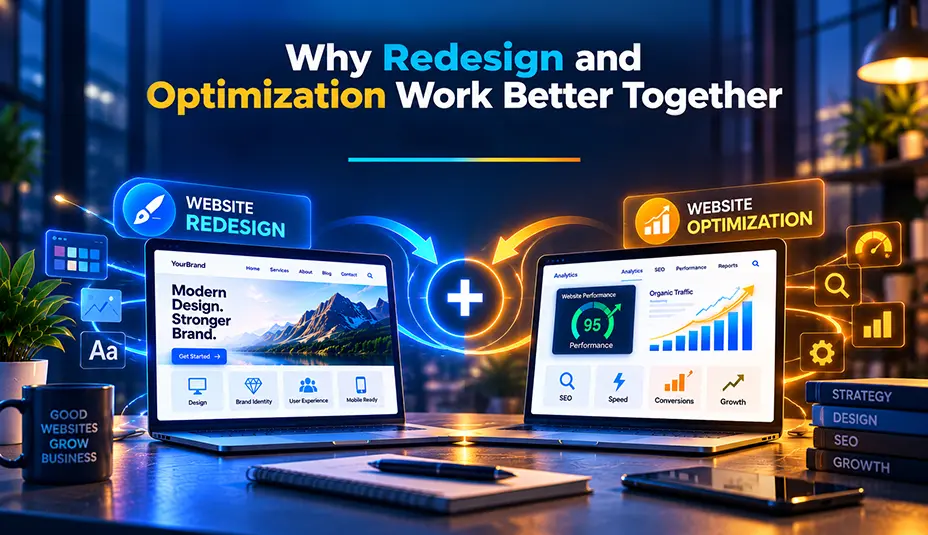
Redesign and optimization are not mutually exclusive. Many projects benefit from combining the two approaches.
A redesign can establish a stronger foundation by improving the website’s structure, navigation, visual design, and functionality. Optimization can then help ensure that the website performs effectively, loads efficiently, communicates clearly, and supports conversions.
For example, a service business may redesign its website to organize its offerings more logically. During development, the team can also improve page speed, structure content around customer needs, create clearer calls to action, and prepare redirects for any URL changes.
The important point is to prioritize improvements based on business needs. Rebuilding the website does not mean every element must change, and optimization does not mean every existing feature should be retained.
The right combination depends on the findings of your assessment, your budget, and the results you want to achieve.
Choosing the Right Approach for Your Business

Website redesign is worth considering when your website’s structure, technology, or overall user experience no longer supports your business goals. Website optimization is often the better starting point when the existing website works well but needs improvements in performance, search visibility, usability, or conversions.
The decision should come from an assessment of your website rather than its appearance alone. Identify the underlying problems, review available data, and compare the cost and likely impact of the available solutions.
At Engage Coders, website design, development, and digital marketing should serve a clear business purpose. Whether your website needs targeted improvements or a more substantial overhaul, the priority is to choose an approach that supports your customers and your long-term goals.
Ready to determine what your website needs?
Request a free quote from Engage Coders to discuss your goals and explore the right next steps.
Request a free quote
FAQs
Consider a redesign when your website’s structure, functionality, technology, or usability no longer meets your customers’ needs. If the problems are limited to page speed, content, or a few conversion barriers, optimization may be sufficient.
Optimization can cost less when it addresses a limited set of problems. However, the total cost depends on the technical complexity, number of pages, and work required. Compare the scope and expected outcomes of each proposal.
Yes. Improving page clarity, navigation, loading performance, forms, and calls to action can help visitors complete important actions. The impact depends on the problems being addressed and the quality of implementation.
It can. Changes to URLs, content, internal links, redirects, and technical settings may affect search visibility. Planning for SEO before launch and monitoring the website afterward helps reduce avoidable risks.
There is no fixed schedule that applies to every business. Review your website regularly and consider a redesign when its technology, structure, functionality, or user experience no longer supports your goals. A well-performing website may need ongoing optimization instead of a complete overhaul.


