
Google Ads Customer Match: The Advantage AI Can’t Create for You
Google Ads has quietly changed the rules of competition.
Tasks that once separated experienced advertisers from everyone else are increasingly handled by automation. Bids adjust automatically. Campaigns expand into new inventory without manual intervention. Audience discovery happens at a scale no human could manage alone.
That’s great for efficiency but it’s “not that great” for differentiation.
When thousands of advertisers are using the same machine-learning systems, the advantage no longer comes from having access to better tools. It comes from giving those tools better information.
The opportunity is obvious but creating new campaigns now can scale faster with less manual labour with a problem which is harder to spot.
Now more and more advertisers switch to these new but same automation tools, accounts begin to look increasingly alike. Two companies can use identical campaign types, similar bidding strategies, and the same machine-learning systems. Yet one consistently generates better results.
While, this new difference often comes down to something Google’s AI cannot create on its own customer data.
Table of Contents
- Why Customer Match is the Steering Wheel for Google’s AI
- Why First-Party Data Is Becoming the Competitive Advantage
- Feed the Machine: How Customer Match Influences Google’s AI
- The Four Customer Segments That Matter Most
- Why Customer Match Often Fails
- Stop Uploading CSV Files
- The Compliance Factor Global Advertisers Can’t Ignore
- The Real Customer Match Question
- FAQs
Why Customer Match is the Steering Wheel for Google’s AI
This is why Customer Match has become far more important than many advertisers realise.
Most discussions around Customer Match focus on audience targeting. Upload a customer list, create an audience, and reach existing customers across Google’s properties. While that’s still useful, it understates the role Customer Match now plays inside an AI-driven advertising ecosystem.
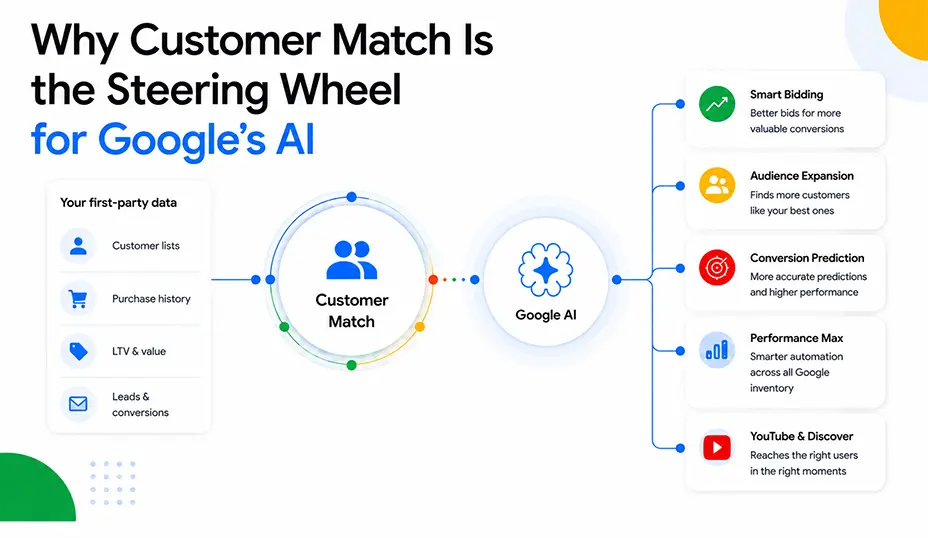
Today, Customer Match functions as one of the clearest ways to help Google’s systems understand what a valuable customer looks like.
That distinction matters because Google’s automation relies on signals. Every automated bidding decision, audience expansion, and conversion prediction is influenced by the information available to the platform. The better the information, the better the prediction.
In practical terms, Customer Match has evolved from a targeting tool into a training dataset.
Why First-Party Data Is Becoming the Competitive Advantage
Consider what happens when two advertisers use Performance Max.
Both optimize for conversions.
Both use Smart Bidding.
Both rely on Google’s machine learning.
On the surface, the accounts appear similar.
Underneath, the systems may be learning from completely different datasets.
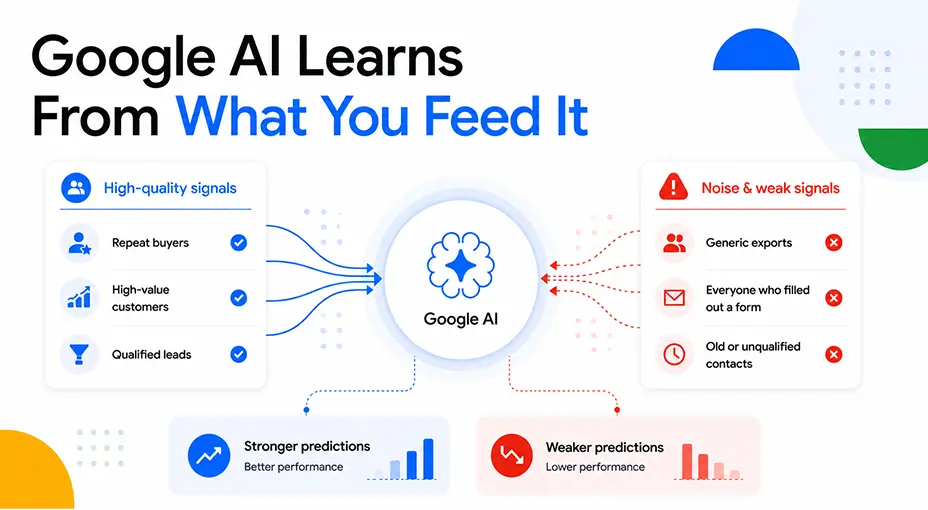
One advertiser uploads a list of repeat buyers, high-value customers, and qualified leads. The other uploads a generic customer export containing everyone who has ever filled out a form.
The first list tells Google’s systems something useful.
The second creates noise.
As Google Ads becomes increasingly automated, the quality of these signals becomes one of the few areas advertisers still control. This is why Google’s own guidance increasingly focuses on audience quality, customer segmentation, and first-party data strategies rather than purely tactical optimisation.
The question is no longer whether you’re using automation.
The question is whether you’re helping automation make better decisions.
Feed the Machine: How Customer Match Influences Google’s AI
Many advertisers think Customer Match works only after a list is uploaded.
In reality, its impact often extends far beyond the audience itself.
When customer lists are connected to Smart Bidding strategies, Performance Max campaigns, or Search campaigns, Google’s systems gain additional context about the people generating revenue.
A list of repeat purchasers sends a different signal than a list of one-time buyers.
A list of high-lifetime-value customers provides stronger indicators than a list containing every lead in a CRM
Customer Match becomes particularly valuable when combined with offline conversion imports. This closes the feedback loop by showing Google which leads eventually became customers, not just which users submitted a form.
The result is a more complete understanding of customer quality.
That’s the real value.
Not reaching existing customers.
Teaching Google’s systems which future customers deserve more attention.
The Four Customer Segments That Matter Most
One of the biggest mistakes advertisers make is treating every customer record the same.
Advanced Customer Match strategies rely on segmentation.
| The Segment | How to Route It in Google Ads | Tactical Benefit |
|---|---|---|
| Whales (Top 10% LTV) | Performance Max + Search Value Rules | Helps Smart Bidding identify and prioritize users who resemble your highest-value customers. |
| Cart or Lead Abandoners | Search + YouTube Retargeting | Re-engages high-intent prospects before competitors capture demand. |
| Dead Leads or Disqualified Prospects | Negative Audience Lists | Prevents wasted spend and improves signal quality by excluding users unlikely to convert. |
| Churn Risks (No Purchase in 180+ Days) | Demand Gen + Video Campaigns | Supports re-engagement through visual formats across YouTube and Discover. |
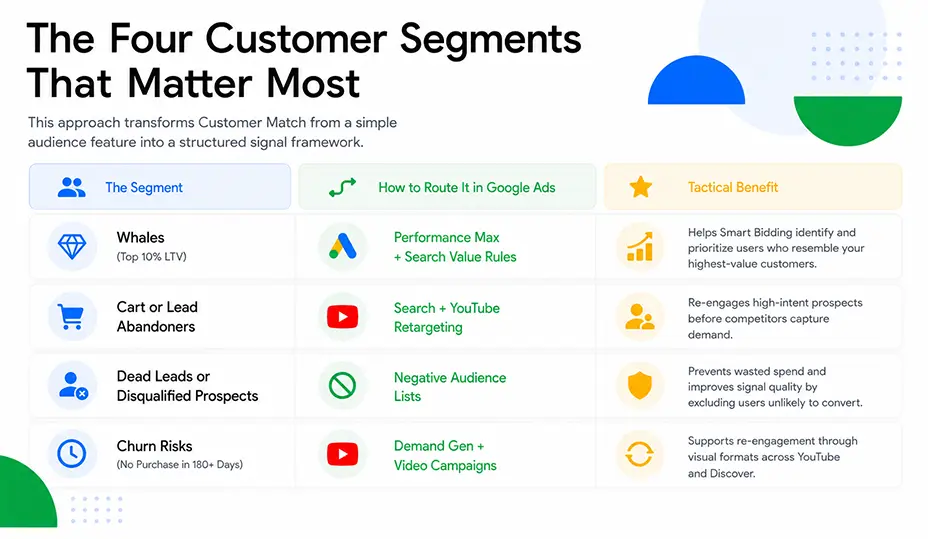
This approach transforms Customer Match from a simple audience feature into a structured signal framework.
Why Customer Match Often Fails
At this point, many advertisers assume success is simply a matter of uploading more data.
That’s rarely the case.
One of the most common problems is poor match rates.
A B2B company may upload 10,000 contacts and discover only a fraction become active matches. The reason is straightforward. Many contacts were collected using work email addresses, while users interact with Google services using personal accounts.
The solution is not necessarily a larger database.
It’s a richer one.
Uploading email addresses alongside phone numbers, first names, last names, and additional identifiers gives Google more opportunities to match users accurately.
Another overlooked challenge is audience eligibility.
Customer Match operates under strict policy requirements. Certain categories involving sensitive information face additional restrictions, and advertisers must ensure they have appropriate consent before using customer data for advertising purposes.
Ignoring these requirements can limit audience availability or prevent campaigns from running as intended.
Stop Uploading CSV Files
Many Customer Match lists fail for a simpler reason.
They become outdated.
Customer behaviour changes daily. Leads become customers. Customers stop purchasing. Sales teams disqualify opportunities. Yet many advertisers continue relying on static CSV uploads created months earlier.
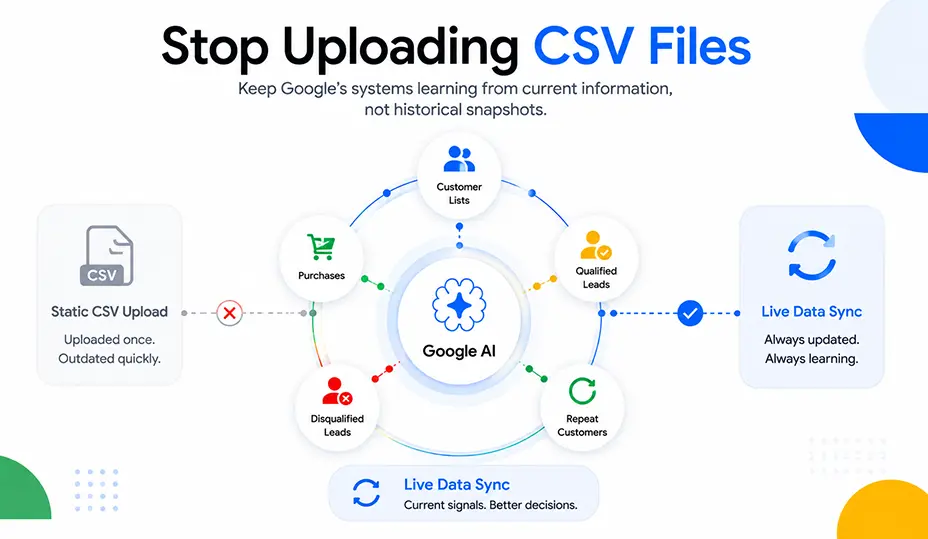
This creates a lag between business reality and Google’s understanding of the business.
For enterprise organisations, Customer Data Platforms (CDPs) and Google Ads Data Manager integrations help keep audience signals current.
For mid-market businesses and growing teams, low-code solutions often provide a practical alternative. CRM platforms such as HubSpot can be connected through automation tools, allowing customer data to flow directly into audience management workflows without constant manual intervention.
The objective is simple.
Keep Google’s systems learning from current information rather than historical snapshots.
The Compliance Factor Global Advertisers Can’t Ignore
For advertisers operating in the European Economic Area, Customer Match introduces another layer of complexity.
Consent Mode V2 has changed how customer data is processed and activated.
If appropriate consent signals are not passed correctly, users may be excluded from audience eligibility regardless of whether they exist within the uploaded dataset.
Many marketers view this as a compliance issue.
It is.
It’s also a performance issue.
Every missing signal reduces the information available to Google’s systems, limiting the effectiveness of audience matching and optimisation.
Google’s AI Needs Better Signals. We Help You Provide Them.
Customer Match is no longer just an audience tool. It is one of the strongest signals influencing bidding, targeting, and campaign performance. Engage Coders helps you build cleaner audiences and stronger first-party data strategies.
Improve My Customer Match Setup
The Real Customer Match Question
Customer Match is often described as a targeting feature.
That description is becoming increasingly outdated.
As Google’s advertising systems become more dependent on machine learning, Customer Match is evolving into something much more strategic. It helps define customer value, improves signal quality, strengthens bidding decisions, and provides context that automation cannot generate on its own.
The advertisers who benefit most from Google’s AI are not necessarily the ones using different tools.
They’re the ones teaching those tools what success looks like.
Before launching another campaign, take a closer look at your CRM.
Great Customer Match results start with great data. Engage Coders helps automate the flow from CRM to Google Ads, eliminating manual uploads and stale audiences.
FAQs
Large uploads, formatting issues, low-quality data, or policy reviews can delay processing. If the status remains unchanged for several days, review your file format and account eligibility.
Convert emails to lowercase, remove extra spaces, then apply SHA-256 hashing without adding salts or modifications. Incorrect formatting before hashing can reduce match rates.
Formatting errors usually stem from incorrect headers, missing fields, unsupported phone number formats, or extra spaces. Ensure your CSV follows Google’s upload template exactly.
Use the country code and full number without spaces or symbols. For example: +14155552671.
Customer Match lists do not have a fixed membership limit. They can remain active as long as the audience stays eligible and the data remains valid.
Customer Match requires at least 100 matched users. Lists may stop serving if match rates decline, data becomes outdated, or audience size falls below Google’s threshold.
Refresh lists regularly to maintain match quality. Most advertisers update audiences weekly or monthly, while automated CRM integrations can refresh data daily.
Value Rules allow you to assign higher conversion values to Customer Match audiences. This helps Smart Bidding prioritize users who are more likely to generate greater revenue.
Connect your customer data source to Google Data Manager, map the required fields, validate audience syncing, and replace manual uploads with automated updates to keep lists current.
Customer Match lists can be used as audience signals in Demand Gen campaigns, helping Google’s AI identify and reach users who share similar characteristics to your existing customers.


